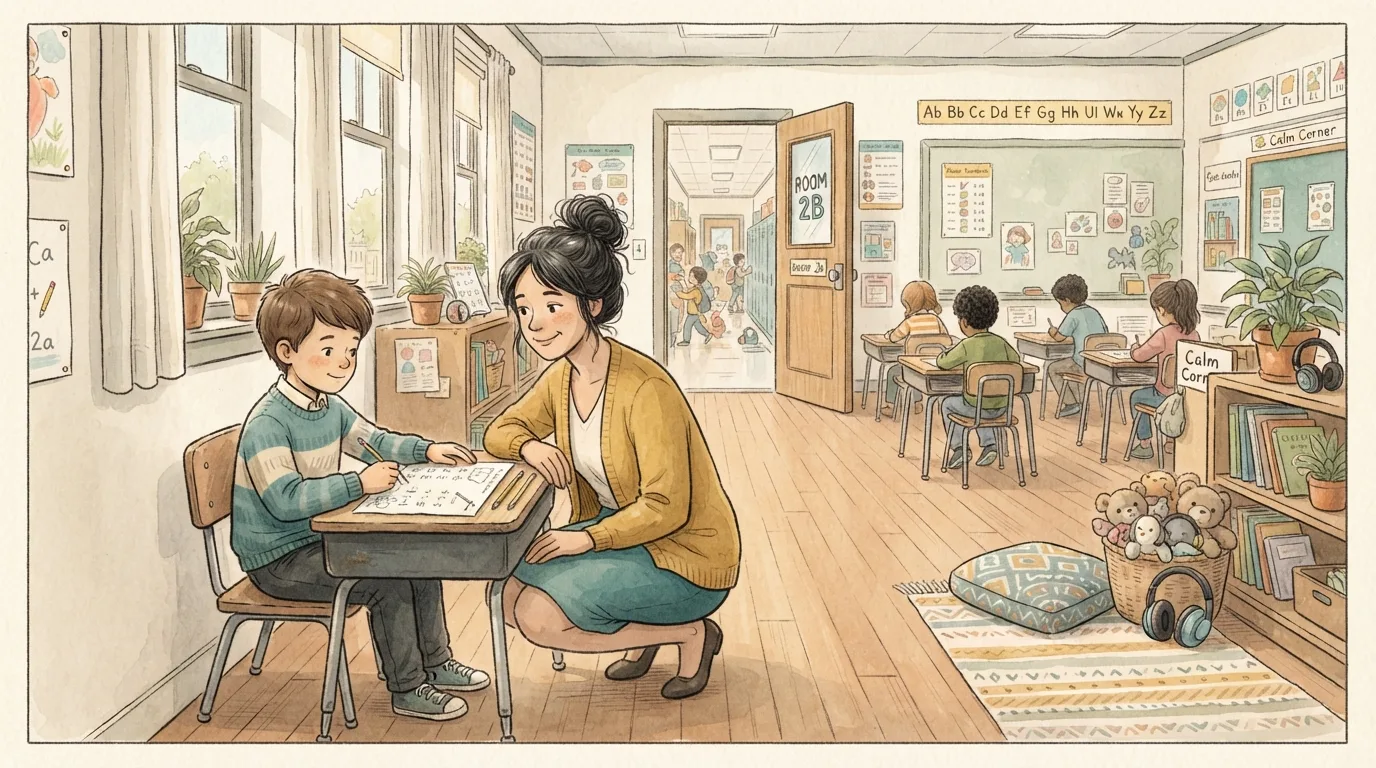
Marcus is in second grade, and he turns around every time the classroom door opens. When a chair scrapes behind him, his shoulders jump. During partner work he edges his desk a few inches away from his partner's, and when you let the class choose seats on a Friday, he heads for the same spot against the side wall every single time. He isn't trying to be difficult. He's keeping watch.
Teachers see this pattern in students who have lived through something frightening: violence at home, a sudden loss, a move from a war zone, a long stretch of not knowing whether the adults around them were safe. You may never learn the details, and you don't need them to help. What you can control is the room. Some seats ask a student like Marcus to spend the whole day on alert, and some let him put that job down for a while.
How Many Students in Your Class Have Lived Through Trauma?
More than most of us would guess. William Copeland, Jane Costello, and their colleagues at Duke followed 1,420 children each year from ages 9, 11, or 13 through age 16 and asked them and their parents about frightening events. By 16, more than two-thirds had been through at least one potentially traumatic event.1"Potentially traumatic" is a wide net here. It covers events like a serious accident or the sudden death of someone close, along with violence and abuse. Most children in the study showed few or no stress symptoms afterward, and fewer than 0.5% met the full criteria for PTSD. The children who struggled most were the ones who had been through several events, or who already had an anxiety disorder or a hard family situation. The sample came from one region of the rural southeastern United States, followed in the 1990s and early 2000s.
Most of those children were fine. The ones who weren't tended to share a profile: more than one frightening experience, an anxious temperament, or ongoing stress at home. In a class of 25, that's probably a handful of students rather than one, and they won't come with a label on their file. That's a strong argument for designing the whole room with them in mind instead of waiting to find out which child needs it.
Why a Trauma-Exposed Brain Scans the Room
A child who has learned that danger can show up without warning starts watching for it. Researchers call this hypervigilance, and it shows up in how children look at faces.
Julia Michalek, Isabelle Mareschal, and their team used eye-tracking with 86 children aged 7 to 11 in Amman, Jordan, about a third of them Syrian refugees. Each child looked at grids of four faces (angry, happy, sad, and neutral) while a camera recorded where their eyes went. Refugee children were slower to look at the angry face in the first place. But across the whole group, the more trauma a child had been through, the longer their eyes stayed on the angry face once they found it.2This was a small lab study using photographs, not a classroom. Only a few children in it had PTSD, so it says more about trauma exposure than about the disorder. The face photos were of white children because no database of Arab children's faces was available, and that unfamiliarity may have shaped where the children looked.
Look away at first, then get stuck. That's a useful picture for a teacher. A student carrying trauma may not seem to notice the classmate who's getting angry two desks over, and then can't pull their attention back to the math page once they do. Every bit of attention spent tracking a possible threat is attention that isn't going to the lesson.
So the question for your room is a practical one. From this seat, how many things could a watchful child feel the need to track?
Seats That Keep a Student on Guard
We haven't found a controlled study that tests desk orientation with trauma-exposed children. Nobody seems to have run it. But the threat-attention research points in a clear direction, and so does a little time spent sitting in your own students' chairs.
The hardest seat for a watchful child is one where things happen behind them. A desk in the middle of the room with its back to the door means every opening of that door is a sound they can't see the source of. A seat along the main walking path means classmates brush past from behind all day. A desk right next to the pencil sharpener or the cubbies puts sudden noise and movement inside arm's reach. None of those seats are bad for most kids. For a student who startles easily, each one is a small alarm that goes off over and over.
The easier seat is often near a side or back wall, with the door in view and nothing much happening behind it. From there a student can see who's coming and going without turning around. That's a lot of watching they no longer have to do.
Two cautions. First, a seat at the edge isn't the same as a seat on its own. Separating a struggling student from the rest of the class tends to hurt their standing with peers, and a child who has lived through trauma needs connection at least as much as space. Against the wall, still part of a row or a group, is the goal. Second, a view of the door doesn't mean a seat beside it. If a student tends to bolt when overwhelmed, put them where they can see the exit without being the closest person to it.
Personal Space and Desk Spacing
Remember Marcus edging his desk away from his partner's? That habit has research behind it.
Shilat Haim-Nachum, Monique Pfaltz, and a team of researchers across 43 countries asked almost 3,000 adults to watch a figure walk toward them on a screen and press a button when it got uncomfortably close. Sometimes the figure was a friend, sometimes a stranger. People who reported more maltreatment in childhood stopped the figure farther away, and that held for friends as well as strangers. The pattern showed up in every country in the study.3These were adults reporting on their own childhoods, which isn't the same as measuring children in a classroom, and memories of childhood can be incomplete. The task was a figure approaching on a screen rather than a real person. About 69% of the participants were women, and some countries contributed far more people than others.
A student who keeps sliding their desk away from a classmate may be making the room livable, not being rude.
In practice, the tightest spots in your room are the ones to avoid for these students. The middle seat of a crowded table group is one. The desk wedged against the reading rug, with kids sitting on the floor all around it, is another. An end seat in a row, or a few extra inches between two desks, can lower the temperature without anyone noticing you did anything.
Who fills the seat next door matters too. A calm, predictable neighbor feels very different from one who flares up without warning. Distance from a specific volatile classmate is worth planning for on purpose.
A Calm Adult Within Reach
One of the more hopeful findings in this research is about the effect of a trusted adult simply being in the room.
Sanne van Rooij, Tanja Jovanovic, and colleagues studied 104 children and young teens from a low-income community in Atlanta, many of whom had been exposed to violence. In a lab task, the children learned that one shape on a screen came before an unpleasant puff of air to the throat and that another shape never did. Telling the danger signal from the safety signal is exactly what trauma can make harder. Children aged 8 to 10 were better at it when their mother was in the room. The quality of the relationship, as mothers described it, didn't change that.4The adult in this study was the child's mother, not a teacher, and nobody has tested whether a teacher nearby has the same effect. Children weren't randomly assigned to have their mother present or absent; the researchers compared the two groups after the fact. The effect showed up in children aged 8 to 10 and not in those aged 11 to 13.
A teacher isn't a parent, and we shouldn't pretend the finding transfers neatly. Still, it fits what teachers see every day. Younger children borrow calm from the adults around them. A seat within easy reach of where you usually teach lets you crouch down beside a desk or catch an eye without making a show of it. Teacher proximity does a lot of work in a classroom, and for a watchful child it may do more.
Close to you is different from front and center, though. The first row puts every classmate behind the student, which brings back the problem from earlier. A seat off to the side of the front, or near wherever you tend to sit during independent work, gives you both.
Calm Corners That Feel Safe, Not Like Punishment
Most trauma-informed classroom guides recommend a calm corner, a small area where a student can step away and settle. We've written about how to build one for neurodiverse learners, and almost all of that advice applies here.
A 2024 study by Christopher Liang and colleagues adds a useful detail. They looked at Peace Spaces in a Pennsylvania middle school, a mix of classroom Peace Corners and a staffed Peace Room set up as part of a trauma-informed plan. Teachers described students using them to step away from classmates for a few minutes and to talk problems through with a trusted adult. The school's own records showed the most common reasons students came were trouble with peers and their mental health. The school also saw discipline referrals trend downward.5This was one school, studied through teacher interviews and the school's own records, with no comparison school. The drop in discipline referrals can't be credited to the Peace Spaces with any confidence, since many other things change in a school from one year to the next. The students were in middle school, older than most elementary classrooms.
Trouble with peers is the detail worth holding onto. If a classmate is often the trigger, then the path to the calm corner matters. A student shouldn't have to walk past the classmate who just upset them to get there. And the seats nearest the calm corner should go to the students most likely to need it, so getting there takes a few steps instead of a walk across the room with everyone watching.
What Trauma-Informed Design Can't Promise Yet
We'd be doing you a disservice if we skipped this part. In 2019, Brandy Maynard and colleagues set out to review every rigorous study of trauma-informed approaches in schools, meaning studies that compared students who got the approach with a comparison group who didn't. They screened more than 7,000 records and read 67 full reports closely. Not one met their standards.6The review searched for studies published through 2017, and the field has grown since then. Finding no rigorous studies means nobody had properly tested the whole-school approach yet. It doesn't show that the approach fails. The review also only counted programs that combined several parts, such as staff training and school-wide policy changes, so it doesn't speak to single changes like where a student sits. The authors urged caution, given how quickly states and districts were adopting these programs.
That's a reason to stay humble, and not a reason to give up. The findings this post leans on, about how trauma shapes attention and personal space, come from their own separate lines of research. Rearranging a seat costs you nothing and is easy to undo. What we'd steer away from is buying an expensive "trauma-informed" furniture package on the strength of a label. Watch the student instead. If Marcus stops turning around every time the door opens, the seat is working.
Building a Trauma-Informed Seating Chart in Inclusive Seating
Most of what this post recommends is a set of restrictions on one student: near the side wall, close to the teacher, near the calm corner, away from one particular classmate. That's hard to juggle on paper, especially when you have several students with their own needs. It's what Inclusive Seating was built for.
Start by adding your room's fixed features to the classroom grid. Your Element type menu includes the exit, the teacher's desk, and the calm corner, so the room on screen matches the room you actually teach in. Then open the student's profile. A Must sit near restriction can point at the teacher's desk, the calm corner, or a side of the room such as the left or right. A Must not sit near restriction keeps them away from a specific classmate, or away from the exit if they're likely to bolt. When one exact seat matters most, add an assigned seat and lock the student to it with Must sit in.
Click Randomize and every restriction is honored at once, while the rest of the class still gets a fresh arrangement. That matters here. A student with a trauma history shouldn't be the one child whose seat never changes while everyone else moves, because that makes the accommodation obvious to every classmate. With restrictions, their needs stay met and their seat still moves with the class. Save the class once it's set up, and the restrictions are there the next time you rearrange the room.
A seating chart can't undo what a child has been through. It can decide whether their seat asks them to keep watch all day, or gives them a little room to stop.