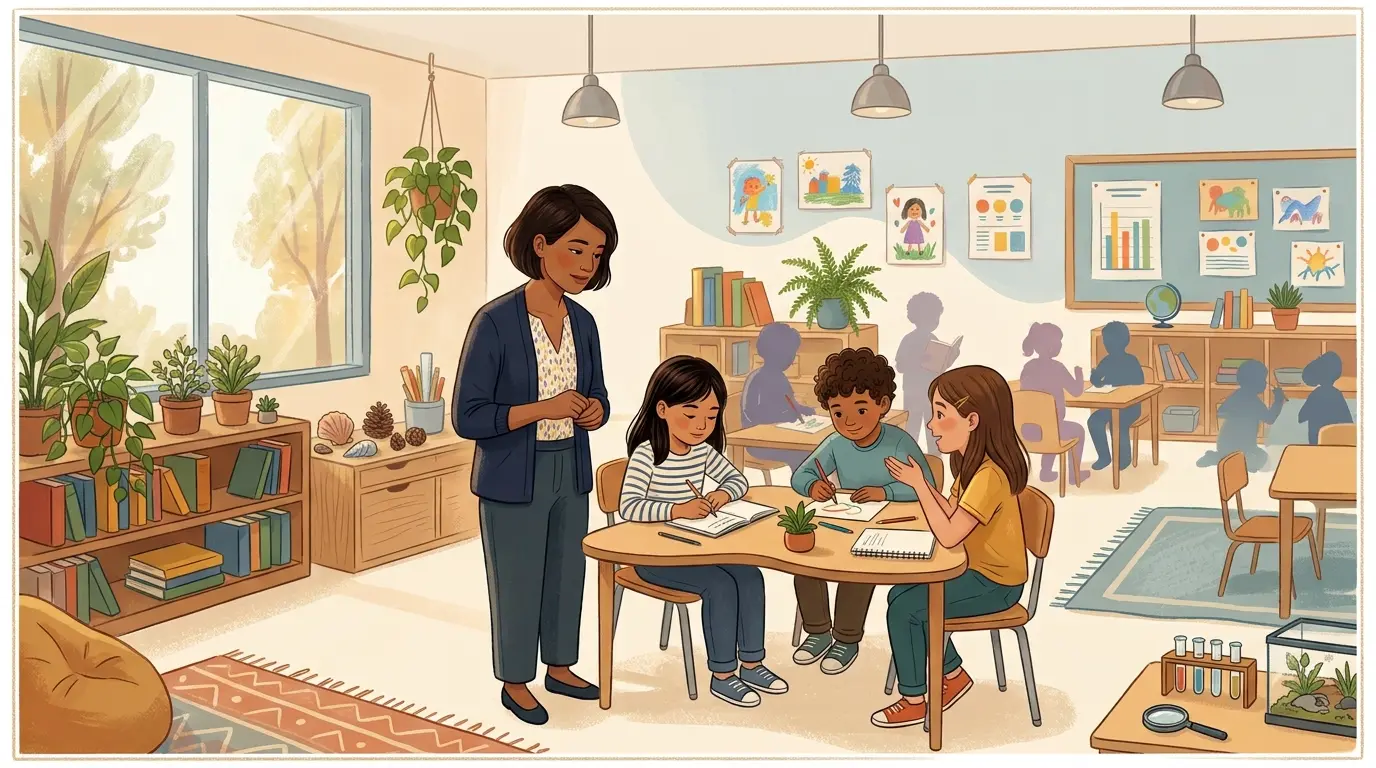
A teacher walks toward a desk during independent work, and the student who had been quietly chatting with his neighbor goes silent before she says a word. Every teacher discovers this trick within the first few weeks on the job, usually by accident. You don't have to raise your voice. You don't have to call a name across the room. You just have to be close.
For a long time, that was mostly instinct, something a mentor teacher tells a student teacher over lunch. That's started to change. Researchers have spent the last few years pointing motion sensors, eye trackers, and virtual reality headsets at classrooms to measure exactly what proximity does, why it works, and where it stops working. Some of the most useful findings are only months old. This matters well beyond the students with the most visible needs, since almost every classroom has a few kids whose behavior shifts the moment an adult gets close, whether or not they have a formal support plan. Here's what the research shows, and what to do with it.
An Old Instinct That Research Is Finally Catching Up To
Formal research on this goes back further than most teachers would guess. In the 1950s, a researcher named Jacob Kounin was lecturing a college class when he noticed a student reading a newspaper in the back row. He reprimanded the student, who put the paper away, which was exactly what Kounin expected. What surprised him was that several students sitting nearby, students he had never addressed at all, also sat up straighter and got back to work. Kounin and Gump (1958) called this the ripple effect, one of the earliest documented cases of a teacher's presence changing behavior beyond the one student being addressed. Kounin (1970) later folded the idea into a broader concept he called withitness: a teacher's ongoing, visible awareness of everything happening in the room, communicated as much through physical presence and movement as through anything said out loud. Withitness can sound abstract until you watch it play out in an elementary classroom: the teacher who quiets a squirrely reading group without ever turning around, just by drifting a few steps in that direction while still talking to the rest of the class.
One framing note before getting into the specifics: most of the research below measures visible classroom behavior rather than long-term learning.1Most of the research below measures visible classroom behavior: whether a student is on task, off task, or out of their seat, usually coded by trained observers or, in newer studies, by motion and eye-tracking software. That is real, useful evidence about engagement and classroom management. It says less about whether a given moment of good behavior adds up to deeper learning, which is a separate and harder question. Keep that distinction in mind as you read. That's real, useful evidence about engagement and classroom management. It says less about whether a given moment of good behavior adds up to deeper learning, which is a separate and harder question. Keep that distinction in mind as you read.
Moving Toward a Problem Beats Waiting for One
Kounin's ripple effect showed that a teacher's actions reach farther than the one student being addressed. A more practical question followed decades later: what happens when a teacher moves closer to a student before there's anything to correct at all? Gunter and colleagues (1995) tracked teachers working with students who had serious behavior disorders and found that when teachers left their desks and circulated through the room, disruptive behavior dropped and positive interactions went up, without a single extra word of instruction. Proximity did the work a verbal correction usually has to do, and it did it more quietly.
Picture a fourth-grade classroom during a math worksheet. Two students in the back corner start talking. A teacher glued to the whiteboard has to raise her voice to be heard over the room, which pulls the rest of the class's attention toward the disruption too. A teacher who instead takes ten steps toward that corner while continuing to explain the next problem out loud usually handles the same moment without most of the class ever noticing there was anything to handle.
That finding held up in a very different setting twenty-five years later. Weaver and colleagues (2020) looked at proximity control not in a structured classroom but during recess and other unstructured group time, using a design that switched the intervention on and off to isolate its effect. Staff proximity reliably reduced inappropriate behavior every single time it was introduced. The honest part of that study is what came next: staff reported that actively circulating felt less comfortable and took more effort than their old habit of watching from one spot. The technique that works best isn't always the one that feels easiest, which may be exactly why it doesn't get used as consistently as the research says it should.
Standing Still Might Be the Real Problem
Most teachers, without planning to, spend a large share of every lesson anchored to a narrow, T-shaped zone at the front and center of the room, close to the whiteboard and the teacher's desk. That's not a guess. It has been documented in classroom research since the 1970s, and it has a name: the action zone. Students inside it get called on more, get more eye contact, and get more of the teacher's attention. Students outside it, especially in the back corners, can go most of a lesson without a single direct interaction. It happens for understandable reasons: the whiteboard, the document camera, and most of a teacher's own materials tend to live at the front of the room, and it's simply more convenient to teach from there.
A 2023 study put real numbers behind why that matters. Huang and colleagues (2023) had preservice teachers deliver a short lesson inside a virtual reality classroom while tracking their body movement and eye movement at the same time. Three distinct patterns showed up: teachers who barely moved at all, teachers who stayed anchored near one spot, and teachers who moved continuously and reached every part of the room, including the far corners. The teachers in that last group, the ones who broke out of the action zone entirely, noticed classroom disruptions faster and more often than the other two groups. Movement wasn't just a management style. It was a measurable attention advantage.
Who You Notice Depends on Where They're Sitting
Movement is half the equation. Where a student sits is the other half, and a 2026 study makes that connection directly. Cao and colleagues (2026) tested 230 special education teachers, a mix of those still in training and those already in classrooms, on how quickly they noticed a student leaving their seat during a lesson, once with a still camera view and once with a moving one.2Two of the most recent studies described here used simulated rather than live classrooms. Huang et al. (2023) placed preservice teachers in a virtual reality environment, with only 21 participants delivering a single short lesson. Cao et al. (2026) used a vignette-based detection task with special education teachers in China rather than direct classroom observation. Both approaches make it possible to control variables that are nearly impossible to control in a real classroom, and both trade away some real-world messiness to do it. The directional findings, that movement and seating position affect what a teacher notices, are consistent with decades of less controlled classroom research, which is reassuring, but the exact numbers reported in these two studies may not transfer perfectly to an actual elementary classroom with twenty-five real children in it. Two things stood out. Off-seat behavior in front-row seats got caught significantly more often than the same behavior anywhere else in the room, and that was true whether the teacher's viewpoint was static or moving. Experience mattered less than seating position did. That distinction matters most for the students whose safety depends on being noticed quickly: a child prone to wandering off, a student who shuts down quietly rather than acting out, or a student who needs a break before a small frustration turns into a bigger one.
That's a genuinely practical finding for anyone building a seating chart. If a student is prone to wandering, melting down, or needing quick redirection, a seat near the front isn't just easier for the teacher to walk to. It's a seat the teacher is statistically far more likely to actually be watching the moment something starts to go wrong.
Proximity Isn't a Cure-All
It would be convenient if moving a distractible student closer to the teacher solved the problem on its own. The research says it helps, but not evenly. Blume and colleagues (2019) placed fifth and sixth graders in a virtual classroom, either near the teacher or far from her, during a math lesson, then measured what they learned afterward.3The studies in this piece span a wide range of ages, countries, and settings: American college students and children with serious behavior disorders in the 1990s, German fifth and sixth graders in a virtual math class, and special education teachers in China evaluating seating position. That range is reassuring in one sense, since the core finding, that a teacher's proximity and movement shape student behavior, shows up across very different contexts rather than depending on one narrow population. But the size of the effect, and which students benefit most, does vary by age, disability status, and classroom setting, so treat the specific numbers here as a general direction rather than a guarantee for any one student. Students seated closer generally learned more. But when the researchers looked specifically at students with higher levels of inattention and hyperactivity, sitting close to the teacher didn't give them the same extra boost it gave everyone else. It's worth being precise here: the study didn't find that proximity hurt these students, only that it helped them less than it helped their classmates, which is a meaningfully different and more encouraging result.
That's not a reason to give up on proximity as a strategy. It's a reason to treat it as one tool rather than a fix that applies equally to every student. A seat near the teacher helps most kids. For a student whose challenges run deeper than distance can solve, it has to be paired with something else: a specific peer, a clearer line of sight to the board, or space from whatever is pulling their attention away. This is exactly why seating decisions work best when they're made student by student instead of arrangement by arrangement, a point we've made before when looking at which seating arrangement fits which activity.
The Finding That Ties It Together
Look across all of this research and one thing becomes clear: proximity isn't a seat assigned once in September and forgotten about. It's something a teacher can use on purpose, all day long, through where they choose to stand, how they choose to move, and who they choose to seat where. The ripple effect works because students are always watching how close a teacher is willing to get. The action zone research works because most teachers stay closer to some students than others without ever deciding to. The seating research works because a well-placed seat gives a teacher's presence somewhere reliable to land.
Proximity isn't only about where students sit. It's about where the teacher is willing to go, and how often.
The two depend on each other. A carefully built seating chart does little if the teacher never leaves the front of the room. A teacher who moves constantly still needs the hardest-to-reach students seated somewhere reachable.
What This Means for Real Classrooms
You don't need a motion tracker to put any of this to work. A few habits, all backed by the research above, go a long way.
Walk while you teach, not just while you manage. The dynamic movement pattern that won out in the 2023 study wasn't teachers pacing anxiously during a behavior problem. It was teachers who moved through the whole room as a normal part of delivering a lesson, not only when responding to something. Build a loop into your instruction, even during direct teaching, instead of anchoring to the front the entire time.
Use proximity before you use your voice. A quiet correction delivered by walking over works as well as one delivered from across the room, and usually better, since it spares the student an audience.
Seat the students who need quick reach where you can actually reach them. Front-row and near-aisle seats aren't just easier to walk to. The research says they're also the seats a teacher is statistically most likely to be watching the moment something starts to go sideways.
Don't assume proximity alone will fix every case. For students whose needs go beyond simple distance, pair a good seat with the accommodation that actually addresses what's going on: a supportive peer, a clear sightline, or space from a specific distraction.
Change where you stand, not only where they sit. If you tend to teach from the same spot every day, your own action zone becomes just as fixed as any seating chart. Rotate your position deliberately during a lesson, not only after you notice a problem starting.
Using Inclusive Seating to Navigate This
This is where a seating chart tool earns its keep, and Inclusive Seating was built with exactly this kind of decision in mind.
When you build a classroom in the layout editor, you're not just arranging desks for looks. You can set a Must sit near or Must not sit near restriction that targets the teacher's desk directly, or a room direction like front, back, left, or right, so a student who benefits from quick teacher access stays within reach no matter how the rest of the room gets rearranged. Those restrictions travel with the student, not with the layout, so a student who needs a front-row seat keeps it whether you're set up in rows this week or clusters next week.
The classroom grid also makes your own movement visible in a way a mental picture of the room never quite manages. Laying out aisles, desks, and the teacher's desk on the grid shows you, at a glance, whether your current arrangement actually lets you walk a full loop through the room or quietly forces you to stay anchored near the front. That's a harder thing to notice from inside your own classroom than it looks on paper. Because the whole room is visible on one screen, it's easy to spot a corner that's boxed in by furniture, or a desk cluster that leaves no real path to reach a student without squeezing between chairs, the kind of thing that's surprisingly hard to catch while you're standing inside the room every day.
None of this replaces the habit of actually getting up and moving. But a seating chart that keeps your hardest-to-reach students reachable, and shows you where your walking paths really go, makes that habit a lot easier to keep.
