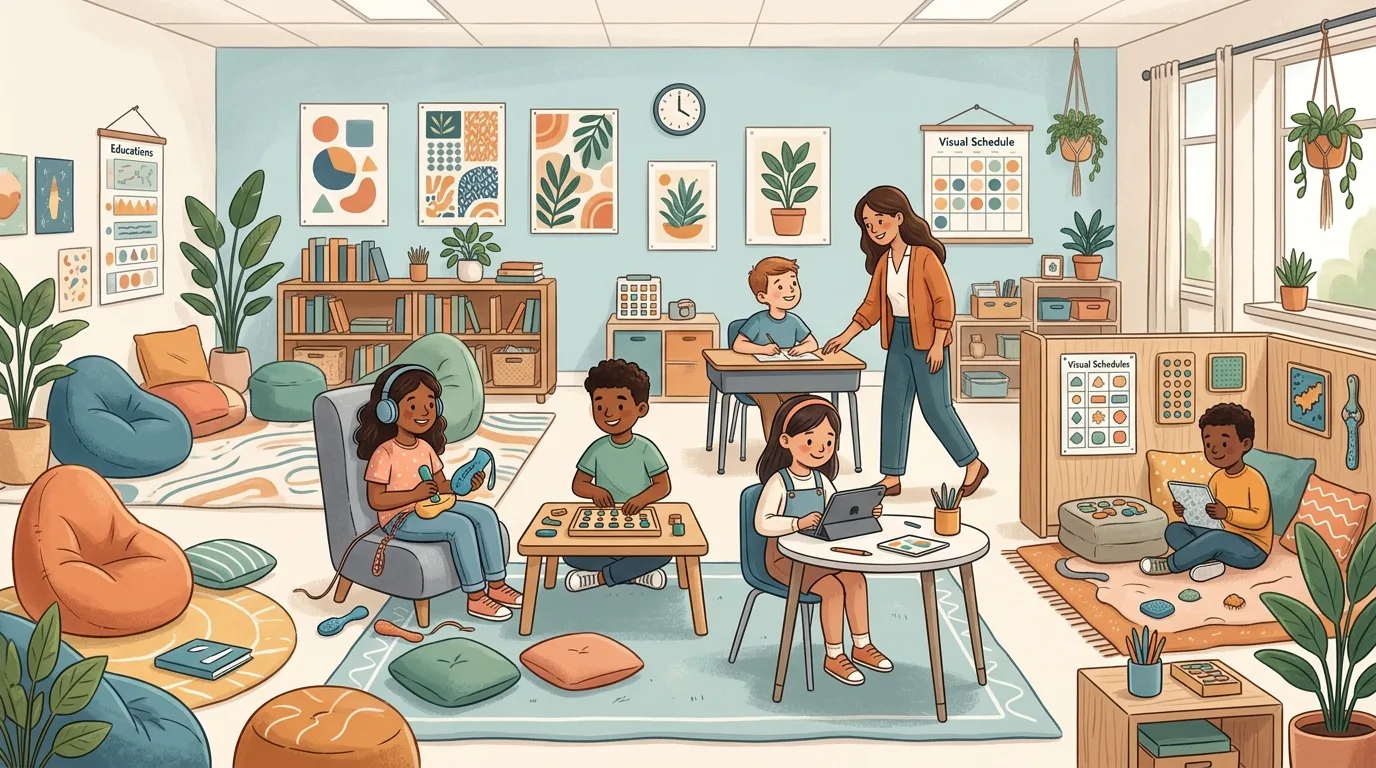
It's 10:40 on a Tuesday, and two students are sitting at neighboring desks. One is rocking his chair onto its back legs, chewing the cap off a pencil, and humming under his breath. The other has her shoulders up around her ears because a chair across the room just scraped the floor. Both of them are neurodivergent. Both of them are having a hard morning. And the room is making it harder for each of them in the exact opposite way.
Most teachers have a student with ADHD, an autistic student, a student with dyslexia or a language disorder, or several of these at once, sitting in the same class. Individual accommodations matter, and IEPs and 504 plans exist for good reason. But the physical room is the one support that reaches every one of those students at the same moment, all day long. It's also the one you set up in August and then rarely think about again.
This post covers what recent research says about designing that room: where the sensory load comes from, which parts of it you can control, and how to seat students once you've done the work.
One Room, Many Nervous Systems
A lot of advice about a "sensory-friendly classroom" assumes there's one right setting. Dim the lights, take down the posters, keep things quiet. For some students, that's exactly right. For others, a quiet, still, beige room is its own kind of misery, because their bodies need input to stay alert.
A 2025 meta-analysis led by Lucie Jurek pulled together 30 studies covering more than 5,000 people and compared how those with ADHD and those without it responded on standard sensory processing questionnaires. People with ADHD scored higher on every pattern the researchers measured. They were more sensitive to sensory input and more likely to avoid it. They were also more likely to miss input entirely and more likely to go looking for it. And the gaps were large, more than a full standard deviation in each category.1Every study in this meta-analysis measured sensory processing with questionnaires rather than direct observation. The results also varied enormously from one study to the next, and the authors rated only 9 of the 30 studies as having a low overall risk of bias. What it supports is the broad claim that sensory differences are common in ADHD. It can't tell you which pattern any particular child has.
Read that carefully, because it's easy to miss what it means for a classroom. The same diagnosis produces children who crave sensory input and children who flee from it. Add autistic students, who often have their own intense sensory profiles, and you have a room where one kid's regulation strategy is another kid's trigger. The pencil-chewing, chair-rocking boy from the opening isn't misbehaving at his neighbor. He's doing what his body needs, a few feet from a girl whose body needs the opposite.
So the goal of neurodiverse classroom design isn't one perfect sensory setting. It's range. You want a room with a calmer end and a livelier end, and a seating chart that puts each student at the end that fits them.
Start With Sound: Classroom Acoustics and Neurodiverse Students
If you only change one thing about your room, make it the noise. Dawn Adams and colleagues published a systematic review in 2025 of 23 studies on how the built school environment affects autistic students. Noise came through as the clearest problem: more of it, or particular kinds of it, went along with worse learning and lower well-being.2The review found plenty of research on noise and lighting but very little on the physical layout of a room, and almost none on smell or temperature. That's an uncomfortable gap for teachers, since furniture arrangement is the part of the environment we control most directly. The review also focused on autistic students specifically, so its findings don't automatically carry over to students with ADHD or learning disabilities. The students themselves say the same thing more bluntly. In a separate 2025 interview study, an eight-year-old autistic boy told researchers, "I don't like a noisy space. It makes me have a headache and when it's noisier, it gets worse and hurts a lot."
Noise isn't only an autism issue, though. Katherine Gordon and colleagues tested how well children aged 5 to 12 could repeat sentences against background noise, with and without the kind of echo you'd get in a hard-surfaced classroom. Children with a language disorder struggled more in noise than their typically developing peers. Adding echo made things worse for both groups.3This was a very small study, with 9 children who had a language disorder and 9 who didn't, and it ran in a lab using a simulated room rather than an actual classroom. It measured whether children could repeat sentences correctly, which isn't the same as understanding or learning new material. The authors themselves describe the results as preliminary and say they shouldn't be read as a clinical recommendation. That second finding matters. Reverberation, the echo that bounces off tile floors, bare walls, and whiteboards, cost every child something, which makes acoustic fixes some of the easiest changes to justify for the whole class.
Then there's a finding that deserves more attention than it gets. Lucy Shiels and colleagues in Melbourne gave inattentive children aged 6 to 12 in regular classrooms a remote microphone system: the teacher wears a small mic, and the child wears ear-level receivers that carry the teacher's voice straight to them. About two-thirds of the kids had an ADHD diagnosis. During a four-week trial, their ability to understand speech in noise jumped from about 59 percent to about 86 percent, and teachers reported less inattention and less hyperactivity while the devices were on. Kids who kept the system for 30 weeks made bigger gains in reading fluency than those who didn't.4The sample was small, 35 children in the first phase and 37 in the second. The 30-week phase wasn't randomized, and everyone involved knew which children had the devices, which leaves room for expectations to color the results. By the end of that longer phase, the teacher-reported drops in inattention and hyperactivity were no longer statistically significant. Device use was also tracked through teacher estimates rather than recorded data.
Most of us can't hand out remote microphones. But look at what one actually does: it moves the teacher's voice closer to the child and pushes the room's noise further into the background. A seat can do a smaller version of the same thing. This is where seating near the teacher earns its keep. Research on ADHD suggests proximity by itself doesn't do much for attention, but for a student who struggles to pick speech out of noise, a shorter distance to where you usually talk and a longer distance from the noisiest corners is a genuine listening accommodation.
Before you assign a single seat, find your room's acoustic hot spots. Sit in a student chair during a normal transition and listen. The pencil sharpener, the sink, the door to a noisy hallway, a rattling heating vent, the cubbies where backpacks get unzipped and zipped back up all day: those are the spots to keep your most sound-sensitive students away from. Then soften what you can. A rug, fabric on a bulletin board, felt pads or tennis balls on chair legs, and a bookshelf standing between two work areas all cut down on echo for everyone.
Light, Clutter, and Which Way a Desk Faces
The Adams review also linked lighting and visual distractions to weaker learning outcomes for autistic students, which fits a larger body of work on busy classroom walls. This blog has already covered lighting and visual clutter for autistic students in depth, so the short version here is practical. You don't have to strip your walls. Look at which way each desk faces, and make sure your most easily overwhelmed students face the calmest stretch of wall in the room rather than the crowded bulletin board or the window onto the playground. A flickering fluorescent tube is worth a maintenance request today, not next month.
Calm Corners: A Quiet Space Students Choose, Not One They're Sent To
Jodie Smith, Elizabeth Pellicano, and colleagues interviewed 36 autistic students, aged 4 to 18, from Chinese, Vietnamese, Somali, Lebanese, and white Australian families, about their school experiences. Overwhelm came up again and again, and so did the value of having somewhere safe to go. Many named the library. One 10-year-old described finding "this perfect little nook that's sandwiched between a little one of those turning book things, so no one can really disturb me there."5The interviews were done over Zoom, which the authors note may have made it harder to build rapport. The study also couldn't include children who don't speak or who speak only a little, a group whose experiences of overwhelm may look quite different. All the students attended school in Australia.
A nine-year-old in the same study described a different strategy: "I just ask the teachers if I can go to the toilet and then I have a little time when I feel better." That's a child who needed a break badly enough to invent one. If your room doesn't offer a retreat, students will find their own, and some of them will cost more instructional time than a calm corner would have.
The design of that space matters as much as its existence. Ari Dyer and colleagues interviewed 13 autistic secondary students about using sensory rooms at school, then filmed each of them spending five minutes in one on their own terms. Students said the room helped their mental well-being, their learning, and their ability to manage sensory overwhelm. What they valued most was the freedom to adjust it to what they needed that day. And the videos showed what you'd expect after reading the Jurek meta-analysis. Students used the same space to switch off and rest, and also to go looking for sensation.6Thirteen students is a small group, and all of them were 11 to 15 years old, older than most of this blog's readers teach. The study looked at dedicated sensory rooms rather than a corner of a regular classroom, and each filmed session lasted only five minutes. The benefits come from what students reported, not from measured changes in learning or behavior.
A calm corner a student gets sent to is just a time-out with a beanbag.
So build the corner with choices in it. Put a pair of headphones and a soft cushion next to a fidget bin and something with weight to it. Make the rule simple: anyone can use it, and nobody gets sent there as a consequence. Then think about the path. A student on the verge of overwhelm shouldn't have to cross the whole room, weaving past every desk, to get there. The seats closest to your calm corner are valuable real estate, and they should go to the students most likely to need it.
One caution. A seat near the calm corner shouldn't become a seat that's cut off from the class. Isolating a student at the edge of the room tends to hurt their standing with peers without fixing much of anything. Close to the retreat, still inside the group, is the target.
Predictability Is Part of the Physical Design
Smith's team closed their paper with a recommendation that's easy to overlook: educators should build as much certainty as possible into autistic students' environments. Elaine McGoldrick and colleagues make the same point in their Autistic SPACE framework for schools, which lists predictability as one of five core areas to plan around, right alongside sensory needs.7Autistic SPACE is a practical framework, not an experiment. The authors adapted it from a model originally designed for healthcare settings and built it from existing research, but the framework itself hasn't been tested in classrooms to see whether following it changes outcomes for students.
That has a direct bearing on your room. Rearranging desks over a weekend can feel like a fresh start to you and like the floor dropped out to a student who depends on knowing where things are. That doesn't mean you should never change the layout. It means you should change it on purpose, with warning. Show the new chart the day before. Let a student who struggles with change see the room early, or keep their seat in roughly the same spot while everyone else moves. If you're wondering how often to switch things up in the first place, there's research on that too, and it's worth reading alongside this.
Predictability also covers the parts of the room that don't move. If supplies, the calm corner, the turn-in tray, and the classroom library each stay in a consistent spot, students spend less energy tracking where things are and more on the actual work.
Build the Room First, Then the Seating Chart
Here's the order that works. Walk the room at a student's eye level and mark your hot spots, both the loud ones and the high-traffic lanes. Decide where your calmer end and your livelier end will be, and put the calm corner inside the calmer end. Then, and only then, place students. The student who needs to hear you clearly sits near where you actually teach from and away from the sink. The sound-sensitive student sits at the quiet end, facing a calm wall, a short walk from the calm corner. The student who needs to move sits somewhere a standing desk or a wobble cushion won't bother anyone, not wedged between the two students who find motion hardest to tune out.
It's worth saying plainly that almost none of this is special treatment. Every child in Gordon's study heard worse in an echoey room. A rug under the reading area, a quieter seat for the kids who need it, and a retreat space open to anyone are good design for the entire class. The neurodivergent students are simply the ones who feel it first.
Where Inclusive Seating Fits In
Once you've done the thinking, keeping track of it is the hard part. A class with several neurodivergent students can have a dozen overlapping seating needs, and a paper chart doesn't remember any of them.
Inclusive Seating lets you build your actual room on screen, including fixed elements like your desk, the doors, the cubbies, the classroom library, and a calm corner. Each student can then carry their own restrictions: sit near the teacher for the student who needs to hear you, sit near the calm corner for the student who needs a short path to it, stay away from the exit or the cubbies for the student who can't tune out the traffic, and stay away from a particular classmate whose regulation style clashes with theirs. Click Randomize, and the app builds a chart that honors every one of those rules at once.
Because restrictions belong to the student rather than the layout, you can save more than one arrangement of the room and switch between them without rebuilding anyone's accommodations. And when you need predictability on a day you're out, print a PDF of the chart for the substitute so the room looks the same when your students walk in.
A seating chart can't soften the echo in your room or hang a curtain over a busy wall. But once you've done that work, it makes sure every student lands in the part of the room you designed for them.
