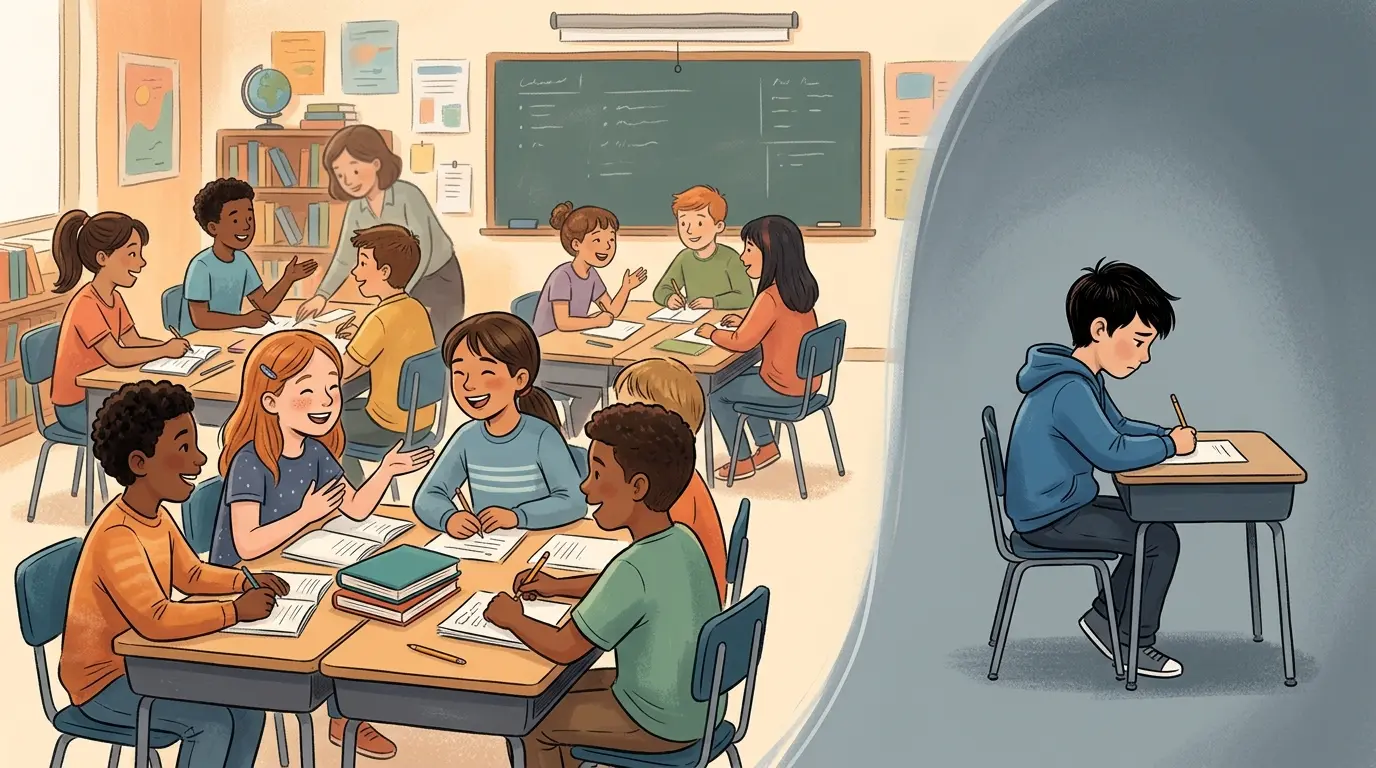
Every teacher has met a student who seems to unravel the whole room. One outburst turns into three, other kids start watching for it, and by October the fastest fix looks obvious: give that student a desk of their own, away from the group. Maybe it gets pushed against the back wall. Maybe it is the "quiet desk" by the window, or a single chair pulled out of a cluster and never put back. The intention behind it is almost always good. Teachers want to protect the rest of the class from disruption and give a struggling student room to reset.
New research suggests this common move carries a cost most teachers never see. A 2025 study published in the Journal of Emotional and Behavioral Disorders found that elementary students seated apart from their peers developed measurably worse reputations among classmates, and that this happened even after accounting for how disruptive the student actually was. Isolating a struggling student does not just fail to fix the behavior problem. It can make the social problem worse, in ways that are hard to undo once the rest of the class has decided who that kid is.
What Seat Isolation Actually Looks Like in the Classroom
Seat isolation, in the research sense, is narrower than "sitting at the back" or "near the door." Researchers who code classroom seating charts define an isolated seat as one that is not directly adjacent, front, back, left, or right, to any other student's desk.1Diagonal neighbors do not count as adjacent under this definition, and it is stricter than it sounds. A student at the end of a row, with one neighbor to their side, would not be coded as isolated. A single desk with open space on every side would be. The definition comes from a 2025 study that tracked seating charts in nine K to 3 classrooms across six urban elementary schools over a full school year, coding every desk as isolated or not at three points in time. A student at the end of a row, with a neighbor to one side, does not count. A single desk with open space on every side does. That distinction matters, because it is the second kind of placement, the desk that stands genuinely alone, that shows up again and again as a deliberate behavior strategy in elementary classrooms.
Teachers reach for it for reasonable reasons. Surveys of how elementary teachers actually build their seating charts have found that separating students with behavior problems is one of the most common considerations teachers weigh, right alongside promoting new friendships and balancing academic skill levels across the room. Interviews with upper-elementary teachers describe a real tension behind the decision: teachers want to reduce distraction for the rest of the class while still keeping a difficult student close enough to supervise. A single isolated desk can look, in the moment, like the one arrangement that solves both problems at once.
None of this makes the instinct wrong. A classroom genuinely cannot function if one student's outbursts derail every lesson, and a short, supervised break from the group is a legitimate tool. The question the newest research raises is not whether teachers should ever separate a struggling student. It is what happens, socially, when that separation becomes the default seat, week after week, for months.
The Study That Should Make Every Teacher Pause
The most direct evidence comes from a team of researchers based at Vanderbilt University and Virginia Commonwealth University, led by Kristen Granger. Published in the Journal of Emotional and Behavioral Disorders in 2025, the study followed 17 students in kindergarten through third grade who had been identified, through a systematic behavioral screening process rather than a teacher's general impression, as showing or being at risk for the kind of persistent noncompliance, impulsivity, and aggression that researchers group under the label emotional and behavioral disorders. The researchers tracked exactly where each of these students sat in relation to their classmates across the fall, winter, and spring.
In the fall, nearly half of these students, 47%, sat in a seat with no adjacent neighbor at all. By winter, that had dropped to 29%, where it stayed through spring. So even with some improvement over the year, close to a third of students who were already struggling socially spent the second half of the school year seated alone.
The researchers also asked every consenting classmate to name students who fit specific descriptions: who starts fights, who gives the teacher a hard time, who is nice, who cooperates. This method, called peer nomination, is standard in child development research and produces a reliable, if blunt, picture of how a student is seen by the group they sit with every day. When the researchers compared seating placement to these nominations, isolated students received significantly more nominations for starting fights and giving the teacher a hard time, and significantly fewer nominations for being nice and cooperating, than students who had at least one neighbor.
Here is the detail that should give any teacher pause: this pattern held up even after the researchers accounted for how disruptive each student's behavior actually was, based on the teacher's own ratings.2This is a small pilot study, 17 focal students across nine classrooms, so its findings are best read as an early signal rather than a settled fact. The researchers only compared seating placement in the fall to peer reputation in the winter, so it is possible that early, informal reputations among classmates shaped both where a student ended up seated and how they were later described, rather than isolation alone driving the reputation. What strengthens the finding is that the researchers statistically controlled for the student's own teacher-rated externalizing behavior before looking at the isolation effect, and the association held anyway. Larger, longer studies that track reputation from the very start of the year are the clear next step. In other words, isolation was not just a mirror reflecting a kid who was already a handful. It appeared to add something on top of that, a reputational penalty layered over whatever behavior got the student moved in the first place. One more detail stood out: how far a student sat from the teacher's desk showed no similar link to peer reputation. Isolation from other kids predicted a worse reputation. Distance from the adult in the room did not.
Why Isolation Can Backfire
There are two separate mechanisms worth understanding here. The first is about what isolation signals to everyone else. Researchers who study classroom social dynamics describe teachers as central reference points for how a class decides who belongs and who does not. When a teacher visibly treats a student differently, physically setting their desk apart from the group, classmates tend to read that as information about the student's social standing, not just a logistical choice.3This idea draws on what researchers call social reference theory, and on a body of work showing that children calibrate their own opinion of a classmate partly by watching how the teacher treats that classmate. One study found that students who believed a teacher liked a particular peer became more likely to say they liked that peer too, purely based on the perceived signal from the adult in the room, independent of anything the peer had actually done. The intervention research on seating and behavior cited throughout this piece spans different countries, age groups, and methods, from Dutch fourth- through sixth-grade classrooms to American kindergarten through third-grade classrooms, so exact numbers should not be treated as interchangeable even though the overall pattern holds up across contexts. A desk that sits alone tells the other 25 seven-year-olds something, whether or not the teacher means it to. It says: this is where a problem gets put.
The second mechanism is about what isolation does to the student who has been set apart. Decades of research on social exclusion, most of it conducted with adults in controlled experiments rather than children in classrooms, has found a consistent and uncomfortable pattern: people who are excluded from a group become more likely to act aggressively, not less.4This research comes from lab experiments with college-age adults, so it should not be read as a direct study of children in classrooms. Participants were told they had been rejected by a group of peers or would end up alone later in life, then given a chance to respond to a stranger, for instance by setting the volume and duration of an unpleasant noise blast, or by giving someone a harsh evaluation. Excluded participants consistently chose harsher responses than included participants did, even toward people who had done nothing to them. The general pattern, that feeling shut out of a group makes people more likely to act out rather than less, has been replicated many times since in adult samples, though direct evidence in elementary classroom seating specifically is still thin. In one well-known study, participants who had been told a group rejected them responded to a minor insult with more hostility than participants who had not been excluded. The logical response to rejection would be to try harder to fit in. What actually tends to happen is closer to the opposite.
Put those two mechanisms together and the isolated desk starts to look less like a neutral management tool and more like a setup. The student gets less exposure to peers modeling calm, cooperative behavior up close, at the exact moment their own behavior needs the most reinforcement from watching it done well nearby. Meanwhile, everyone else in the room quietly absorbs the message that this is the kid who does not sit with the group. Neither outcome makes the next outburst less likely.
The stakes go beyond this year's behavior chart, too. Research on childhood peer relationships has repeatedly linked exclusion and rejection to lower classroom engagement over time, and a large meta-analysis covering more than a hundred studies found that how well a student is accepted by classmates is meaningfully tied to academic achievement, not just to how the student feels about school. A seating decision that quietly damages a student's standing with classmates is not only a social side effect. It can work against the academic goals the classroom is there to serve.
Isolation and Sitting Near the Teacher Are Not the Same Thing
It is worth separating two strategies that can look similar from the front of the room but are not. Moving a student's desk closer to the teacher, for supervision, quick redirection, or an easier hand on the shoulder, is a different move than pulling a student's desk away from every other student. The 2025 study found real evidence for that distinction: distance from the teacher's desk had no meaningful link to how classmates rated a student's behavior, while isolation from peers did. A student can sit right next to the teacher and still be seated among friends, with a neighbor to the left and right. That is not the arrangement the research flags as risky.
Interviews with upper-elementary teachers back this up from the other direction. Many teachers already gravitate toward putting students whose behavior is disruptive or easily distracted at the front of the room, near their own desk, specifically so they can intervene early and quietly. That is a reasonable, evidence-consistent strategy on its own. The risk is not proximity to an adult. It is the absence of any peer close enough to sit with.
A struggling student does not need to be removed from the group to be managed. The research suggests the opposite might be true: removing them from the group is part of what keeps the struggle going.
What Works Instead: Proximity, Chosen Carefully
If isolating a struggling student tends to backfire, what is the alternative? The clearest evidence points toward the opposite move: seating a student with challenging behavior next to a specific, well-liked classmate, rather than away from the group entirely. In a randomized controlled trial of 221 fourth- through sixth-grade students with elevated externalizing behavior, researchers who intentionally seated these students next to socially skilled peers found that, over time, the target students were better liked by their new seatmates and showed fewer externalizing behaviors, according to their teachers. The logic is straightforward: sitting close to someone who models calm, cooperative behavior gives a struggling student more chances to see it, copy it, and get quiet social feedback when they get it right.
This is not a guaranteed fix, and it is worth saying so plainly. When researchers rolled the same strategy out more broadly, results were mixed. Some target students improved. Others showed more aggression or less cooperation than before, and in some cases the arrangement affected the status of the peer sitting next to them. The lesson is not that proximity always works. It is that a specific student needs a specific, thoughtfully chosen neighbor, not a rule applied automatically to every seating chart. A separate field experiment found something encouraging in the same vein: deliberately seating students who disliked each other closer together increased mutual liking and reduced both victimization and social withdrawal over the following months. Proximity, used well, is a lever. It is just not a lever you can pull the same way for every student.
What This Means for Real Classrooms
Treat a fully isolated desk as a short-term tool, not a fixture. A brief, supervised break from the group after a specific incident is different from a permanent seating decision that quietly becomes the norm by October and is still in place in May. If a student has been isolated for more than a few weeks, that is worth a second look, not a shrug.
When a struggling student's seat needs to change, change who they sit next to, not just where they sit. A calmer, well-liked classmate nearby does more work than empty space around the desk. It will not work with every pairing on the first try, so treat it as something to watch and adjust, not a decision you make once and leave alone.
Keep proximity to yourself separate from proximity to peers. Seating a student near your own desk for easier supervision is a reasonable, low-risk strategy on its own. It stops being low-risk only when it is paired with cutting the student off from everyone else.
Distinguish a calm-down space from a punitive seat. A calm corner or quiet spot a student can choose to use for a few minutes is not the same thing as an assigned desk that sits apart from the group all day. One is a tool the student uses and returns from. The other is a standing arrangement that sends a message to the rest of the class every single day it is in place.
Revisit isolated seats on a schedule, not just when something goes wrong. The 2025 study found isolation dropped over the school year but never disappeared for a meaningful share of struggling students. Left alone, an isolated seat tends to stay isolated. Checking on it routinely, rather than waiting for a crisis, is what actually changes that.
Using Inclusive Seating to Navigate This
This research points to a specific, practical need: teachers need to be able to seat a struggling student near a chosen peer, and away from a specific conflict, without losing track of either decision as the room gets rearranged throughout the year. That is exactly what Inclusive Seating's restriction system is built for.
For any student on your roster, you can set a Must sit near restriction pointing at a specific, steady classmate, the kind of intentional pairing the research above found effective, alongside a Must not sit near restriction for a peer who reliably escalates things. Both restrictions travel with the student, not with a particular layout. Switch the room from rows to clusters to a U-shape with the magic wand button, and those pairings hold. You are not forced to choose between supervision and inclusion every time you rebuild the chart, and a calm corner or couch element can be added to the layout as a place a student uses briefly, separate from their assigned seat.
The Randomize button respects every restriction you have set while still generating a full seating chart, so a student who needs to sit near a specific classmate, or near the teacher's desk, or away from the exit, gets placed accordingly no matter which arrangement is active that week. That matters because the research above suggests isolation tends to become the default less through any single decision and more through inertia: a seat nobody questions because nobody has an easy way to check it. Because these seating conversations often come up again at IEP or student support meetings, being able to print a clean PDF of the roster with each student's restrictions listed, or of the layout itself, gives you something concrete to bring to that conversation instead of describing a seating chart from memory. A tool that keeps a student's accommodations attached to them, rather than buried in last September's chart, makes it easier to catch an isolated seat before it becomes the pattern the rest of the class remembers.
