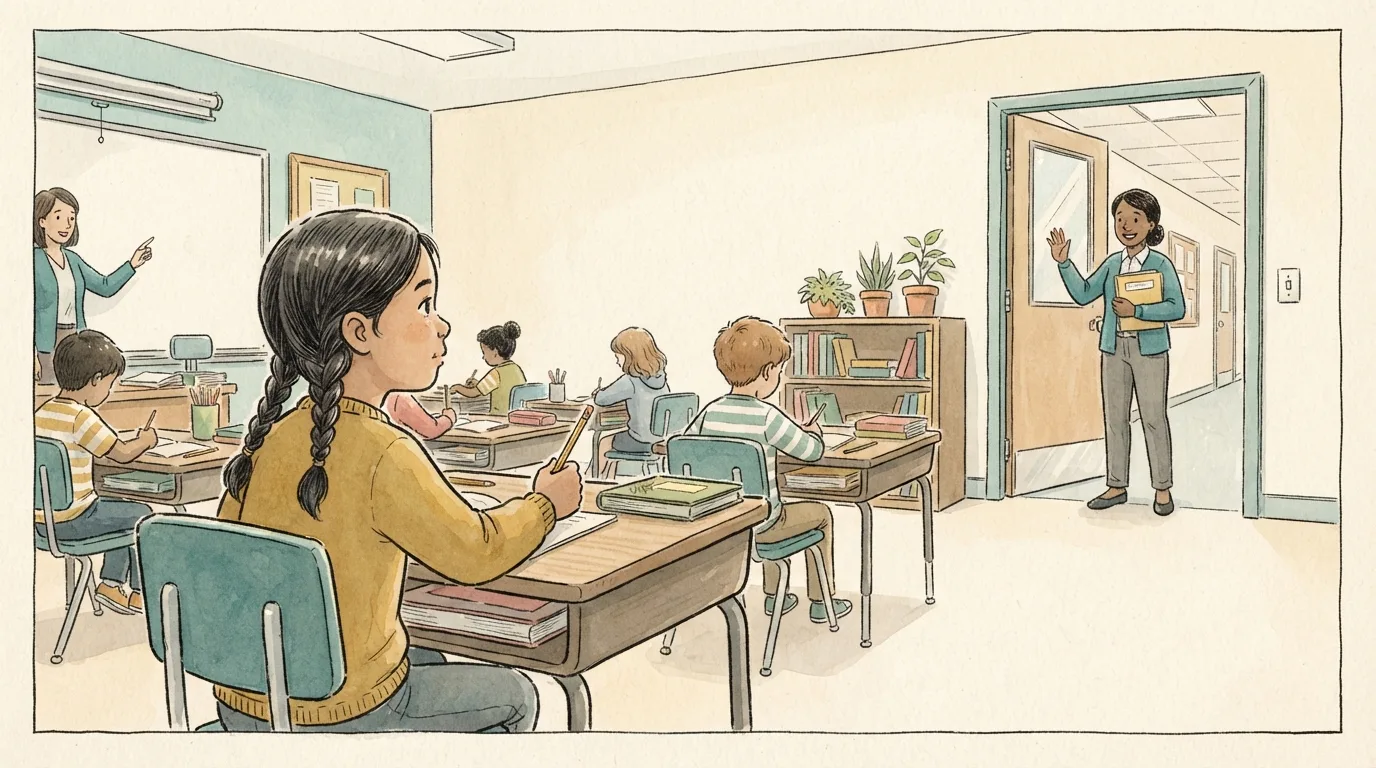
Lena sits in the front row, dead center, because someone decided years ago that this is where you put a student who needs help paying attention. The classroom door is behind her, in the back corner. By ten in the morning she's turned sideways in her chair with one foot in the aisle. From there she can see you and the door at the same time. You ask her to face forward. She does, for about a minute.
It's easy to read that as restlessness, or as a third grader testing you. It may be something else. A child who has lived through frightening things can come to treat a door as the most important object in the room, because it's the one place where somebody new can appear. Last week we wrote about trauma-informed classroom design and how a whole room can feel safer. This post is about that one object, and what to do when a student can't stop watching it.
Why the Classroom Door Matters to a Student with Trauma
Nearly everything else in your room announces itself. Students can see who's at the sink and who's headed for the pencil sharpener. The door is different. It opens for the principal, the late bus kids, the office aide with a note, and the angry voice from the hallway, and it rarely gives any warning first.
Warning turns out to matter a great deal. Anja Schmitz, Christian Grillon, and their colleagues at the National Institute of Mental Health ran an experiment in 2011 with 36 children and teens. A screen told each child what kind of stretch they were in. In the safe stretches, nothing unpleasant could happen. In another kind, a loud scream or a blast of air might come, but only while a red square was showing. In the last kind, it might come at any time. The researchers then measured how hard the children startled at sudden bursts of noise.1All 36 children in this sample were free of any psychiatric diagnosis, and they came from White, middle-class families near Washington, DC, so this shows how ordinary kids respond to unpredictability. It doesn't test children with a trauma history. Forty-eight signed up, and seven of them declined to continue after trying the scream and the air blast; the youngest children were the likeliest to drop out. Girls showed a stronger reaction to the unpredictable stretches than boys did, though the groups were small.
With the red square, the kids were jumpier while it was up than while it was gone. When the bad moment could come at any time, they stayed jumpier than they'd been in the safe stretches even when nothing was happening. Their bodies never got the signal to stand down.
We think a door in plain view does the job of the red square. You can see the handle turn. Just as important, you can see when it isn't turning. A door behind your back is the other condition, the one where something could come at any time. That comparison is ours and not the researchers', but anyone who has picked the restaurant chair facing the entrance knows the feeling.
Why "You're Safe Here" Isn't Enough
Of course you should tell a frightened child they're safe. The trouble is that knowing it and feeling it run on separate tracks.
Katie McLaughlin and colleagues worked with 94 children aged 6 to 18 in Seattle, about 40% of whom had been physically or sexually abused or had witnessed domestic violence. The children saw pictures of two bells, one blue and one yellow. One of the bells was usually followed by a harsh alarm. The other never was. In children who hadn't been maltreated, sweat responses on the skin quickly told the two bells apart. In the maltreated children, the skin responded about the same to both bells early on.2The difference came mainly from a weaker reaction to the danger bell. The maltreated children didn't react more strongly to the safe one, which is not the jumpy picture many of us carry in our heads. They did begin to separate the two bells later in the session. The study compared children who had been maltreated with children who hadn't, at one point in time, so it can't prove that maltreatment caused the difference. Four of the 94 children weren't included in the main analysis.
Then the researchers asked the children how scared each bell made them. Both groups rated the alarm bell as much scarier, and maltreatment made no difference to the answers. These kids could tell you which bell was the bad one. Their bodies were slower to sort it out.
So Lena may agree with you completely that nobody scary is going to walk in, and turn around anyway. Repeating yourself won't settle it. What might help is ordinary experience, piled up over weeks: the door opens, she sees that it's Ms. Ruiz with the attendance sheet, nothing bad happens. A student who faces away from the door gets the sound and misses the ending, unless she turns around to look for it.
What Watching the Door Costs a Student
Matthew Kimble's lab at Middlebury College found a clever way to see what standing guard does to a person. In 2014 the team had college students look at photos of ordinary places, including streets, stores, and classrooms. Some were told to search each photo for threats, and that a blast of noise would sound if they missed any. Others were told just to look. The photos held no threats at all, and both groups heard exactly the same noise, from speakers placed two feet behind them. The threat hunters moved their eyes more, covered more of each picture, and had wider pupils, a sign of a body on alert.3The volunteers were college students from a nonclinical sample with low anxiety, and their vigilance came from an instruction they followed for about eight minutes. That isn't the same as vigilance a child has carried for years. A third group was told to hunt for pleasant targets instead. The threat hunters scanned more than that group too, but the pupil difference was only clear against the group that simply looked.
And they didn't report feeling any more anxious than the others did. Keep that in mind the next time you ask a student whether they're okay and get a shrug and a "fine." They may mean it. The work of keeping watch can go on underneath a person's own sense of how they're doing, which makes the chair and the shoulders better evidence than the answer.
The chair and the shoulders are better evidence than the answer.
Does any of this reach schoolwork? Johanna Lacoe's study of New York City middle schools suggests it does. Each year more than 340,000 students answered a survey that asked whether they were safe in their classes, and 15% said they weren't. Comparing students with themselves in other years, Lacoe found that math scores dipped a little when a student felt unsafe in class, by roughly the equivalent of a month of instruction. Feeling unsafe in hallways and bathrooms had no separate link to scores once the classroom was accounted for.4This is one city's middle schools between 2007 and 2010, and the survey item didn't separate physical safety from emotional safety. The study had no information about seats or trauma histories. The link was clearest in the schools with the most violent and disruptive incidents, and it wasn't statistically significant in the schools with the fewest. Following the same students over time rules out many other explanations, though not all of them.
The effect is small. But it's about the room where the learning happens, and that's the one part of a child's day you get to arrange.
Where to Seat a Student Who Needs to See the Door
Nobody has run a controlled experiment on door-facing desks, so we'll be plain about what this section rests on: the research above, and the judgment of people who teach. One of them, Orsolya Dunn, teaches English to a college class in Scotland that includes many Ukrainian refugees. In a piece for ELT Journal, Dunn describes students who "had to constantly twist one way or another to see the board and the door." Dunn's position is that students who have been through trauma "need clear sightlines and cannot be made to sit with their backs to the door."5This is a teacher's reflection on one room and one college class. It has no comparison group and no measured outcome, and the new table arrangement had been requested but not carried out when the article was written. When the students were asked about the room, their own suggestions were about things like paint, posters, and plants. The point about the door is the author's.
That twisting gives you a test you can run after school. Sit in the student's chair with your shoulders square to the desk. Look at the board. Now find the door by moving your eyes and, at most, turning your head a little. If your shoulders have to move, it's the wrong seat. Do it with your eyes at the student's height, since the bookshelf you see over may be a wall to an eight-year-old.
The answer depends on where your door is.
If it's at the front of the room, you're in luck. Most seats see the door and the board together, and a place along a side wall or near the back adds the comfort of having little going on behind. If the door is on a side wall, look to the opposite side, toward the back. The whole room, door included, is then laid out ahead of the student.
A door at the back is the hard one, and it's Lena's problem. Any desk that faces the board squarely has the door behind it. Try the side wall across from the door, as far back as you can manage, with the desk turned about 45 degrees into the room so the board is off one shoulder and the door is off the other. A seat toward the back of a U-shape's arm does much the same thing without any special angle, and since everybody else on that arm faces the same way, it doesn't single anyone out. If you teach in rows, turning a whole column beats turning one desk.
Seeing the door is different from sitting beside it. The seat by the door gets every draft, hallway noise, and passing elbow, and it puts a student who bolts when overwhelmed one step from the hallway. Aim for a clear view from some distance. And keep the student in among classmates, since a desk set apart from everyone carries its own costs.
Make the Door More Predictable for Everyone
A good seat handles the seeing. You can also cut down on the surprises.
Ask colleagues to knock and wait a beat before they come in. When you know a visitor is due, say so in the morning: "Mr. Ortiz is coming at 10:15 to borrow the projector." Choose whether your door stays open or shut during lessons and stick with it, because a door that changes by the hour has to be checked by the hour. Keep the door's window uncovered if your school's safety rules allow it. If they don't, the knock matters more. And leave a line about all this in your sub folder, since an unfamiliar adult at the front of the room is already a lot.
Can a Door-Facing Seat Make Anxiety Worse?
It's a reasonable worry. Therapists use the term safety behaviors for the things anxious people do to head off a feared outcome, and the concern is that relying on them keeps the fear going. In 2026, Jason Goodson, Jesse Cougle, and their colleagues published a review of studies that deliberately turned these habits up or down. In the five experiments that had people do more of them, symptoms rose. In the larger set that had people cut back, symptoms eased.6The review covered adults only, and just one of its 26 studies dealt with posttraumatic stress. The studies that increased these habits used healthy college samples, and the authors warn that publication bias may have affected the results. None of them tested where anyone sits. The review also left out studies of safety behaviors during exposure therapy, where the authors note that an earlier meta-analysis found instructions about safety behaviors made little difference.
We'd still give Lena the seat. The habit worth shrinking is the checking, all day long, over her shoulder, and a seat with a view should need less of it. Forcing a child to face away doesn't take the checking away either. She's already showing you that, sideways, with her foot in the aisle.
What the review does argue for is paying attention to direction. Pick a 15-minute stretch of independent work and count how many times the student turns or looks up at the door. Count again two weeks after the move, and again a month later. Fewer checks means the seat is doing its job. If the count holds steady, or the need spreads so that the student can't sit in the library or the lunchroom without the same setup, it's time to bring in your school counselor or psychologist. Any plan to wean a student off a certain seat belongs with them, worked out with the student. It shouldn't come as a surprise on a Monday.
Ask the Student, and Skip the Why
You don't need the story behind the watching. Asking for it can do harm, and the seat works the same either way.
Find two or three seats that pass the shoulder test, then ask privately: "I noticed you like to see who's coming in. Would one of these work better for you?" Offering a choice among seats you've already checked gives the student some say without handing over the whole chart. It also guards against a wrong guess. Some students want the door in view. Some want to be as far from it as possible, and others care more about being near you. And some kids who stare at the door are just hoping it's lunchtime. You can be wrong here at no cost. Move the desk, watch for a couple of weeks, move it back if nothing changes.
If the seat helps, write it down where next year's teacher will find it. For a student with a formal plan, the view of the door can go in as a seating accommodation on the IEP or 504, worded so a substitute could follow it: "Seat with the door and the board both in view, not directly beside the door."
Building Door-in-View Seats into Your Seating Chart
Inclusive Seating can show which way each chair faces, but it can't sit in one and notice what a bookshelf is blocking. So do the shoulder test first. Once you know which seats pass, the app is good at making sure the right students end up in them.
Start by making the chart match the room. Add an exit to your classroom grid where the real door is. Then click the small arrow on each seat until it points the way that chair faces. The arrows carry over to your seating chart and its PDF, so you can see at a glance which desks look toward the door, and so can a substitute.
The arrows describe the room, but they don't steer Randomize. Restrictions do that. For a student who needs one particular spot, place an assigned seat there and choose it under Must sit in on the student's profile. When several seats along one wall pass the test, a Must sit near restriction set to the left, right, or back of the room leaves more wiggle room. Add a Must not sit near restriction for the exit if the student shouldn't be right beside the door.
From then on, Randomize works around those restrictions each time you reshuffle the class. Save the class when you're done and they'll be waiting for you at the next seating change, which is when a quiet accommodation like this one is easiest to forget. If you picked two good seats for the student, switch between them now and then so theirs isn't the only desk that never changes hands.
Then sit in the new seat one more time before the bell. Look at the board, find the door, and notice whether your shoulders moved.