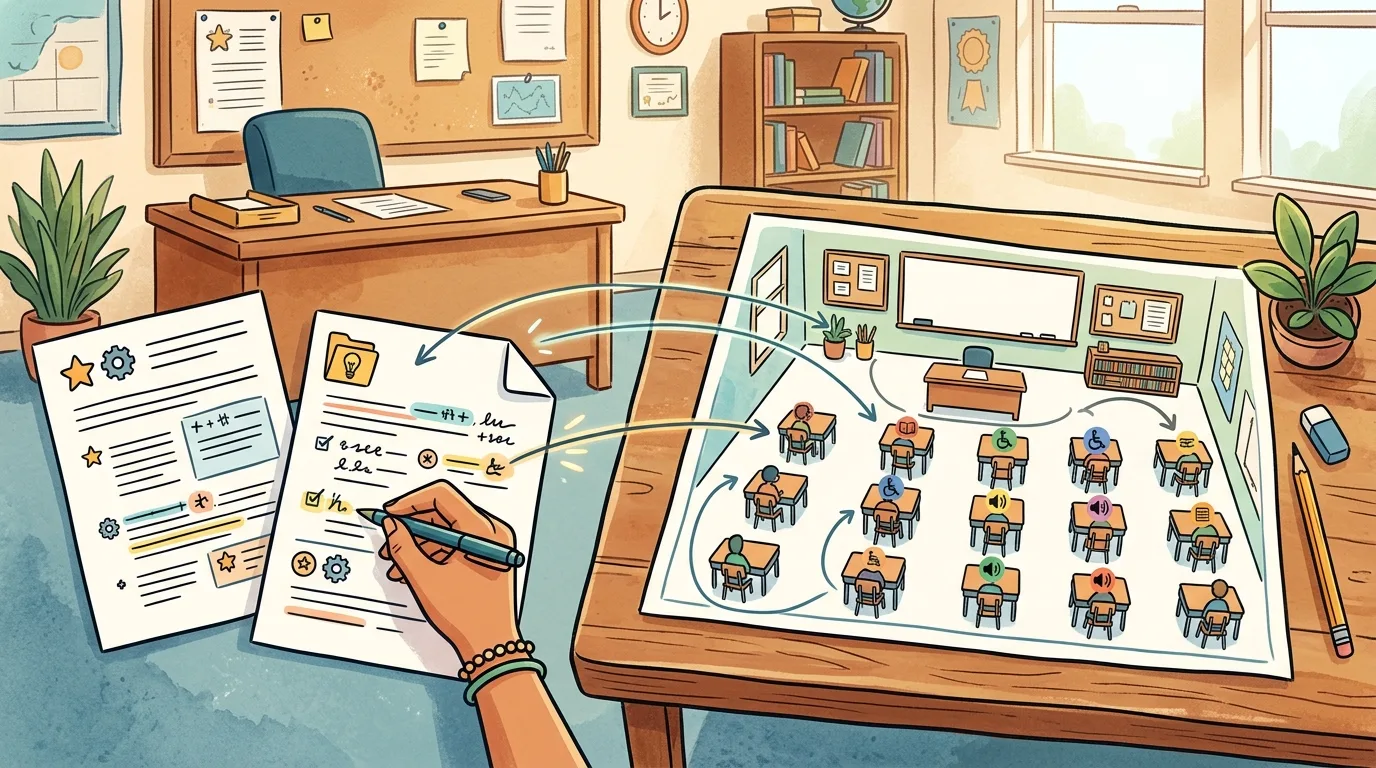
Every fall it shows up in some form. A binder, a shared folder, a stack of stapled summaries from the case manager. Five students in your class have IEPs and three more have 504 plans, and somewhere in all those pages are the accommodations you're now responsible for. You read them. You highlight a few things. And then you sit down to make a seating chart and realize the plans don't really tell you where anyone should sit.
That gap is common, and it isn't your fault. When Kathleen Rotter surveyed 426 general and special education teachers in New Jersey in 2014, most said they read their students' IEPs fairly promptly and found them moderately useful for planning. Their main complaint was the documents themselves. Teachers wanted shorter plans built around student-specific information that connected to what actually happens in a classroom.1This was a self-report survey of teachers from suburban districts in central New Jersey, so it tells us what teachers said about reading IEPs rather than what they did with them. Teachers who answer a survey about IEPs may be more engaged with them than teachers who don't. The study is also more than a decade old, and many districts have since moved IEPs into online systems that change how teachers access them.
A seating chart is one of the few places where a plan becomes a concrete, daily decision. This post walks through how to read a plan with seating in mind, turn each accommodation into a rule you can actually follow, and build a chart that keeps all of them in place at once.
Seating Needs Hide All Over an IEP or 504 Plan
Most teachers look for the words "preferential seating" and stop there. That phrase matters, and we've written a whole post on what preferential seating means and why it's legally binding. But plenty of seating needs never use the word "seating" at all.
Frequent breaks is a seating need. A student who leaves the room several times a day needs a desk with a short, clear path to the door, or they'll cross the whole room and pull every eye along with them. Noise-canceling headphones are a seating need, because headphones help a lot less next to the pencil sharpener. An FM system or a hearing aid is a seating need. So is a tablet that has to stay plugged in, a wobble stool, a scheduled check-in from a paraprofessional, or a behavior plan that names transitions and crowding as triggers.
So read the whole plan, including the present levels section near the front. That's where the team describes what's hard for the student, and it often explains an accommodation better than the accommodation itself does. "Becomes overwhelmed in noisy, crowded settings" tells you more about where a desk should go than "preferential seating" ever will.
Expect to do some interpreting. In 2022, Jennifer Kurth and colleagues rated the IEPs of 112 elementary students with complex support needs from across the country. The supplementary aids and services sections, where accommodations live, averaged about 11 items per student and ran as high as 55. Specificity was the weakest part of those sections, and the researchers concluded that the plans were often so vague and nonspecific that it would be "nearly impossible" for team members to implement them with any certainty or fidelity.2The sample was students with complex support needs, most of them with intellectual disability, autism, or multiple disabilities, so these IEPs may be longer and more involved than the typical plan for a student with a learning disability or ADHD. The researchers worked from the documents alone. They couldn't attend the meetings or see the team's notes, which might have explained what a vague line was meant to accomplish. With 112 IEPs, the study also had limited power to detect smaller differences. When a plan says "seat near instruction" and nothing else, someone has to decide what that means on a Tuesday. Usually that someone is you.
Turn Each Accommodation into a Seat Rule
Here's the move that makes everything else easier. Every seating-related accommodation can be rewritten as one of four kinds of rules: the student needs to be near something, away from something, next to someone (or not next to someone), or in one particular seat.
A few translations, to show how it works. "Frequent breaks" becomes near the door, on the edge of a row. "Check for understanding" becomes near the spot where you usually stand while kids work. "Reduced auditory distractions" becomes away from the hallway door and the sink. "Peer support during independent work" becomes next to a specific, steady classmate. "Uses a standing desk" becomes in the one seat where the standing desk lives.
Writing it this way does two things. It forces you to name the thing the student needs to be near or away from, which is usually what the plan left out. And it turns a fuzzy intention into something you can check against the chart in three seconds.
When you can't tell what a rule should be, go back to the reason. Judith Harrison and her colleagues at Ohio University reviewed the research on classroom accommodations for students with ADHD and emotional or behavioral disorders in 2013. They found very little evidence behind the accommodations schools recommend most often. In the setting category, which covers things like furniture, teacher proximity, and small-group instruction, they found only five studies, and the evidence for teacher proximity came from a single study whose benefits showed up on some measures but not others.3Thin evidence isn't the same as evidence that an accommodation doesn't work. It means nobody has tested it well, at least for students with ADHD or emotional and behavioral disorders, which were the only groups this review covered. It's also from 2013. The research base may have grown since, and an accommodation with little testing behind it can still be the right call for a particular student. Their argument was that an accommodation should be chosen to address a specific impairment, not pulled from a list.
That's useful for you. The label on the plan isn't evidence that a particular seat will help. The reason behind the label is what you're designing around. If you can't figure out the reason, ask the case manager. It's a two-minute conversation that can save a student a semester in the wrong seat.
Where the Paraprofessional Sits Matters Too
If a student has a one-on-one aide or shares a paraprofessional with classmates, the seating chart has a second person in it. Where that adult ends up is a seating decision too, even if nobody writes it down.
The easy default is to put the student at the edge of the room with an empty chair beside them for the aide. It's practical. It keeps the adult out of everyone's way. It's also the arrangement Michael Giangreco and his colleagues warned about in their 1997 study "Helping or Hovering?" After observing and interviewing teams supporting students with multiple disabilities in general education classrooms, they found that an aide's constant closeness tended to separate students from their classmates, build dependence on adults, get in the way of peer interactions, and quietly shift responsibility for the student's learning away from the classroom teacher.4This was a qualitative study based on observations and interviews, and it focused on students with multiple disabilities. It describes patterns the researchers saw and how people experienced them, not how often each one happens across schools. It's also nearly thirty years old. Paraprofessional training and roles have changed since then, though concerns about isolation under one-to-one adult support keep showing up in later research.
What works better is seating the student among classmates first and then figuring out where the aide can work nearby without taking the neighboring seat. A small work spot at the end of a table group or a stool the aide can pull up and then leave lets the adult step in when needed and step back the rest of the time.
That stepping back can be planned. Kelsey Trausch, Matthew Brock, and Eric Anderson had a classroom teacher train five paraeducators to set up peer support arrangements for four elementary students with multiple disabilities. Instead of the adult doing most of the helping, the paraeducators coached classmates to give academic and social support. The students' interactions with peers rose to levels similar to those of classmates without disabilities, and they leaned less on the paraeducators for everyday classroom routines.5This was a single-case study with four students, which is normal for research with students who have significant disabilities but means the results come from close observation of a few children rather than a large comparison group. The design is good at showing that a change followed the intervention for those students. It can't tell you how many students in a typical school would respond the same way. None of that is possible if the student's only neighbor is an adult.
None of that is possible if the student's only neighbor is an adult.
Choose the Neighbors on Purpose
A lot of plans include some form of peer support, whether it's a "peer buddy," "partner reading," or "peer model for social skills." All of them start with a seat. You can't run a peer support arrangement between two kids sitting on opposite sides of the room.
The research here is encouraging. A 2026 meta-analysis by Sarah Emily Wilson and colleagues pulled together 37 studies of peer-mediated social interventions for secondary students with intellectual and developmental disabilities. The effects were large and positive overall. The two approaches that came out strongest were peer support arrangements, where a few trained classmates help a student during class, and peer networks, where a small group of peers meets regularly with the student, often outside of class. Both did better than approaches built around teaching peers to start and respond to interactions.6The studies in this meta-analysis involved middle and high school students, so the elementary picture leans more on smaller studies like the Trausch study above. Many of the included studies used single-case designs, which tend to produce larger effect sizes than group studies, so the numbers from the two kinds of designs shouldn't be compared directly. The analysis also focused on social outcomes rather than academic ones.
For a seating chart, that means picking neighbors deliberately. Look for classmates who are patient, reasonably independent in their own work, and kind without being bossy. Two peers usually work better than one, because the load gets shared and the student has more than one person to connect with. Then rotate the arrangement every few weeks so the job doesn't land on the same responsible kid all year. We've written more about this in our post on using seating to fight social isolation.
Keep the "not next to" rules too. Some plans name specific peer conflicts, and some behavior plans point at certain pairings as triggers. Those belong on the chart as firmly as anything else.
When Two Students' Accommodations Collide
Sooner or later the rules bump into each other. Four students need to be "near the teacher," and there aren't four seats that close. One student needs the seat by the door for breaks, and another student's plan says to keep them away from the door. A student who needs to move and fidget ends up next to a classmate whose plan calls for minimal distractions.
Start by going back to the reason behind each rule. "Near the teacher" for a student with hearing loss means near your voice. For a student who drifts during independent work, it means within easy reach of your walking path. Those aren't the same spot, and once you separate them, the four-way tie often falls apart. You can also move. Teaching from the side of the room some of the time changes who's "near the teacher" without moving a single desk.
Next, place the students with the most rules first. The student with four constraints has maybe three possible seats in the room. The student with no constraints can sit almost anywhere. If you fill in the easy kids first, the hard placements end up squeezed into whatever's left.
And if two needs truly can't both be met in your room, say so to the case managers. That's not a failure on your part. It's information the team needs, and sometimes the fix is a small change to one plan that nobody would have thought of without your view of the room.
Build a One-Page Seating Profile for Each Student
The teachers in Rotter's survey asked for shorter, more classroom-relevant plans. You can make your own version for seating. For each student with a plan, write one short line covering the reason, what they need to be near, what to keep them away from, who they should or shouldn't sit beside, and whether any of it changes during group work or testing.
Something like: "Hearing, left ear better. Near my teaching spot, right side of the room. Away from the hallway door and the air vent. During group work, the table farthest from the door." That fits on an index card, and it's a lot easier to check against a seating chart than a 20-page IEP.
Keep these profiles private. They belong in your planning materials and your sub folder, not on the version of the chart that's taped to the wall where students can read it. A student's diagnosis is nobody else's business, and a seating chart shouldn't announce it. Done carefully, though, a profile is exactly what a substitute teacher needs to keep accommodations in place when you're out.
Then revisit them whenever something changes. A new annual IEP, a new 504 meeting, a student moving into your class in March, a switch from rows to table groups. Each one is a moment when an accommodation can quietly fall off the chart if nobody's looking for it.
Putting Your IEP and 504 Seating Rules into Inclusive Seating
The four kinds of seat rules above map directly onto how Inclusive Seating works. Each student can carry a Must sit near restriction pointing at your desk, the whiteboard, the exit, the calm corner, a side of the room, or a specific classmate. A Must not sit near restriction does the reverse, keeping a student away from the exit, the back of the room, or a classmate their plan says to separate them from. And Must sit in locks a student into one numbered assigned seat when only that seat will do.
Those restrictions stay attached to the student, not to the layout. Switch from rows to table groups for a science unit and every accommodation comes along. When you click Randomize, the algorithm places everyone around all of the restrictions at once, so you can shuffle the rest of the room as often as you like while the students with plans land where their plans say they should. You don't have to remember to place the hard cases first. The tool does it.
Saved classes keep every restriction from one week to the next, and the roster PDF lists each student's restrictions next to their name, which gives you a tidy page for the sub folder or for the next IEP meeting. Everything runs in your browser and stays on your own device, so the details of students' accommodations never get uploaded anywhere.
The plans in that binder were written by people who care about these kids. Your seating chart is where their intentions turn into something that happens every single day.
