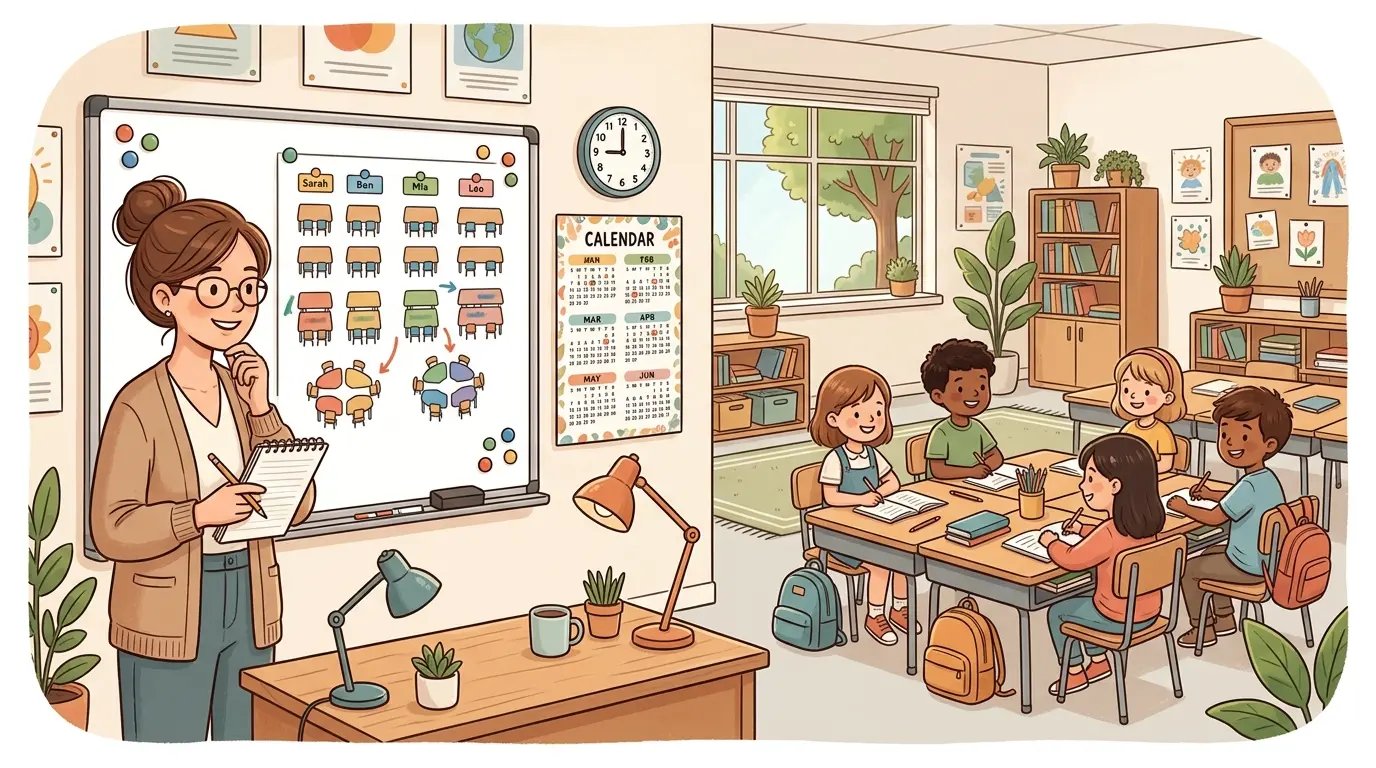
Ask five teachers how often they change their seating chart and you'll get five different answers, plus at least one story about a change that went sideways. Some teachers rearrange every Friday. Some pick a chart on day one and don't touch it again until June. Most land somewhere in between and second-guess themselves the whole way through.
There's actual research on this question, and it points to something more specific than "whenever it feels right." Two separate studies, run a decade apart, in different countries, with different students, landed on roughly the same window for how long it takes a seating arrangement to actually do its work. That's not a coincidence, and once you see why, the whole question gets a lot less mysterious.
There's No Universal Number, But There Is a Window
In 2012, a research team led by Yvonne van den Berg ran a field experiment in 27 fifth and sixth grade classrooms in the Netherlands. They found pairs of students who actively disliked each other, then rebuilt the seating chart so those students sat closer together. Ten to twelve weeks later, the classmates who had been rated most negatively at the start were being seen more positively by their peers, and reports of victimization and social withdrawal had dropped across the whole class. The researchers weren't trying to figure out how often to change a chart. But the length of time they gave the new arrangement to work, ten to twelve weeks, wasn't arbitrary. Shorter windows in earlier research hadn't produced reliable effects. This was roughly how long it took for a new arrangement to actually reshape how kids saw one another.
A decade later, a different team found something similar from the opposite direction. Sharon Faur and Brett Laursen followed 235 students in grades 3 through 5, asking them to name their friends at two points in the year, thirteen to fourteen weeks apart. Students who ended up sitting near a new classmate after a seat change were significantly more likely to become friends with that classmate by the second check-in, even though every student in the room already knew every other student by name.1These two studies measured different things using different methods, which is worth keeping in mind. Van den Berg, Segers, and Cillessen (2012) ran a randomized field experiment specifically designed to change proximity between disliked classmates, then measured likeability, victimization, and social withdrawal through peer nominations. Faur and Laursen (2022) instead tracked seat assignments that teachers had already made on their own and measured friendship nominations over time, without manipulating anything themselves. The first study used fifth and sixth graders in the Netherlands; the second used third through fifth graders in the United States. That two independent teams, using different methods, in different countries, with different age groups, converged on a similar multi-week window for seating effects to show up is a big part of why the finding is worth taking seriously, rather than treating it as a coincidence of one particular study design. Van den Berg, Y. H. M., Segers, E., & Cillessen, A. H. N. (2012). Changing peer perceptions and victimization through classroom arrangements: A field experiment. Journal of Abnormal Child Psychology, 40(3), 403–412. https://doi.org/10.1007/s10802-011-9567-6. Faur, S., & Laursen, B. (2022). Classroom seat proximity predicts friendship formation. Frontiers in Psychology, 13, 796002. https://doi.org/10.3389/fpsyg.2022.796002 Physical proximity was still doing quiet social work, months into a school year students had already spent together.
Line those two findings up and a pattern emerges. Somewhere between nine and fourteen weeks, or roughly the length of a grading quarter, is enough time for a seating arrangement to genuinely shape who gets along with whom, who feels comfortable asking a neighbor for help, and who ends up isolated. That's not a rule to circle on your calendar in permanent marker. It's closer to a research-backed rhythm. Change things much faster than that and the social effects barely have time to register. Wait a lot longer, and you risk locking in dynamics that aren't serving your class.
Why a Seating Chart Has a Shelf Life
A seating chart isn't neutral scenery. It's an environment your students live inside for hours a day, and environments accumulate effects the longer they stay in place.
Some of those effects are social. The same proximity that helps two shy kids become friends can just as easily let two easily distracted students settle into a routine of quietly derailing each other, day after day. A 2024 study found that inattentiveness spreads specifically between direct neighbors: students seated next to a distracted classmate took fewer notes and scored lower on a later quiz, regardless of how focused the rest of the room was.2This particular study was conducted in a university lecture hall, not an elementary classroom, which is a real limitation worth naming. College students and eight-year-olds pay attention differently, and a lecture hall isn't the same setting as a cluster of elementary desks. That said, the underlying mechanism, that a distracted neighbor pulls down the attention of the student seated beside them more than students seated farther away, isn't a claim about lecture halls specifically. It reflects a pattern documented in social attention research across age groups, and elementary teachers who've watched one restless student set off an entire table are describing the same basic phenomenon this study measured directly. Forrin, N. D., Kudsi, N., Cyr, E. N., Sana, F., Davidesco, I., & Kim, J. A. (2024). Investigating attention contagion between students in a lecture hall. Scholarship of Teaching and Learning in Psychology. https://doi.org/10.1037/stl0000419 The effect is neighbor-specific, which means the longer two particular students stay side by side, the more room that dynamic has to compound, for better or for worse.
Some of the effects are more structural. If the same students sit in the back corner all semester, they end up getting less of your attention, not because you're neglecting them, but because proximity quietly shapes who you make eye contact with, who you call on, and who you notice drifting off task. A chart that never changes locks that pattern in without anyone deciding to.
And some of it is just human nature. Novelty fades. A seat that felt fresh in September is just furniture by November. Students who once found their tablemates fascinating have often said everything they have to say to each other by winter break, and a low hum of restlessness sets in that has nothing to do with your teaching and everything to do with staring at the same three faces for ten straight weeks.
A seating chart rarely fails because it's the wrong shape. It fails because it's been the same shape for too long.
What Teachers Are Actually Doing, According to the Research
In 2023, a research team interviewed thirteen upper elementary teachers about how and why they arrange their classrooms. Not one of them treated their opening seating chart as a fixed decision for the year. Every teacher described rearranging students as the year went on, though their reasons varied. Some worked from a set schedule. Others changed the chart the moment they noticed a specific problem: a friend group getting too chatty together, a student drifting toward isolation, two kids who couldn't sit near each other without an incident.3This study is qualitative: thirteen teachers, semi-structured interviews, coded for recurring themes rather than tested against a control group. That means it can't tell you how much any particular strategy improves outcomes, only what experienced teachers report actually doing and why they say they do it. A sample this small is also shaped by the specific schools and region involved, so it may not represent every classroom context. Even with those limits, the study is useful here because it captures the reasoning behind real classroom decisions instead of an artificial experimental setup, and its central finding, that experienced teachers actively manage their seating chart rather than setting it once and leaving it alone, lines up with what the timing research above would predict. Hoekstra, N. A. H., Van den Berg, Y. H. M., Lansu, T. A. M., Mainhard, M. T., & Cillessen, A. H. N. (2023). Teachers' goals and strategies for classroom seating arrangements: A qualitative study. Teaching and Teacher Education, 124, 104016. https://doi.org/10.1016/j.tate.2023.104016
That mix, part calendar and part observation, is worth taking seriously. It lines up with what the timing research above suggests. A scheduled refresh roughly once a quarter gives an arrangement's social and academic effects time to develop before you disrupt them, which fits the nine-to-fourteen-week window from the studies. But waiting for the calendar while a specific problem gets worse doesn't serve anyone either. The teachers in this study weren't choosing between a fixed schedule and reacting to what they saw in the room. They were doing both.
Signs It's Time to Change the Chart, Even Off Schedule
A few signals are worth watching for between your regular resets. If the same small group keeps getting louder and less focused every time they're seated together, that's usually less a discipline problem than a seating problem, and separating them for a few weeks tends to work faster than any consequence will. If a student seems to be sitting alone socially, even while technically surrounded by classmates, moving them near someone warm and inclusive can do more for that isolation than a conversation ever could. A new student arriving mid-year is a trigger of its own; dropping them into whatever seat happens to be open rarely serves them as well as a bit of thought about who they're likely to connect with. And if you notice yourself avoiding a particular corner of the room during instruction, it's worth asking whether that avoidance has quietly become a habit, and whether certain students have been sitting just outside your notice for longer than you realized.
None of that needs to wait for the end of the quarter. It's the responsive half of the pattern the research points to. The scheduled changes handle the slow, structural stuff. The responsive changes handle what comes up in between.
One Caution Before You Reach for the Eraser
It's worth knowing that seating changes aren't risk-free, especially when they're aimed at fixing one specific relationship. A 2020 follow-up to the Dutch field experiment tested what happened when teachers deliberately moved students who disliked each other closer together, the same move that had worked well for that one pair in the original study. Across 59 classrooms, the targeted pairs did improve, largely as expected. But other students in those same classrooms reported more aggression and less cooperation overall. The intervention had rippled outward in ways the researchers hadn't set out to measure.4This study is a direct follow-up to the Van den Berg et al. (2012) field experiment discussed earlier in this post, using the same seating strategy but measuring effects on the whole classroom instead of just the targeted pairs. Fifty-nine fifth grade classrooms in the Netherlands took part. The apparent contradiction, that the same intervention helped the target pairs while showing costs for their classmates, isn't really a contradiction. It just means seating changes have a scope larger than the two or three students you set out to help, which is a reason to think about your whole roster rather than a reason to avoid targeted placement altogether. Braun, S. S., van den Berg, Y. H. M., & Cillessen, A. H. N. (2020). Effects of a seating chart intervention for target and nontarget students. Journal of Experimental Child Psychology, 191, 104742. https://doi.org/10.1016/j.jecp.2019.104742
That doesn't mean strategic seating backfires. It means a seating chart touches more students than the two or three you're focused on when you build it, and it's worth glancing at the whole room, not just the seats you're actively trying to fix, before you finalize a change. A scheduled reset every quarter tends to carry less of this risk than a series of small, reactive tweaks aimed at one relationship at a time, since it resets the whole social landscape at once instead of singling anyone out.
Using Inclusive Seating to Keep Up With This
Following a research-backed cadence sounds simple until you picture actually doing it: redrawing a chart from memory, remembering which student can't sit near the door, figuring out who's been paired up too long, and doing all of that four times a year on top of everything else already on your plate.
This is where Inclusive Seating earns its keep. Every restriction you've set for a student, must sit near the teacher's desk, must not sit near a particular classmate, needs a specific assigned seat, stays attached to that student's profile permanently. When your quarter is up, click Randomize, and the algorithm builds a fresh arrangement that still honors every restriction you've set, while specifically avoiding repeats of the same neighbors and seats from your previous chart. The result is a genuine reset, not a shuffle of the same three pairings.
For the responsive changes, you don't need to touch anything you've already built. Add a single new restriction, a must-not-sit-near between two students who've started feeding off each other, or a must-sit-near pointing a new student toward a classmate you think they'll connect with, then randomize again. Everything else in your chart stays exactly where it was. You get the responsiveness the research supports without rebuilding your seating strategy from scratch every time something changes.
