A teacher moves a fidgeting student to the front row, closer to her desk, and it works exactly the way it's supposed to for ADHD. She tries the same move on an autistic student in her class who keeps covering his ears during transitions, and it does nothing. He isn't struggling to hold his attention on the lesson. He's struggling to hold himself together against a room that's too loud, too bright, and too visually busy, and moving him three feet closer to the teacher doesn't touch any of that.
That's the gap this post is about. Most seating advice for neurodivergent students gets written with attention in mind: distance from the teacher, who sits next to whom, rows versus clusters. Sensory processing is a different problem with a different fix, and it deserves its own seating logic.
Sensory Processing Isn't the Same Problem as Attention
It's tempting to treat "seating for autism" as a variation on seating for ADHD, and the two do overlap in places. But the underlying mechanism is different. An ADHD brain struggles to filter distractions out. An autistic brain often takes in sensory input, sound, light, texture, motion, at a different intensity than a neurotypical brain does, and that difference doesn't resolve just because the input is easy to ignore for everyone else in the room.
Kiri Mealings, Wayne Wilson, and Joerg Buchholz ran a scoping review pulling together what's actually known about how the classroom environment affects listening, learning, and wellbeing in autistic children, screening 1,301 papers down to the 35 that met their criteria.1A scoping review maps the shape and size of a research area rather than pooling results into a single effect size the way a meta-analysis does. The 35 included studies varied widely in design, sample size, and how strictly "autistic" was defined, so this is better read as a survey of what's been studied and how consistently, not a single number you can act on. Their headline finding cuts against the instinct to treat sensory struggles as an attention problem: autistic children showed measurably worse speech perception in background noise than their neurotypical peers, a hearing-in-noise difficulty that has nothing to do with willpower or focus. Assistive listening tools like FM systems and sound-field amplification helped. So did something a lot cheaper: physically separating quiet, focus-heavy work from the noisier parts of the room.
That distinction matters for how you read the rest of this post. A seat that reduces attentional pull won't necessarily reduce sensory load, and a seat that reduces sensory load won't necessarily be the one that keeps a student's eyes on the board. Building both into one seating chart means treating them as separate design problems that happen to intersect at the same desk.
What the Noise in Your Room Is Actually Doing
Shireen Kanakri and colleagues spent time in four classrooms observing 42 children with high-functioning autism, ages six to nine, coding their behavior against measured decibel levels using observational software.2This was an observational, correlational design across four classrooms rather than an experiment that manipulated noise directly, so it shows association rather than proof of cause. The sample was also limited to children specifically described as high-functioning, which means the pattern may not hold the same way across the full range of the spectrum. As ambient noise climbed, so did the frequency of repetitive motor movements, repetitive speech, ear covering, hitting, loud vocalizing, and verbal complaints. The behaviors researchers usually read as "acting out" or "stimming" tracked the sound meter almost like a dial.
That reframes a seat near a pencil sharpener, a shared printer, or a doorway that squeaks every time it opens. For most students those are minor annoyances. For a student whose nervous system registers noise more intensely, they're a recurring trigger, and the behavior that follows isn't defiance. It's regulation, happening in the only way available in the moment.
The Mealings review backs this up with concrete fixes beyond just picking a quieter seat: choosing quieter HVAC systems where a school has any say in it, adding sound absorption like rugs or acoustic panels, and setting aside separate quiet spaces with noise-cancelling headphones available for independent work. None of that requires new furniture. It requires knowing which corners of your room are acoustically hot and keeping the students most affected by noise away from them.
The Visual Environment: Lighting and Displays
Elizabeth Jones, Mary Hanley, Jessica Rose Hirst, Emily McDougal, and Deborah Riby built a "mini-classroom" experiment specifically to isolate this question, running 25 autistic children (ages 8 to 11) and 22 neurotypical children (ages 6 to 11) through a reading comprehension task under four conditions: a quiet, undecorated baseline, visual clutter from classroom displays, added background noise, and both together.3The sample sizes here are modest, 25 autistic and 22 neurotypical children, and the task itself was a brief, self-directed reading exercise in a lab-built mini-classroom rather than a full school day. Notably, this particular experiment did not find a measurable effect from added classroom noise on its own, which the authors discuss as possibly tied to how the noise condition was set up rather than evidence that noise doesn't matter more broadly. Displays measurably increased off-task behavior, and the effect landed harder on the autistic group than the neurotypical one. Noise didn't show the same clear effect in this particular setup, a genuinely useful reminder that even well-designed studies don't always confirm what seems obvious, and that visual and auditory sensitivity don't necessarily move together in the same student.
A separate systematic review by Rahaf Al Qutub, Zhi-Wen Luo, Carolina Vasilikou, Teresa Tavassoli, Emmanuel Essah, and Hannah Marcham looked specifically at indoor environmental quality and autistic pupils' behavior, pulling together 11 studies on the topic.4Eleven studies is a small evidence base to synthesize, and the authors describe the correlation between environmental quality and autistic behaviors as nascent rather than settled. Lighting and acoustics were the best-studied factors; thermal comfort had comparatively little research attention, and indoor air quality had essentially none, which the review flags as an open gap rather than a finding. Lighting and acoustics turned up as the two most consistently studied and most consistently linked factors, with harsh or flickering lighting associated with worse outcomes on both learning and behavior measures.
Put together, a desk facing a bulletin board crammed with student work and sitting under a buzzing fluorescent fixture is asking more of a sensory-sensitive student than it looks like on paper. The fix isn't stripping every wall bare. It's noticing which seats face the busiest, brightest surfaces in the room and being deliberate about who ends up in them.
Zoning the Room Without Overpromising
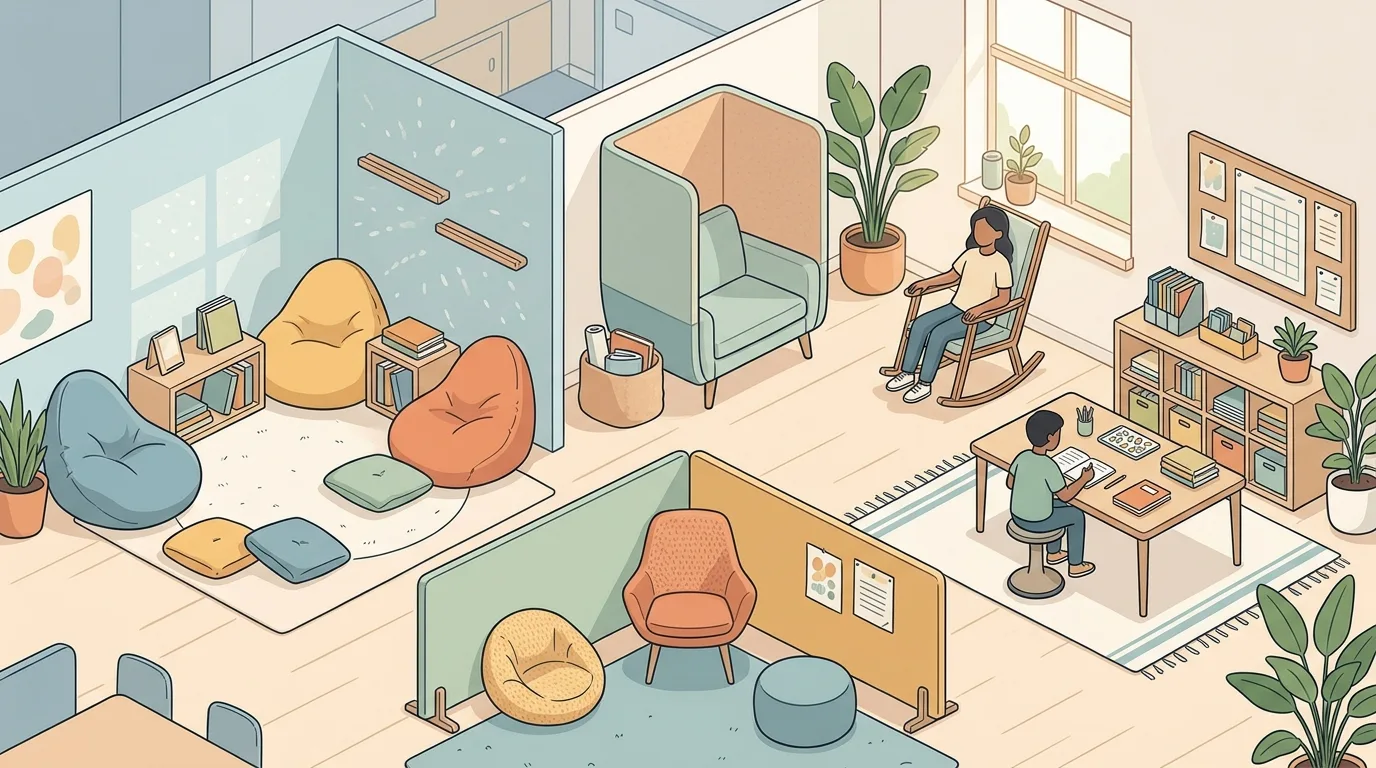
A common piece of advice for autism-friendly classrooms is to physically divide the room into clear zones: one area for independent seatwork, another for group instruction, another for quiet regulation. The Mealings review supports part of this directly, noting that classrooms with clearly defined activity areas and less visual clutter saw fewer triggers for inattention and stress. That's worth building into your layout.
Where it's worth being careful is treating structured, zoned environments as a proven fix for everything. Structured teaching approaches built around this idea, most notably TEACCH, have a real evidence base, but it's a mixed one. Yiwei Zhu and colleagues ran a systematic review and meta-analysis of ten studies testing structured teaching programs for children with autism and found significant gains in fine and gross motor skills, but no significant improvement in communication, socialization, or daily living skills.5The ten pooled studies varied enormously, from randomized trials to non-randomized comparisons, with sample sizes as small as eleven participants and heterogeneity scores high enough that the authors flagged the results as inconsistent across studies. The review also couldn't isolate physical zoning as its own variable; it evaluated structured teaching as a bundled package of physical organization, visual schedules, and individualized work systems together.
None of that means zoning is worthless. It means a defined quiet corner and clearly bounded work areas are a reasonable, low-cost piece of a sensory-friendly layout, not a substitute for the other supports a student needs. And it's worth resisting the temptation to solve sensory overwhelm by tucking a student's desk into permanent isolation at the back of the room. Research on seating isolation shows that move tends to cost a student socially without necessarily calming their nervous system, so a quiet zone should still keep the student inside the social fabric of the class, not off to the side of it.
What Actually Reduces Overwhelm: Choice and Flexibility
Maria Canal, Nazli Yeserdir, Emma Hynds, and Tim Pocock surveyed 159 university students, 31 percent of whom identified as neurodivergent, about what made a study space work or fail for them.6This sample was undergraduate and graduate students at a single UK university, not elementary or secondary school children, and the neurodivergent group combined ADHD, autism, and learning differences rather than isolating autistic respondents on their own. Self-reported preference data also measures what people say helps them, not a directly observed behavioral outcome. Both neurodivergent and neurotypical students named noise and bright lighting as the most disruptive elements, but neurodivergent students flagged sensitivity to a wider range of environmental factors overall. The clearest gap between the two groups: neurodivergent students rated flexible seating arrangements as meaningfully more effective than their neurotypical peers did.
A seat that reduces attentional pull won't necessarily reduce sensory load, and a seat that reduces sensory load won't necessarily be the one that keeps a student's eyes on the board.
That lines up with something worth building into any autism-friendly seating plan: the specific fix that works varies enormously from one student to the next, more than it does for most other seating considerations. One student's ideal seat faces a blank wall. Another needs a clear sightline to the door so unexpected movement doesn't come as a surprise. A seating chart built around a single universal rule for "students with autism" will underperform one built around each student's specific triggers.
Building the Sensory-Friendly Seat
Put the research together and a workable seat tends to share a few traits, even though the exact combination varies by student. It sits away from the acoustic hot spots in your room: shared equipment, high-traffic doorways, anything mechanical that hums or clicks. It faces a calmer visual field rather than a busy display, without requiring you to redecorate the whole room. It has quick access to a defined, socially connected quiet space rather than permanent isolation. And whenever it's practical, it leaves room for a student to have some say in small adjustments, whether that's facing direction, distance from a specific sound source, or which side of the room they're on.
None of that is a fixed formula, because sensory profiles aren't uniform even within one diagnosis. It's a checklist to walk through for each student individually, the same way you'd think through rows versus clusters for a specific lesson rather than picking one layout and using it for everything.
Where This Gets Easier With the Right Tool
This kind of seating decision involves several sensory factors stacked on one student at once, which is exactly the situation that gets unmanageable on a paper chart. Inclusive Seating lets you set a restriction keeping a student's desk away from doors, windows, or specific high-traffic elements, a separate one requiring proximity to a calm corner or quiet zone, and another keeping them clear of a specific loud neighbor, all attached to the same student simultaneously.
Click Randomize and the algorithm rebuilds the full chart around every restriction at once, whether the room is set up in rows for independent work or clusters for a group activity. Because restrictions travel with the student rather than the layout, switching the room around for a different kind of lesson doesn't mean rebuilding a sensory accommodation from scratch. You can save the arrangement that works, load a different one for assessment days, and randomize within either while every accommodation stays exactly where you set it.
No seating chart will substitute for the sensory supports a student's IEP or 504 plan actually calls for. But it's one of the few supports that costs nothing to try, works the moment class starts, and doesn't ask a struggling student to keep advocating for it every single day.
