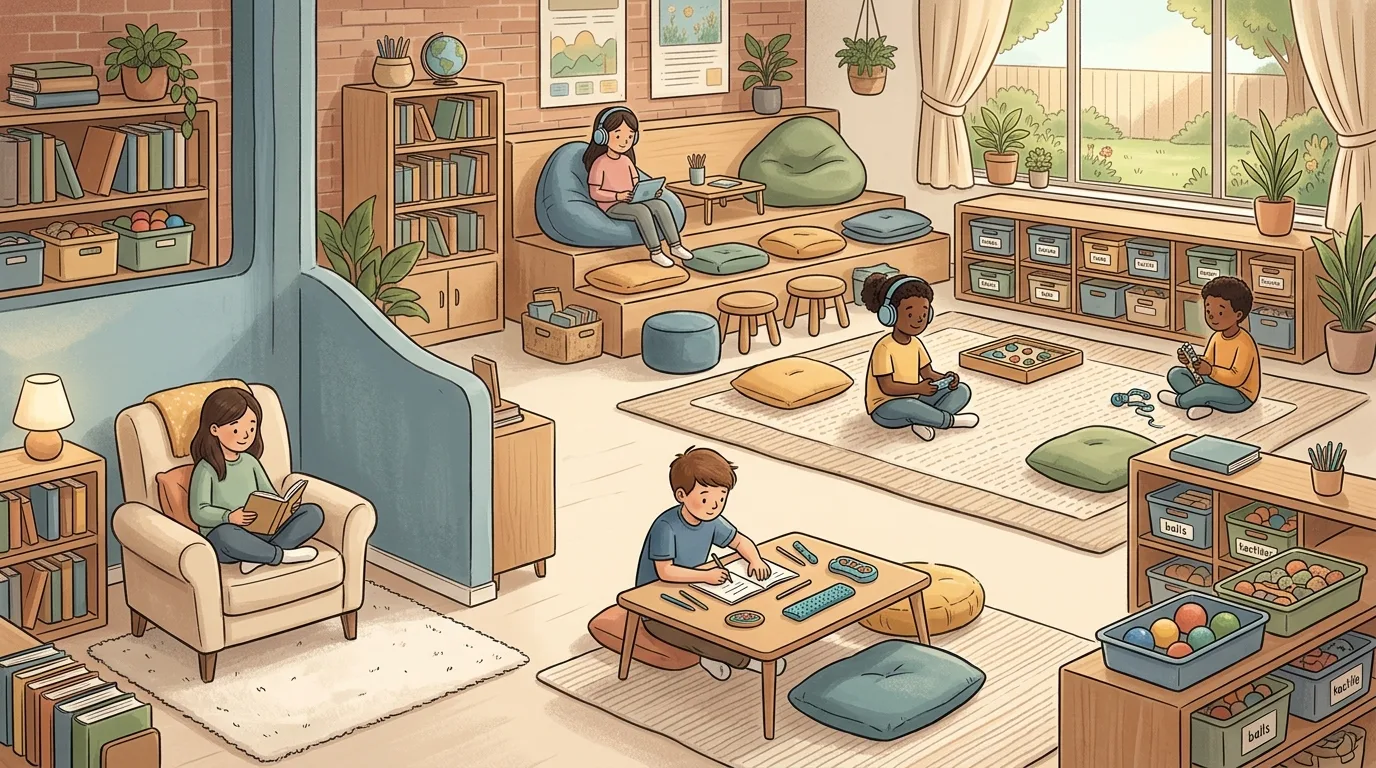
Two kids sit at the same table during a spelling test. One flinches every time a chair scrapes and has read the first word four times. The other is slumped low in his seat and didn't hear you say the second word at all. You'd probably file the first child under anxious and the second under tired. There's a good chance both are reacting to the same room, just from opposite ends.
"Sensory processing differences" describes how a child's nervous system handles ordinary input like sound, touch, light, and movement. Some children register it too strongly. Some barely register it. Some go looking for more of it. None of this needs a diagnosis to be real, and it doesn't wait for one before it starts shaping a child's school day. We tend to talk about overstimulation as something happening inside a kid. It usually starts with the room, and the room is the part you control.
How Common Are Sensory Processing Differences in the Classroom?
More common than most seating charts assume. Ayelet Ben-Sasson and her colleagues followed a representative group of 925 children from infancy into elementary school. By ages 7 to 11, parents of 16 percent of them said at least four everyday sounds or textures bothered their child. In a class of 28, that's four or five kids, and most of them won't have a diagnosis of anything.
Those children weren't only uncomfortable. Their parents also reported more anxiety, more acting out, more trouble calming down, and weaker social skills than parents of children without that sensitivity.1Both studies relied on parents filling out questionnaires rather than on anyone observing the children at school, so they capture what bothered kids at home and in daily life, not in a classroom specifically. The 16 percent figure also depends on where the researchers drew the line: at least four bothersome sensations. A lower cutoff would count more children and a higher one fewer. In the Carpenter study, the follow-up at age six included only 191 of the original 917 children. A later study by Kimberly Carpenter and colleagues at Duke took the question further. Tracking 917 preschoolers, they found that sensory over-responsivity between ages 2 and 5 predicted anxiety symptoms at age 6, and the relationship didn't run the other way. Early anxiety didn't predict later sensory problems. Early sensory problems predicted later anxiety.
That's a strong reason to take the sound of your room seriously. A child who spends six hours a day bracing against noise is getting a lot of practice at being on edge.
The Kids Teachers Notice, and the Ones They Miss
You'd expect these students to be easy to spot. A 2025 study led by Caroline Mills suggests it isn't that simple. Teachers rated the sensory processing of 194 children in their first five years of school, kindergarten through Year 4, with an average age just under eight. Whether a child got flagged for sensory difficulties depended partly on the child's sex and age. It also depended on the size of the class and on the teacher's own qualifications.2This was a cross-sectional study, meaning it captured one moment rather than following children over time. It identifies which factors shifted teacher ratings, but it can't tell us whether the children teachers flagged were the ones who actually had the most difficulty. The sample of 194 children is modest, and the data came from teacher ratings alone, so it describes what teachers noticed rather than everything there was to notice.
Those last two have nothing to do with the kid. That isn't a knock on teachers. A room of 30 hides things a room of 18 would show you. But it does mean a seating chart built only around the students you've already noticed will skip some of the ones who need it most. The more reliable starting point is the room itself, because a calmer room helps the kids you've spotted and the ones you haven't.
Same Noise, Different Kids
Chiara Visentin and her colleagues at the University of Ferrara in Italy ran a listening test inside real classrooms with 104 students in grades 3 through 5. The children listened to sentences and answered questions about them. Sometimes the room was quiet. Sometimes two voices chattered in the background, about what a neighboring table group sounds like during partner work. The chatter cost every child accuracy, and it made the task feel harder and drained their motivation to stick with it.3Children rated their own noise sensitivity on a short questionnaire originally designed for adults, which the authors acknowledge may not measure the same thing in eight- to eleven-year-olds. The background noise was a recording of two people talking, played during a single listening task, so it doesn't capture the full mix of a real classroom over a full day. The researchers also removed four children with non-neurotypical development from the analysis, so the sample reflects the general classroom rather than students with diagnosed sensory or developmental differences.
What stands out is how unevenly that cost landed. Children who described themselves as sensitive to noise rated the chatter as more effortful than their classmates did. And how well a child could tune things out, what researchers call inhibitory control, changed how much extra effort the noise demanded. Everyone sat in the same room and heard the same sound. They didn't have the same afternoon.
Effort is the tricky part, because you can't see it. A child working twice as hard to follow you can look exactly like one who isn't, right up until the meltdown at 2:15 or the moment they quietly stop trying. If noise were spread evenly across a classroom, seating couldn't do much about that. It isn't. It pools near the door, the sink, the pencil sharpener, the cubbies, and whichever table group talks loudest, and a seat decides how close a child sits to all of it. If you haven't mapped where the noise collects in your own room, the walkthrough in designing the physical classroom for neurodiverse learners is a good place to start.
Overstimulated or Under-Responsive? Seat Them Differently
Most sensory advice is written for the child who gets overwhelmed. Move them away from noise, give them a quiet corner, turn their desk toward a calm wall. That advice holds up, and the post on sensory-friendly seating for autistic students covers it in depth. The child who gets forgotten is the one on the other end.
Hannah Marcham and Teresa Tavassoli observed 53 autistic students, ages 5 to 18, in two special education schools. Instead of relying on parent questionnaires, they assessed each child's sensory reactivity directly and then had observers record how each child behaved in class. Overall, children with more sensory differences showed more behavior that got in the way of learning and less behavior that helped it. When the researchers broke sensory differences into types, though, only one type tracked with classroom behavior. Over-reactivity didn't. Sensory seeking didn't. Hyporeactivity did: the pattern of under-registering input, where a child is slow to notice their own name and hard to get going.4Fifty-three students is a small sample, and all of them were autistic children attending specialized schools, so the results may not carry over directly to a general education classroom. The design was correlational, which means it shows that hyporeactivity and classroom behavior moved together, not that one caused the other. The correlations themselves were modest, around 0.3, so sensory reactivity explained only part of the variation in how children behaved.
The study was small and limited to autistic students in special schools. The logic still carries over to your room. An under-responsive child almost never causes a problem, so their seat almost never gets a second thought. They end up tucked in a back corner because they're "no trouble," which is exactly the wrong spot for a child who needs a stronger signal to register what's going on.
An overwhelmed child and an under-responsive child need nearly opposite seats.
The overwhelmed child needs distance from input. The under-responsive child needs to be closer to it: near where you teach, facing you head-on, inside your line of sight so a quick tap on the desk is easy, next to a classmate who's engaged rather than next to a wall. Put both of them in the quiet corner and you've helped one and stranded the other.
Then there are sensory seekers, the kids who hum, tap, tip their chairs back, and get up to sharpen a pencil that's already sharp. They aren't missing input. They're hunting for it. The common mistake is seating a seeker right beside the classmate who's most bothered by motion and sound, which turns one child's coping strategy into the other child's trigger. A seeker does better on the end of a row or the outside edge of a group, where shifting or standing doesn't cut across anyone's view, with a short path to wherever they go when they need to move.
What Wobble Cushions and Flexible Seating Can't Fix
When a child can't sit still or seems overloaded, a lot of classrooms reach for equipment first: a wobble cushion, a ball chair, a fidget. The research on that gear is less encouraging than the catalogs.
Aimee Piller and colleagues reviewed studies of sensory-based interventions for children published between 2015 and 2024. Three of them tested alternative seating, including stability balls for students with ADHD at school and cube chairs and T-stools for autistic children. None found a meaningful improvement in attention, seatwork, or behavior, and the reviewers rated the evidence that alternative seating doesn't help as moderate.5Only three studies in the review tested alternative seating, two of them single-subject designs that follow a handful of children closely rather than comparing large groups. The studies measured attention, productivity, and behavior, not whether children felt calmer or more comfortable, so they can't rule out benefits the researchers didn't look for. The review also found only one study that tested changes to the physical environment itself, which the authors flag as a gap. A study of fidget spinners in the same review found they made attention worse. There was one useful result for sound-sensitive kids: in a crossover study, autistic children functioned better around noise when wearing simple earmuffs, while noise-canceling headphones made no significant difference.
You don't need to confiscate every wobble cushion in the building. A child who likes one and isn't bothering anybody can keep it. But equipment doesn't replace placement. A ball chair in the middle of the loudest table group is still in the middle of the loudest table group. A cushion changes what a child sits on. A seat changes everything they hear and see all day.
Do a Sensory Walk-Through Before You Make the Seating Chart
You don't need an occupational therapist to audit your classroom for sensory load. You need an ordinary school day and a sticky note. Overstimulation builds as the day goes on, so do the audit during the day, not in an empty room after dismissal.
Sit in a few different student chairs at different times. Morning arrival, the minute after recess, the middle of a group project, and the last half hour before the bell all sound and feel different. Notice where noise collects and where it thins out. Notice which seats sit along the path to the sink, the trash can, the tissue box, and the door. Notice where the light lands at 1:00 when the sun swings around to the windows, and which fixture has started to flicker.
Then sort your seats into rough zones. Buffered seats sit away from doors and busy walkways, facing a calm stretch of wall. Engaged seats sit close to where you actually teach, with a clear view of you and the board. Edge seats sit at the ends of rows and the outer corners of groups, where a child can shift or stand without blocking anyone. In many rooms the buffered and engaged zones overlap near the front, as long as your teaching spot isn't next to the door. Every room already has these seats. They just haven't been named.
Now assign. A child who's bothered by sound and touch goes in a buffered seat, ideally a short walk from your calm corner. A child who under-registers goes in an engaged seat with an attentive neighbor. A seeker goes on an edge, away from whoever is most bothered by motion. Everyone else fills in around them, and they benefit from the zones too, since nobody learns well sitting on top of the pencil sharpener.
One warning. A buffered seat isn't an isolated one. Parking a child alone at the back of the room might look like the quietest option, but research on seating isolation shows that move tends to cost a student socially without fixing much. Quiet and connected is the goal.
Classroom Layout Changes That Lower Sensory Load for Everyone
Individual seats matter, but the layout sets the baseline for the whole room. Start with traffic. The route from the door to the cubbies to the sink works like a river through your classroom, and the desks along its banks get splashed all day. Pull desks back from it, even by a couple of feet, and turn the ones that remain so students face away from the flow rather than into it.
Spacing between table groups matters too. The background chatter in the Visentin study was the sound of two people talking, which is exactly what a neighboring group produces during partner work. Clusters packed tightly together make every group everyone else's background noise. Spread them as far as the room allows, and put your most sound-sensitive students in the group farthest from the busiest one.
Soften what you can. Felt pads on chair legs, a rug under the reading area, and fabric on a bulletin board all cut down the scrapes and echoes that make a room feel louder than it is. None of it costs much, and every student hears the difference.
Timing counts as well. The minutes right after recess and lunch are when kids come back loudest and most wound up, and they're often when a sensitive child is already running low. A few minutes of quiet reading or a calm routine before you ask for careful listening gives the room time to settle before you need it.
Where Inclusive Seating Helps
Once you've sorted your room into zones, the hard part is keeping every placement straight each time you change the chart. Inclusive Seating lets you build your real classroom on screen, including the doors, your desk, the cubbies, the classroom library, and a calm corner. Then each student carries their own restrictions. The child who's overwhelmed by noise can get a Must not sit near restriction for the exit and the cubbies, plus a Must sit near restriction for the calm corner. The under-responsive child can get Must sit near the teacher or the front of the room. The seeker can get Must sit near the left or right side, along with Must not sit near the specific classmate who can't tune out motion, and that pairing stays in sync on both students automatically.
Click Randomize, and the app builds a chart that honors every restriction at once, so you can still shuffle seats to mix up friendships and partners without undoing anyone's accommodations. Save the class and the restrictions come back next week along with your layout. Print a PDF for the substitute, and the child who needs the buffered seat still gets it on the day you're out.
Your room will never be perfectly quiet, and it shouldn't be. But you get to decide who sits closest to the noise, and you get to make that call again every time the chart changes.
