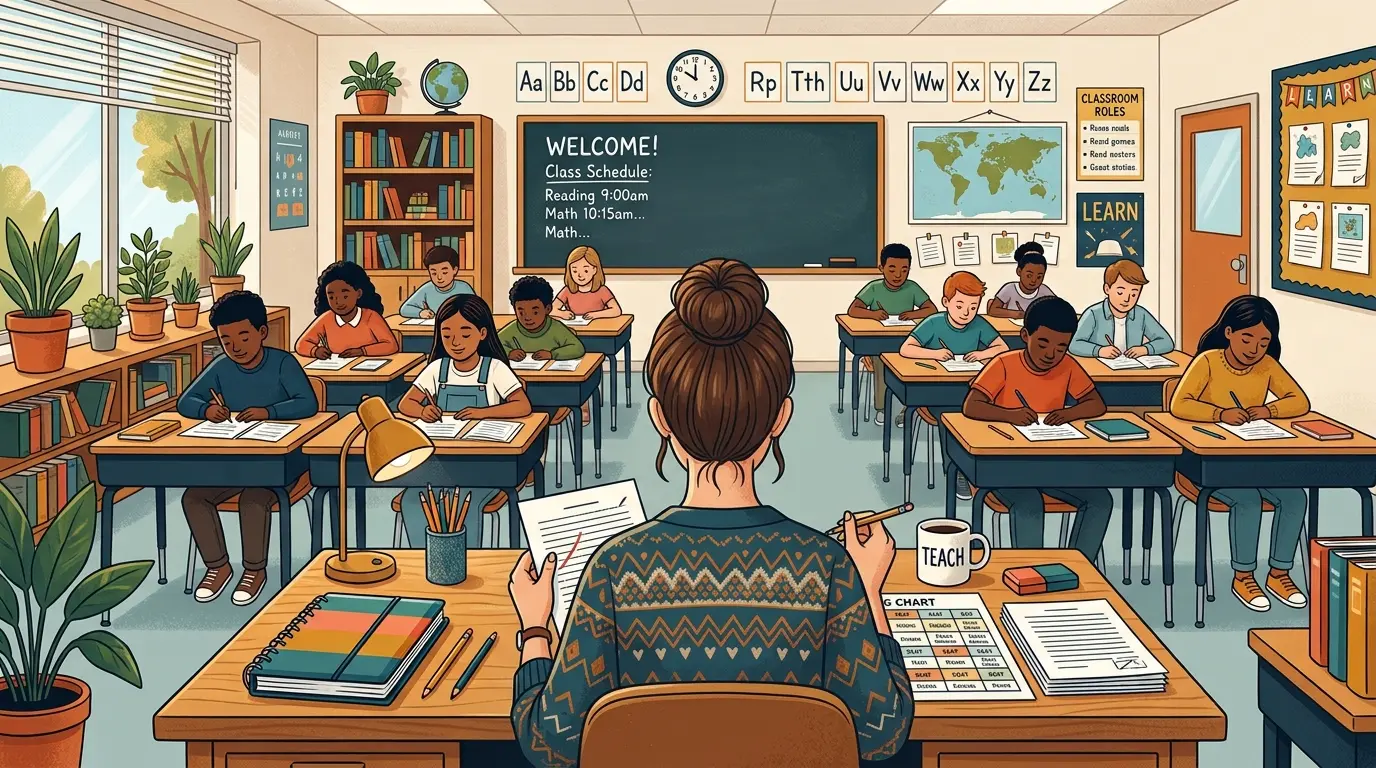
Picture the moment a substitute walks into your classroom. Twenty-five kids, twenty-five names they've never heard, and a lesson plan that assumes they already know who tends to drift off task and who needs to sit up front to hear anything at all. Almost everything that makes your classroom run well this year lives in your head. None of it transfers automatically to whoever is standing at your desk on the day you're out.
A seating chart is one of the few documents that actually does transfer a piece of it. It won't replace you, and no printed page substitutes for a teacher who knows her kids. But research on classroom management keeps pointing at the same idea from a few different directions: a lot of what makes a room run smoothly isn't charm or a clever lesson, it's structural. It's who sits where, whether the adult at the front can identify a student by name in the first minute, and whether the room's default setting is order or improvisation. A substitute starts the day with almost none of that structure already built. A well-made seating chart hands them a working copy of it.
The Substitute Gap Isn't Really About Skill
It's tempting to chalk up a rough day with a substitute to the substitute. Sometimes that's fair. But research on teacher absence points somewhere less personal. Mariesa Herrmann and Jonah Rockoff studied nearly a decade of attendance and test-score records from New York City public schools and found that when a regular teacher is out for even a single day, almost no instructional progress gets made, even with a paid substitute standing in front of the class. Long-term substitutes who stay with the same group for weeks tend to do noticeably better, largely because they eventually build up the same classroom-specific knowledge a regular teacher already carries. A one-day substitute never gets that chance.
That's the real gap: not competence, but information. The regular teacher knows who these particular kids are, how they tend to behave, and what the room actually looks like once the door closes. The substitute doesn't. A seating chart is one of the fastest ways to hand over a real slice of that information without writing pages of notes.
The takeaway: A hard day with a substitute usually isn't a sign they're bad at the job. It's a sign of how much classroom-specific knowledge normally lives only in your head.
The Skill Every Regular Teacher Builds Without Noticing
In 1970, psychologist Jacob Kounin spent a school year recording first- and second-grade classrooms and coding, moment by moment, what separated the rooms that ran smoothly from the ones that didn't. His biggest finding wasn't about how teachers punished misbehavior. It was about whether they caught it early. Kounin called this withitness: a teacher's ability to know what's happening in every part of the room at once, and to make that awareness visible before a small problem turns into a bigger one.1Kounin's study filmed 49 first- and second-grade classrooms for a full day each and coded student engagement in short intervals throughout. Withitness turned out to correlate with lower rates of misbehavior more strongly than almost any other teacher behavior he measured, including how a teacher responded once misbehavior had already started. A partial replication in the 1980s found weaker effects for some of his other measures, a reminder that not every finding from a single classic study holds up perfectly in every context, but the core idea of a teacher's moment-to-moment awareness of the room has stayed influential ever since.
Withitness isn't a personality trait, and it isn't something a teacher either has or doesn't. It's built through repetition. A teacher who has spent months with the same group of kids carries an intuitive map of the room: who whispers to whom, who needs a hand raised before they'll actually start talking, who's genuinely stuck versus who's stalling. That map doesn't exist yet for a substitute on day one, no matter how many years they've spent teaching somewhere else.
A Substitute's Eyes Don't Know This Room Yet
A newer line of research gets even more specific about what's actually missing. Some researchers have used eye-tracking equipment to record exactly where teachers look while managing a room, then compared the patterns of experienced teachers against novices. Niek van den Bogert and colleagues found that experienced teachers scan the whole classroom and pick out relevant behavior quickly, while novices fixate narrowly and often miss events completely, not from a lack of effort, but because they haven't yet learned what to look for.2These eye-tracking studies compared teachers with years of classroom experience to student teachers and pre-service teachers, not specifically to substitutes working in an unfamiliar room. No published study has eye-tracked substitutes directly, so the comparison here is an inference. Since the gap between novice and expert gaze patterns comes from experience with classroom management generally and with a specific group of students in particular, a teacher facing a class they've never met is missing at least the second kind of experience, whatever their overall skill level. Charlotte Wolff and colleagues found the same divide when teachers watched recorded classroom footage and flagged potential problems: the experienced group noticed more, and noticed it faster.
Here's what matters for a substitute: that gap has less to do with years of experience overall and more to do with familiarity with this specific room and these specific kids. A veteran teacher dropped into someone else's classroom for a day is, for that day, working with something close to a novice's gaze, because the pattern recognition an experienced teacher relies on took months to build with one particular group. A seating chart with names attached to seats hands a substitute a shortcut past part of that gap. Instead of scanning a room of strangers trying to work out who's who, they can glance down, find a name, and call on a student directly, which is one of the simplest ways to project the kind of awareness Kounin's research says keeps a room settled.
There's a related pattern worth knowing about here, usually called the action zone. Ray Adams and Bruce Biddle filmed dozens of classrooms and found that teacher attention concentrates heavily on the front row and center seats, largely without the teacher realizing it's happening.3The action zone was first documented using video analysis of real classroom instruction and has been replicated in many later studies. It seems to be driven partly by where teachers naturally stand and face, and partly by which students put themselves in easy-to-reach seats in the first place. The effect shows up across teachers of varying experience levels, which suggests it isn't something that automatically corrects itself with time in front of a class. A substitute without a name-and-seat reference is even more likely to fall into that pattern, because the students in the action zone are simply the easiest ones to identify and talk to on sight. A labeled chart makes it just as easy to call on the student in the back corner as the one three feet away, which spreads attention more evenly across a room the substitute has never seen before.
A substitute doesn't need your instincts. They need a fast way to borrow them for one day.
Free Seating Turns a Substitute's Day Into an Experiment Nobody Should Want to Run
Substitutes sometimes default to something like "sit wherever you'd like today," usually to sidestep the awkwardness of guessing at a seating arrangement they don't have. It's an understandable instinct, and it's close to the worst option on the table. David Bicard and colleagues studied fifth graders under both teacher-assigned and student-selected seating, during independent work and group work alike. Disruptive behavior during independent seatwork was more than three times higher when students picked their own seats compared to when the teacher assigned them.4The study used a within-subject design: the same fifth graders were observed under both seating conditions, in both individual and group setups, which helps rule out the possibility that the effect was really about which specific students happened to land in each condition. Disruptive behavior was measured through direct classroom observation, not teacher report, which reduces the chance the results simply reflect a teacher's expectations rather than actual student behavior. During group work, the gap was smaller, but disruptive behavior still doubled.
A substitute who invites students to sit wherever they like is, without realizing it, recreating the exact condition that study found worst for behavior, on a day when the adult in the room has the least ability to read what's going wrong and step in early. A chart made in advance removes that decision from the table completely. Students walk in, find their seat, and the day starts without an improvised negotiation over who sits next to whom.
The takeaway: An assigned seat is one less thing left to improvise, and improvisation is exactly what a substitute has the least room for.
What Belongs on a Chart Built for Someone Who's Never Met These Kids
A chart you glance at every day and a chart meant to run the room without you aren't quite the same document. A few things separate a version that actually holds up.
Use the names students actually go by. If a student goes by a nickname or a shortened version of their first name, that's what belongs on the chart, not the name from the official roster. A substitute reading out a legal name a student doesn't recognize wastes the exact advantage a chart is supposed to give.
Match the layout to the real room. If the desks moved last week and the chart didn't, you've handed the substitute a map of a room that no longer exists. It takes a minute to check before you're out, and it's a minute worth spending.
Flag what a substitute needs to know without oversharing. That might mean noting that two students shouldn't sit near each other, or that a student needs to stay close to the door for a health plan. It doesn't mean writing out a student's full history on a page that other adults, and sometimes other students, might glance at over someone's shoulder.
Keep it somewhere obvious. A chart buried in a folder nobody can find on the morning you're out helps no one. It belongs in a sub binder, a folder by the door, or wherever your school expects emergency plans to live.
Where Inclusive Seating Fits Into This
This is exactly the gap Inclusive Seating is built to close, using the same information you're already keeping current for your own use. Any chart you build in the classroom grid can be printed with student names clearly labeled on each seat, in a layout that matches your actual room, ready to drop into a sub folder or hand to the front desk on your way out the door.
Because student-level restrictions, things like who shouldn't sit near whom, or who needs to stay close to your desk or the exit, live with the student rather than with any single layout, the printed chart a substitute receives already reflects those decisions. You don't have to write out a second set of notes explaining who can't sit together. It's already built into the chart sitting on your desk.
If the room gets rearranged the week before you're out, updating the printed version takes the same few seconds it always does. Open the classroom grid, drag the desks to match, and print a fresh copy. A substitute working from a chart that matches the room in front of them, with real names attached to real seats, starts the day with something it would otherwise take you months to hand over.
