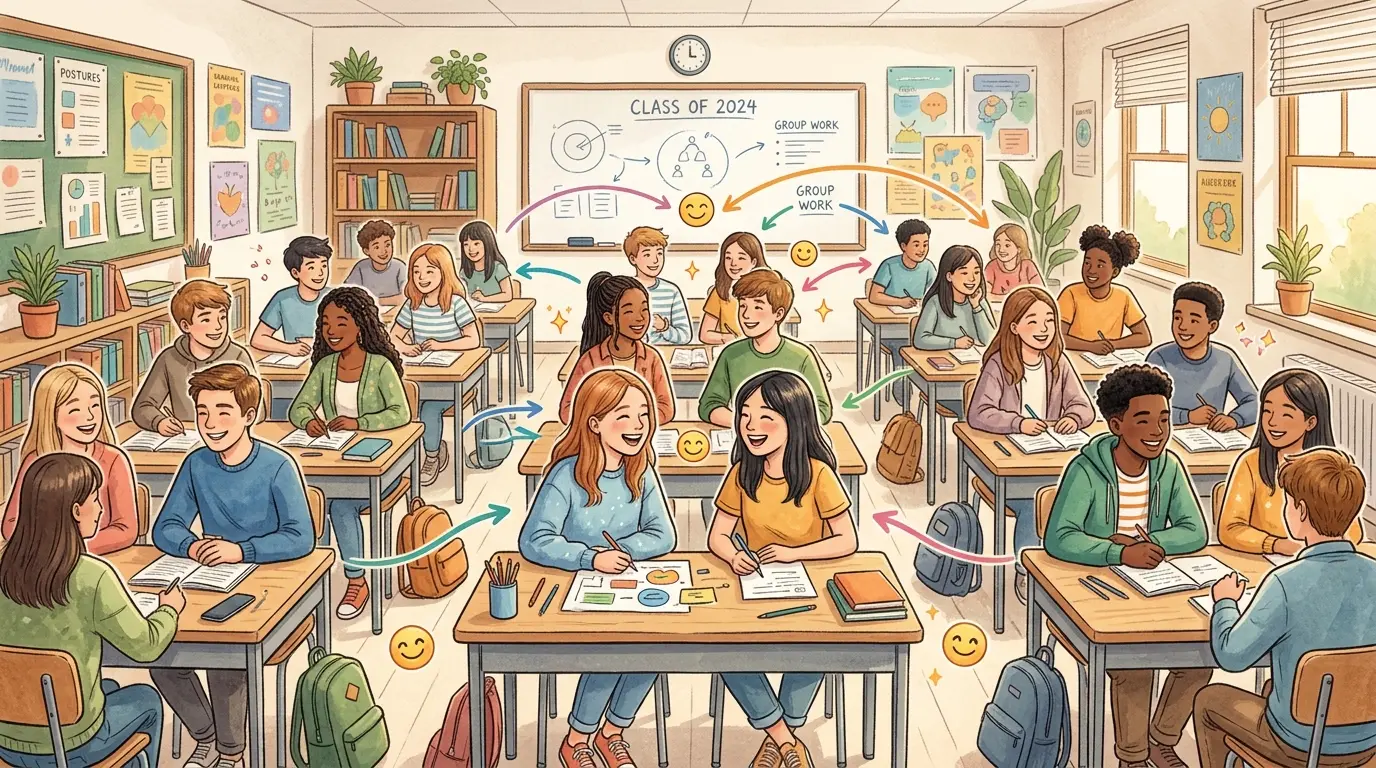
About one in ten elementary school kids says they feel lonely at school on a regular basis, according to a 2023 study in the Journal of School Psychology.1The study surveyed 998 third through fifth grade students across 38 classrooms and measured loneliness through a self-report questionnaire designed to avoid overlapping with the social provisions items, so students weren't simply describing the same feeling twice under two different labels. Yust, P. K. S., Weeks, M. S., Williams, G. A., & Asher, S. R. (2023). Social relationship provisions and loneliness in school: Child- and classroom-level effects. Journal of School Psychology, 99, 101218. https://doi.org/10.1016/j.jsp.2023.05.001. That's two or three kids in every class of twenty five, sitting through the same lessons as everyone else while quietly feeling like they don't belong. Most of what actually moves that number has nothing to do with a formal friendship program or a counselor's schedule. It comes down to something a lot simpler, and a lot more overlooked: who a kid happens to sit next to.
A large randomized study published in 2021 put a real number on how much that matters. Assign two students to sit together for a semester, with no other intervention at all, and their odds of becoming actual friends rise by about fifty percent. Not fifty percent more likely to get along in some vague sense. Fifty percent more likely to name each other as a friend by the end of the term, compared to two students who never got seated near each other in the first place. That's a big enough number that it's worth being specific about where it comes from, why other researchers have landed on the same basic pattern, and what it should change about how you build a seating chart this year.
Where the 50 Percent Number Comes From
The 2021 study is the work of Julia Rohrer, Tamas Keller, and Felix Elwert, and it's one of the largest and cleanest experiments ever run on classroom friendship. The team worked with 182 classrooms across 40 schools in Hungary, covering grades 3 through 8 and nearly 3,000 students total, and used a random number generator, not a teacher's judgment, to assign every student a deskmate at the start of the semester. Five months later, students named their friends, and the researchers checked how many of those nominations were mutual.
Students who happened to be randomly seated together were far more likely to name each other as friends than students who weren't. About 15 percent of pairs who hadn't been deskmates ended up as mutual friends, compared to about 22 percent of pairs who had.2Rohrer, Keller, and Elwert measured this as the rate of mutual friendship nominations, meaning both students named each other as a friend on an end-of-semester survey, not one-sided nominations. The raw numbers were about 15 percent for non-deskmates and about 22 percent for randomly assigned deskmates, a difference of 7 percentage points. Divide that 7-point gain by the 15 percent starting point and you get an increase of roughly 47 percent, which is close enough to half that it's commonly rounded to 50 percent in summaries of this study, including this one. Rohrer, J. M., Keller, T., & Elwert, F. (2021). Proximity can induce diverse friendships: A large randomized classroom experiment. PLOS ONE, 16(8), e0255097. https://doi.org/10.1371/journal.pone.0255097. Do the math on that gap and you get an increase of roughly 50 percent over the baseline rate, purely from where two kids happened to sit. No friendship-building activities, no group projects designed to spark connection, no teacher intervention beyond simply following the seating chart they'd been handed.
That finding didn't come out of nowhere. A year earlier, Sharon Faur and Brett Laursen tracked 235 elementary students across two points in a school year and found the same underlying pattern without the benefit of random assignment: when a teacher moved a student to a new seat, that student was more likely to become friends with the classmates now seated nearby than with the ones who'd been sitting near them all along.3Faur and Laursen followed 235 students in grades 3 through 5 at a single elementary school across two points in the school year, about thirteen to fourteen weeks apart. Because seats weren't randomly assigned in this study, it can't rule out every alternative explanation the way a true experiment can, but it adds real-world, longitudinal evidence from actual elementary classrooms to a finding that was first established under more tightly controlled conditions. Faur, S., & Laursen, B. (2022). Classroom seat proximity predicts friendship formation. Frontiers in Psychology, 13, 796002. https://doi.org/10.3389/fpsyg.2022.796002. Two research teams, two countries, two different methods, and the same conclusion: seat placement doesn't just reflect who's already friends. It actively creates new ones.
We've written a full breakdown of the Rohrer study elsewhere on this blog, including a closer look at the psychology behind why proximity works this way in the first place and what the study found about crossing gender, achievement, and cultural lines. What matters here is simpler: the effect is real, it's been replicated by more than one research team, and it's large enough to change how you think about the chart you're about to build.
The takeaway: assigning seats isn't just a way to keep a room quiet. On its own, with nothing else added, it measurably increases how many new friendships form in your class.
Why Classroom Seating Carries So Much Weight at This Age
Younger kids don't have many other ways to make friends. A teenager can meet people through clubs, sports, a part-time job, or a phone full of group chats. An eight-year-old mostly just has the kids down the hall. That's a big part of why classroom seating has an outsized influence at the elementary level, an influence that fades as kids get older and gain more independent ways to build a social life.
The stakes here are real, not just sentimental. The same 2023 loneliness study found that kids who received more everyday social provisions from classmates, help with a task, an invitation to play, someone who listened when they wanted to talk, reported feeling less lonely at school. That held true not only for kids' own individual friendships, but for how "provision-rich" the whole classroom culture was: in classrooms where more of those small exchanges happened between more pairs of kids, loneliness dropped across the board, not just for the kids who already had friends. Assigned seating is one of the most direct levers a teacher has for increasing the number of those everyday exchanges, since it puts two kids in each other's path all day without asking either one to be the brave one who walks across the room first.
New Friendships That Cross Lines Kids Wouldn't Cross on Their Own
Left on their own, kids tend to sit with whoever they already know, which means free seating quietly reinforces the friend groups that already exist by the time most classes settle in for the year. The Rohrer study found something more interesting once seat choice was taken out of students' hands entirely: proximity pushed kids toward friendships that crossed gender and achievement lines, not just friendships between kids who were already alike. Pairing a stronger student with one who was struggling raised their odds of becoming friends from 11 percent to 17 percent. Pairing a boy and a girl roughly doubled the odds of them naming each other as a friend, though that starting number was much smaller to begin with.
That matters for reasons beyond simple headcount. A class where friendships only run within tight, familiar clusters is a class where a handful of kids quietly hold all the social capital, and everyone else navigates around them. A seating chart is one of the only tools a teacher has that puts two kids who wouldn't otherwise interact within actual arm's reach of each other, every day, for months at a time. We go into much more depth on this specific angle, including where the effect was strongest and where the research came up short, in our post on seating and cross-cultural friendship.
The Catch: Assigned Seating Isn't a Blank Check
None of this means every seating decision helps, or that forcing kids together always works in a straight line. A 2020 study led by Summer Braun tested what happens when teachers deliberately move two students who already dislike each other closer together, based on earlier research suggesting proximity could smooth over that specific kind of conflict. Across 59 fifth grade classrooms in the Netherlands, the opposite happened: students in the intervention classrooms showed more overt aggression and reported less cooperation with classmates than students in classrooms where seating was left alone, and the effect wasn't limited to the two students who'd been moved. It spread to the rest of the class.4"Target" students in this study were pairs who had already indicated they disliked each other before the intervention began; "nontarget" students were their classmates, who weren't moved but were still affected by the change in classroom climate. Data came from 1,573 students across 59 grade 5 classrooms in the Netherlands. Braun, S. S., van den Berg, Y. H. M., & Cillessen, A. H. N. (2020). Effects of a seating chart intervention for target and nontarget students. Journal of Experimental Child Psychology, 191, 104742. https://doi.org/10.1016/j.jecp.2019.104742.
The lesson isn't that seating changes backfire. It's that they backfire specifically when you force together two kids who have already decided they don't like each other, hoping proximity alone will fix what's already broken. That's a fundamentally different move than seating two kids who simply haven't had a reason to interact yet, which is what the Rohrer study tested and what most seating decisions actually involve.
There's a second wrinkle worth knowing about, and it comes from a 2024 study that looked at older students. Alessandra Portinari Maranca tracked 410 students across 24 American high school classrooms and found that when students chose their own seats, the friendships that formed were less segregated by race than when teachers assigned the seats instead.5This study used social network analysis on 410 students across 24 American high school classrooms, comparing friendship formation in classrooms with student-chosen seating against classrooms with teacher-assigned seating over a semester. High schoolers bring years of established peer relationships and far more social independence into a classroom than elementary students do, which limits how directly this finding transfers to a self-contained elementary room. Portinari Maranca, A. R. (2024). The role of classroom seating arrangements in friendship formation and persistence. Connections, 44(1), 204–221. https://doi.org/10.21307/connections-2019.043. That's a genuine finding and it deserves to be taken seriously rather than waved away. But high schoolers aren't third graders. They arrive with years of established friend groups, more social sophistication, and a lot more say over their own social lives than a nine-year-old has. What plays out over one semester in a rotating high school schedule doesn't automatically transfer to a self-contained elementary classroom where a teacher has been making these calls since September. The honest reading of both studies together is that assigned seating is a genuinely strong tool at the elementary level specifically, and that it stops being a neutral default once students are old enough to navigate their own social lives without much adult help. For a wider look at how the free-seating-versus-assigned-seating debate plays out across the research, see our post on that exact question.
The takeaway: assigning seats works best when you're introducing kids who don't yet have a reason to dislike each other, not when you're trying to force a truce between two who already do. Know which situation you're actually in before you move anyone.
What This Means for Your Class
Put together, the research points toward a handful of concrete moves, none of which require a program or extra time carved out of your week.
Change seats more than once a year. The friendship effect in the Rohrer study came from a single semester of one new arrangement, and the Faur and Laursen study found that new friendships kept forming each time seats changed, not just at the start of the year. A chart that gets built once in September and left alone until June only gives each student a single shot at a new neighbor. We've written before about the difference between a genuine reshuffle and just shifting the whole room over by one seat, and that distinction matters more here than it might seem to at first.
Use seating on purpose to introduce kids who wouldn't otherwise cross paths. If a student is new, quiet, or seems to sit on the outside of the class's social scene, placing them next to a couple of warm, welcoming classmates costs you nothing and gives that friendship an actual chance to take root. The same logic applies to mixing kids across achievement levels or existing friend groups now and then, rather than always sorting by who already gets along.
Skip the pairings you already know are a problem. If two students have an established conflict, seating them side by side isn't the same move as seating two strangers together, and the Braun study is a clear warning against treating it as if it were. Save your intentional pairings for kids who simply haven't had the chance to get to know each other yet.
A seating chart isn't just a tool for keeping a room quiet. Handled with a little intention, it's one of the more reliable ways a teacher can hand a lonely kid a friend.
This is exactly the kind of thing a seating chart tool should make easier, not harder. In Inclusive Seating, you can set a restriction to keep two students apart permanently, and a separate one to nudge a particular student toward sitting near someone supportive, and both stay in place no matter how many times you click Randomize over the course of the year. Our complete guide to using Inclusive Seating walks through exactly how those restrictions work. The research says this lever is worth pulling more than once a year. The tool just makes pulling it take a few minutes instead of a full redesign.
None of this asks for a curriculum or a block of time you don't have. It asks for one more question before you finalize the chart you were probably going to make anyway: who hasn't had the chance to sit near this student yet? For a fair number of kids in your class, that turns out to be the whole difference.
