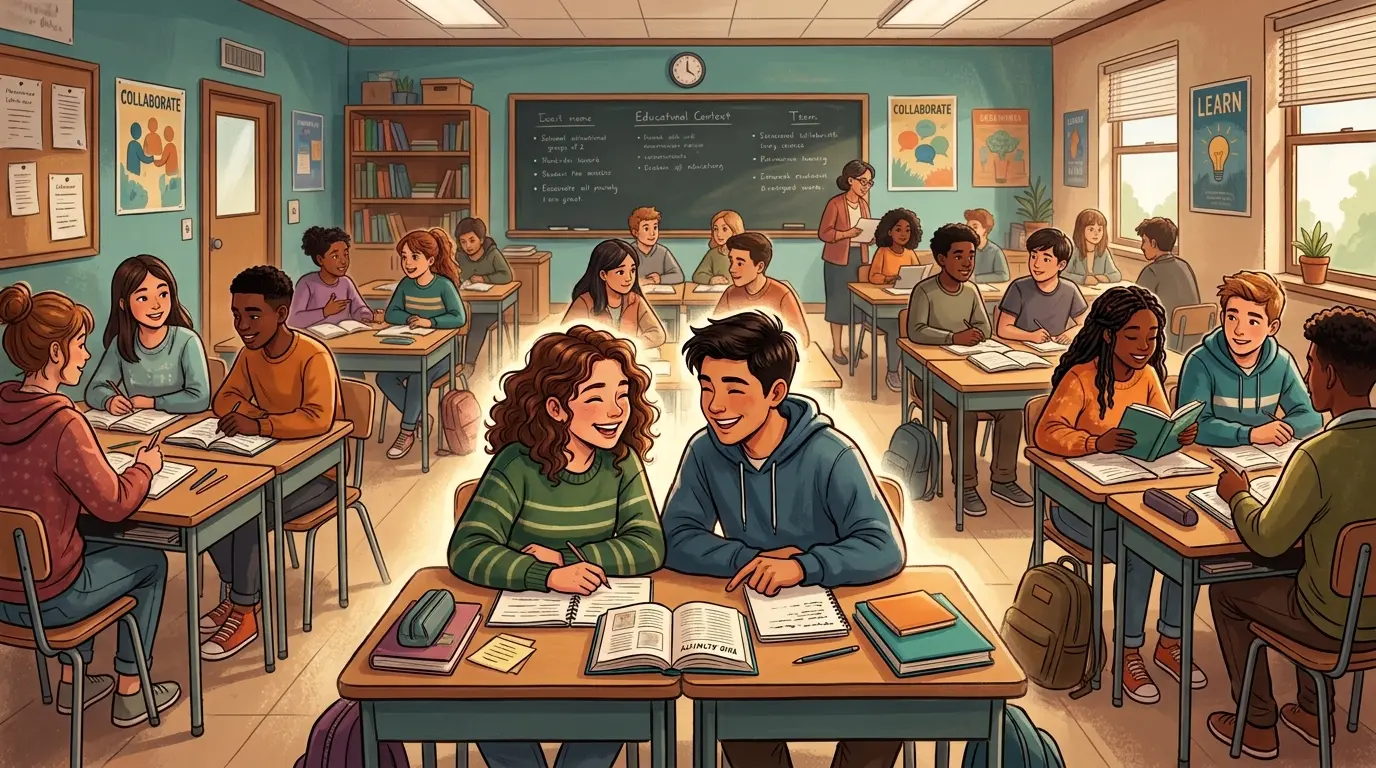
Ask a teacher which two kids in her class are best friends, and there's a decent chance she can also tell you exactly where they sit. That's not a coincidence. It isn't only because friends ask to sit together, either, though that happens plenty. The research runs the other direction too: put two kids who barely know each other in neighboring seats, and there's a real chance they'll end up friends because of it.
For a long time that idea lived mostly as classroom folklore, the sort of thing a veteran teacher will tell you with total confidence and nothing to point to. That's changed. A run of studies published over the last few years, including one from 2024, have turned "just seat them near each other and see what happens" into something closer to a measurable, repeatable pattern. Here's what the research actually found, and what it means the next time you're staring at a blank seating chart wondering who goes where.
The Idea Is Older Than Your Classroom
The formal name for this is the propinquity effect: the tendency to like, and eventually befriend, whoever we happen to be near on a regular basis, regardless of how much we actually have in common with them.1The propinquity effect is a term researchers use for the tendency to like, and eventually befriend, whoever we happen to be near on a regular basis, independent of shared interests or personality. It was first documented systematically in a 1950 study of a postwar housing complex for married graduate students. The finding has been replicated across dozens of settings since, from dormitories to office buildings to classrooms, and it remains one of the more durable findings in social psychology. The idea traces back to a 1950 study of a graduate student housing complex at MIT, of all places. Researchers Leon Festinger, Stanley Schachter, and Kurt Back mapped out who was friends with whom among the residents and found that physical layout predicted friendship better than shared interests, similar backgrounds, or anything else they measured. Residents who lived near the mailboxes or at the bottom of a stairwell, the spots everyone had to pass, ended up with more friends than residents tucked away at the end of a hallway. It wasn't about who those people were. It was about who they kept running into.
That mechanism doesn't stay confined to postwar apartment buildings. It shows up anywhere people get placed near each other repeatedly and without much say in the matter, which describes an elementary school classroom about as well as anything does.
What Happens When You Randomly Assign Seats
The cleanest way to test whether proximity actually causes friendship, rather than just showing up alongside it, is to assign seats completely at random and see what happens later. That's exactly what Mitja Back, Stefan Schmukle, and Boris Egloff did in a 2008 study of German university students.2This particular study was conducted with 54 German psychology students, not elementary schoolers, and with a single class of freshmen rather than a large or diverse sample. Random assignment lets researchers rule out competing explanations, which is genuinely valuable, but a small, one-classroom sample of college students doesn't guarantee the same size of effect in a room full of eight-year-olds, who have far fewer alternative friend options and spend nearly all day with the same small group of classmates. On the first day of an introductory psychology course, 54 students walked in and were handed a random seat number. A year later, the researchers asked everyone to rate how close they felt to each of their classmates.
Students who'd been randomly seated near each other on that first day were significantly more likely to be close friends twelve months later, even after the researchers accounted for how similar their personalities were. That last part matters. It rules out the obvious alternative explanation, that similar people simply end up near each other on their own. These seats were handed out by chance, not chosen. A single seating chart, used for one class period, was still shaping who these students were close with a year later.
The Clearest Evidence Yet, and It Comes From Elementary Classrooms
College freshmen make a useful test case, but they aren't a classroom teacher's actual concern. The most relevant study on this topic came out in 2022, and it looked specifically at children in grades 3 through 5.
Psychologists Sharon Faur and Brett Laursen followed 235 students, ages 8 to 11, across a semester at a public elementary school in Florida. Twice, about fourteen weeks apart, students named their friends, and teachers reported exactly how the classroom was arranged at the time. The results were striking. Kids seated next to or near a classmate were three to five times more likely to name that classmate as a friend than kids seated elsewhere in the room. When the researchers narrowed in on reciprocated friendships, meaning both kids named each other back rather than just one child naming the other,3Researchers studying childhood friendship usually distinguish between an outgoing friend nomination, meaning a child names a classmate as a friend, and a reciprocated friendship, meaning both children name each other. One-sided nominations are common and don't always reflect an actual close relationship, so reciprocated friendships are generally treated as the stronger, more meaningful measure of the two. the effect was even larger: near-seated kids were twelve to eighteen times more likely to be mutual friends.
The longitudinal part of the study is the piece that should really change how you think about your seating chart. When teachers rearranged the room partway through the semester, kids who became newly near-seated were eight to ten times more likely to name each other as a brand-new friend by the end of the study, and 32 to 46 times more likely to become a new, mutual reciprocated friend pair, compared to kids who stayed far apart the whole time. Keep in mind, these were classrooms of about fifteen students. By that point in the year, everyone already knew everyone. New friendships still clustered heavily around whoever had just become a neighbor.
Familiarity alone wasn't enough to produce these friendships. Nearly all of these kids were already familiar with each other by midyear. What predicted a brand-new friendship was a change in who sat next to whom.
Faur and Laursen make a point of noting how much influence this hands to teachers, often without a teacher ever realizing it: the simple act of deciding who sits where turns out to be one of the more powerful levers a teacher has over a child's social life at school.
Proximity Can Undo Dislike, Not Just Build Liking
If proximity can manufacture new friendships out of nothing, a natural next question is whether it can also repair a relationship that's already gone sour. Yvonne van den Berg and Antonius Cillessen looked at this from one angle in 2015, tracking classmates' seat positions against how much they rated each other, and found that kids seated closer together gave each other higher likability ratings than kids seated farther apart.
A more ambitious study, published in 2012 by van den Berg along with Eliane Segers and Cillessen, put the idea to a direct test. The researchers identified pairs of ten- to twelve-year-old classmates who actively disliked one another, then deliberately moved those pairs physically closer together for several weeks. It worked. The children who had started out most disliked by their peers saw real gains in how much their classmates liked them by the end of the study, along with drops in how often they were flagged as victimized or socially withdrawn.
That's a genuinely useful finding for any classroom with a student who's struggling socially. It suggests that distance itself, not just personality or a bad history between two kids, can be part of what's keeping them apart, and that closing that distance on purpose can move the needle.
Where the Research Gets Complicated
Here's where it would be dishonest to stop, because not every study in this line of research tells a tidy success story.
A follow-up by Summer Braun, van den Berg, and Cillessen in 2020 tried a shorter version of that same dislike-reducing intervention across 59 fifth-grade classrooms in the Netherlands, more than 1,500 students in total. It didn't replicate the earlier success. Classrooms that received the seating intervention actually showed more peer-reported aggression and less perceived cooperation than the control classrooms. The researchers' best guess is that closing physical distance between two kids who dislike each other creates friction before it resolves anything, and a short intervention may catch a classroom in that friction phase rather than the resolution phase the longer 2012 study captured.
Then there's a 2024 study by Nathalie Hoekstra and colleagues, published in the journal Aggressive Behavior, that tested the two instincts most teachers reach for the moment they learn a student is being bullied: seat the victim far away from whoever is bullying them, and seat the victim next to their best friend. It's hard to imagine a more sensible plan. The researchers ran it as an actual randomized trial in real classrooms, confirmed the seating changes worked exactly as intended, and then measured whether victims' sense of safety and wellbeing actually improved. It didn't move.
That result deserves a beat of explanation rather than a shrug. A well-run trial that finds no effect isn't a study that failed. It means the seating change happened exactly as designed, and the outcome the researchers cared most about still didn't budge within the timeframe of the study. Bullying is sustained by group norms and power, not just physical distance, and a single desk move wasn't enough to interrupt that on its own.
Put the two kinds of findings side by side and a pattern emerges. Proximity is a strong, almost quiet force when it's left to work on ordinary, everyday relationships, the kind that form (or don't) as a byproduct of who happens to be assigned next to whom. It's a far less reliable tool when a teacher aims it directly at an existing crisis and expects it to do the whole job by itself.
What This Means for Your Seating Chart
Every seat you assign is doing more than organizing bodies in a room. It's quietly nudging who becomes friends with whom, particularly early in the year and particularly for the kids who don't already have an established friend group to fall back on. A new student, a shy kid, a child who just transferred in from another class: these are exactly the students for whom seat proximity carries the most weight, because they haven't yet built the informal social map that makes seating less consequential for a kid who already has a best friend three rows over.
That reframes the fairness question a little. It's not only "does this seat make sense for behavior and academics." It's also "who is this seat quietly introducing this child to." That second question is worth asking on purpose, especially for the kids sitting on the edges of the social map.
The takeaway: use proximity on purpose to widen a struggling or isolated student's pool of potential friends. Don't rely on it alone to resolve an active conflict or a bullying situation. Those need more than a few feet of distance.
Putting This Into Practice With Inclusive Seating
This is where a seating chart tool can earn its keep for something beyond logistics.
The classroom grid in Inclusive Seating lets you set notes and restrictions for individual students, and one of the most useful is a positive pairing: seat this student near a specific, supportive classmate. Teachers usually reach for this to support an accommodation or a behavior plan, and that's a great use of it. The friendship research above points to another one. If you have a new student, a child who seems friendless, or a kid who's quietly been on the outside of the social scene, that same tool lets you deliberately place them near a couple of warm, welcoming classmates instead of leaving it to chance.
When you click Randomize, the algorithm still respects every one of those pairings and restrictions, no matter which layout is active. That means you can keep the social intent behind a seating decision even while you're rotating through rows for a test, groups for a project, or a circle for morning meeting.
And because the research above found that a change in seating, not proximity that stays fixed all year, is what actually predicted new friendships, that's also a case for rearranging seats more than once a term rather than settling on one chart in September and leaving it in place until June. Every rearrangement is another chance for a quiet kid to end up next to someone new.
