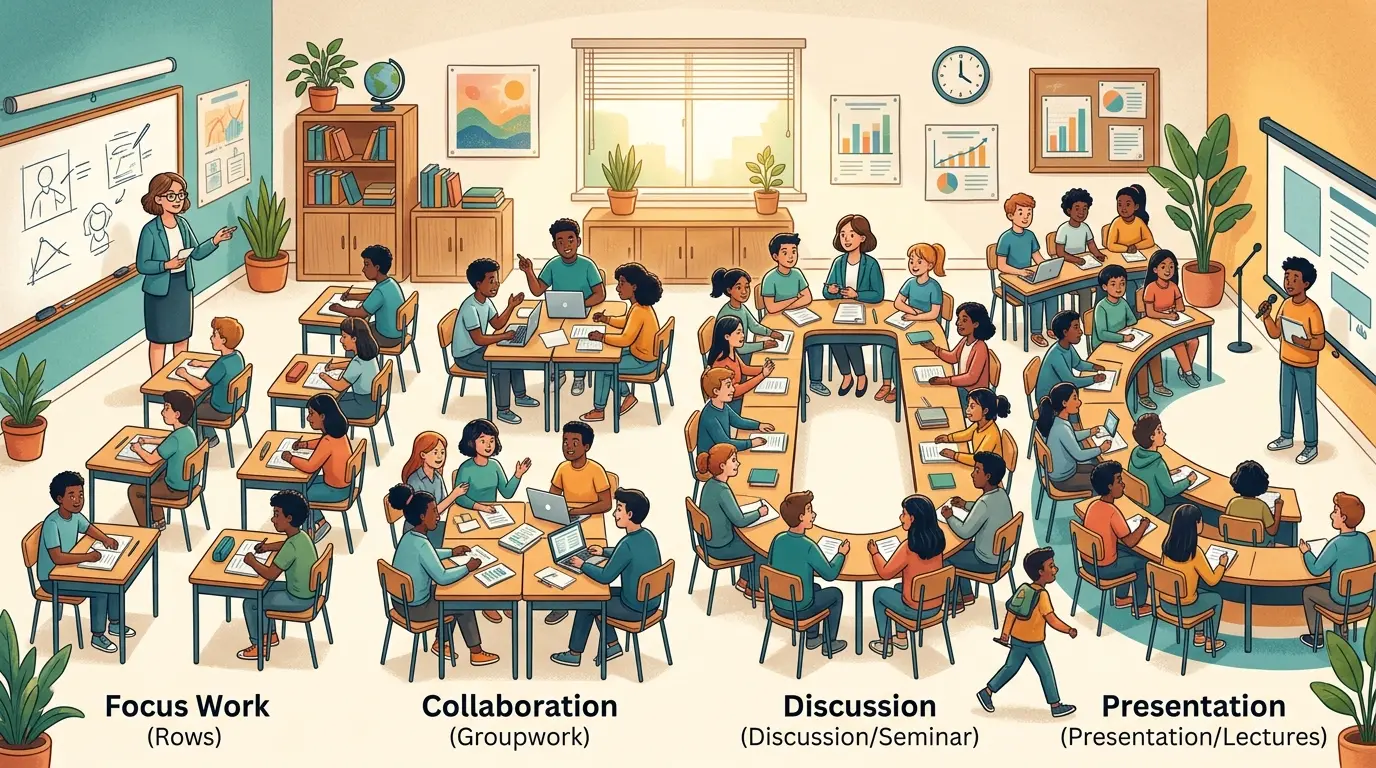
Most classrooms have one seating arrangement. It goes up in August and stays up until June, whether the students are taking a spelling test, building a diorama, or debating whether the class hamster deserves a bigger cage. That arrangement was probably picked for a reasonable reason: it fits the room, it's what the last teacher used, or it just felt right at the time. But when you look at the actual research on classroom seating, it keeps landing on the same conclusion, and that conclusion has almost nothing to do with which single layout is "best."
It has to do with matching the layout to whatever your students are doing right now.
This post walks through what the evidence actually says students need during independent work, discussion, and hands-on group projects, where a rotating layout is genuinely worth the hassle, and where the research is thinner than seating charts on Pinterest would have you believe.
Let the Task Decide, Not the Room
The clearest, most replicated finding in this entire body of research comes from a study that's now three decades old but has never really been overturned. Neil Hastings and Jim Schweiso spent time in two British primary classrooms full of nine- and ten-year-olds, moving the same students back and forth between rows and table groups while they worked through identical individual assignments.1In this research, "on-task behavior" means whether a student is visibly engaged with an assignment: eyes on the page, pencil moving, or actively listening, as recorded by an observer at set time intervals. It's a proxy for focus rather than a direct measure of learning, so these studies tell us the most about behavior and attention and somewhat less about test scores or deeper understanding. That's a real limit worth keeping in mind, but sustained attention is still one of the better predictors we have of whether a lesson is landing. The results weren't subtle. Average time on-task was 77 percent in rows and 62 percent in groups, a fifteen-point gap driven mostly by the students who struggled hardest to stay focused in the first place.
That's one study, but it isn't an outlier. Rebecca Wannarka and Kathy Ruhl's widely cited 2008 review pulled together the available research on rows, groups, and semicircles and reached the same conclusion from a wider angle: students behave better during individual tasks when they're seated in rows, and the benefit is largest for students already prone to distraction. Their advice, in their own words, was that teachers should let the nature of the task dictate the seating arrangement.
Read that sentence again, because it's doing more work than it looks like. It isn't saying rows are good and groups are bad. It's saying the question worth asking isn't which arrangement wins overall. It's which arrangement wins for what your students are about to do.
Independent Work and Tests: Rows Still Win
If your students are taking a test, working through a worksheet, or doing any kind of independent practice, the research points in one clear direction: seat them in rows or single desks, at least for that stretch of the day.
Nigel Bennett and Denis Blundell found this back in 1983, comparing groups of ten- and eleven-year-olds doing reading, language, and math work in both rows and table groups. When the students moved into rows, they completed more work. The quality of that work didn't change, which matters: this isn't a study showing groups make kids sloppy. It's a study showing rows help kids get through more of what's in front of them without the quality dropping.
A more recent study adds a layer researchers hadn't looked at closely before. Valentina Tobia and her colleagues tested Italian primary schoolers on logical reasoning, creativity, and theory of mind while seated at single desks and at clustered tables. Logical reasoning scores came out higher across the board at single desks. The effect wasn't uniform, though: girls scored better on theory-of-mind tasks at single desks than boys did, and children who described themselves as lonelier at school did noticeably better on theory-of-mind and creativity tasks when seated alone. The point isn't that some kids need to be isolated. It's that the right arrangement depends on the child in front of you almost as much as the task in front of them, a nuance no single seating chart can fully capture on its own.
The takeaway: for anything that asks a student to work through material on their own, rows or single desks give students their best shot at staying focused, especially the ones who find groups hardest to work in.
Discussion and Morning Meeting: Bring Out the Circle
Flip to the other end of the day, when the goal is getting kids talking rather than getting them to sit still, and the research flips too.
Alexandra Marx and colleagues ran fourth-graders through more than fifty lessons over eight weeks, rotating the same class between a semicircle and traditional rows and columns. The children asked more questions in the semicircle. Being able to see the whole group, instead of the backs of a dozen heads, seems to lower the social cost of raising a hand.
Rows come with a well-documented catch during discussion-based lessons: the "action zone."2The action zone is a well-documented pattern in classroom research: students seated in the front row and the center column of a traditional row arrangement get called on more often, ask more questions, and interact with the teacher more, largely because of where they happen to be sitting rather than what they know. Ray Adams and Bruce Biddle first documented the pattern in 1970, and classroom observation studies have turned up the same effect many times since. Adams, R. S., & Biddle, B. J. (1970). Realities of Teaching: Explorations With Video Tape. Holt, Rinehart and Winston. Students in the front row and the center column get called on more, ask more questions, and get more one-on-one interaction with the teacher, largely because of where they're sitting. A circle or U-shape mostly erases that effect, since the teacher can reach every student with roughly the same eye contact and proximity.
None of this makes rows bad for discussion, exactly. It means rows quietly reward the kids already inclined to speak up, while a circle gives the quieter half of the room a more even shot.
The takeaway: for morning meeting, read-aloud, or any lesson built around whole-class conversation, a circle or U-shape gets more voices into the room than rows do.
Group Projects and Hands-On Work: Clusters, With a Catch
For group projects, science experiments, or anything where students need to build something together, clusters make sense, and the research on shape gets more specific than "push the desks together."
A 2023 study by Kenji Hayashi and colleagues compared small groups working at round tables versus crescent-shaped tables during a collaborative design task.3This particular study was conducted with university students rather than elementary or middle schoolers, and study samples across this body of research range widely in age, class size, and subject area. The general direction of these findings has held up across that range, but the size of the effect isn't guaranteed to look identical in a third-grade classroom. Groups at crescent tables showed noticeably stronger planning and leadership behavior, plus more eye contact with whoever was leading the group at a given moment. The curved shape appears to help students track who's talking and stay coordinated. The effect on the finished product, though, was smaller than the effect on how well the group worked together along the way. Good process didn't automatically translate into a better final product every time, which is worth knowing if you were hoping seating alone would raise the quality of the science fair board.
Cooperative learning research backs the general idea even without measuring table shape directly. A study of fifth graders working through math problems in mixed-ability groups found that seating and task design both needed to support face-to-face interaction for group problem-solving to actually function, not just look like it was functioning.
Here's the honest gap in the research: nobody has run a large, clean study that isolates desk shape and measures collaborative math or science achievement specifically in elementary or middle schoolers. The closest studies use older students or measure engagement rather than test scores. That doesn't mean clusters don't help. It means the evidence for clusters is real but thinner than the evidence for rows during independent work, and that distinction is worth knowing instead of treating every seating claim as equally solid.
The takeaway: clusters support the mechanics of working together, particularly when tables are arranged so students can see each other's faces instead of the backs of their heads. Just don't expect the arrangement alone to guarantee stronger final work.
Is Flexible Seating Actually Worth It?
Flexible seating, meaning wobble stools, standing desks, and rooms without one fixed layout, has become a genuine trend in elementary classrooms over the past several years, and there's real research behind some of the enthusiasm.
Kristen Kariippanon and colleagues observed Australian secondary students in both traditional and flexible learning spaces and found students in the flexible rooms spent more time collaborating, more time actively engaged, and less time working in isolation.4Flexible-seating research almost always studies a change in furniture and a change in teaching style at the same time, since schools that invest in flexible furniture tend to also shift toward more student-centered, discussion-based lessons. That makes it difficult to credit the furniture alone for gains in engagement or achievement. It's a limitation the researchers themselves point out, and it's worth reading flexible-seating claims with that in mind. A follow-up systematic review from the same research group found students in flexible spaces moved more, stayed on-task more, and in some of the included studies, scored higher in math, English, and humanities than peers in traditional rooms.
Here's the catch worth knowing before requesting a classroom set of wobble stools: nearly every one of these studies changed the teaching style at the same time as the furniture. Teachers who adopt flexible seating tend to also adopt more student-centered, discussion-driven lessons. That makes it genuinely hard to know how much of the improvement came from the furniture and how much came from the teaching that arrived alongside it.
There's also a nuance that rarely makes it into the flexible-seating pitch. A 2022 study of Quebec fifth and sixth graders found flexible seating boosted wellbeing and mental health for girls, but boys in that same study actually did better with fixed, traditional seating. Flexible seating isn't automatically the right call for every student in the room, even where it works well on average.
The best case for flexible seating isn't that it's magic furniture. It's that it makes switching arrangements to match the lesson a lot easier to actually do.
That reframing might be the most useful part of the flexible-seating research. It's less about any specific stool or table, and more about a classroom that isn't locked into one layout regardless of what's happening in it.
The Seat Next to Them Matters Almost as Much as the Shape of the Room
Everything so far has been about shape: rows, circles, clusters. A separate body of research points to something that matters just as much and gets far less attention: who is sitting directly next to whom.
A 2024 study by Noah Forrin and colleagues placed research confederates in a lecture hall and had some of them act visibly inattentive throughout a thirty-minute lecture. Students who happened to be seated between two inattentive confederates took roughly half as many notes and scored about nine points lower on a follow-up quiz than students seated elsewhere in the same room, watching the same lecture. Nobody had a phone out. The inattention spread through nothing more than proximity.
A separate long-term study of elementary students found something similar over time. Mariola Gremmen and colleagues tracked more than 500 fourth, fifth, and sixth graders across a school year and found that students' engagement and grades tended to rise when the peers seated near them were friends who were doing well, and drift down over time when the nearby peers were high-achieving classmates who weren't friends. Proximity to a disengaged peer, whether or not that peer is a friend, appears to be genuinely contagious.
This is worth sitting with, because it means a seating chart isn't really finished once you've picked rows, circles, or clusters. The shape sets the stage, but the specific pairing of student A next to student B is doing real work of its own, in every layout you use.
Making This Realistic in Your Classroom
None of this means you need to rebuild your classroom between every lesson. Nobody has the time or the furniture budget for that, and constantly rearranging desks brings its own cost in noise and lost minutes.
The research on classroom transitions, much of it summarized by teacher-training resources like Vanderbilt's IRIS Center, points to a simple fix: if you're going to switch arrangements regularly, teach the switch as an explicit routine. Students who practice moving from rows to a circle on a specific cue, the same way they'd practice a fire drill, can make the switch in under a minute once it's familiar. The first few tries will feel slow. That's normal, and it gets faster fast.
A realistic version of task-first seating for most classrooms looks less like rearranging every day and more like having two or three go-to layouts and moving between them at natural break points: rows for the first stretch of morning math, a quick shift to a circle for the read-aloud that follows, then back to clusters for the afternoon science project. You don't need a different layout for every fifteen-minute block. You need your most common activity types covered, and a fast way to move between them.
Putting This Into Practice With Inclusive Seating
This is where Inclusive Seating is built to help rather than just to look nice.
The classroom grid is a drag-and-drop layout editor, so you can build your rows arrangement for testing days and save it as one class file, then build a circle for discussion days and save it separately. Switching between them takes seconds: open the Manage class panel, pick the layout you need, and load it. No redrawing the room from scratch every time your lesson changes.
Want a faster starting point? The magic wand button in the classroom grid cycles through eight preset layouts, including rows, grouped tables, a U-shape, a circle, and paired desks facing each other. It gives you a shape to customize rather than a blank grid, which is a genuinely faster way to build a discussion-day layout than dragging forty desks into place one at a time.
Here's the part that connects directly to the neighbor-proximity research above: when you click Randomize, the algorithm builds a seating chart that respects every student-level restriction you've set, no matter which layout is active. A student who needs to sit away from a particular classmate, or close to the teacher's desk, or next to a peer who helps them stay on task keeps that protection whether the room is in rows, a circle, or clusters. The shape of the room changes. The safeguards you've built for specific students don't.
That combination, flexible layouts plus seating restrictions that travel with the student rather than the arrangement, is what makes task-first seating something you can actually run day to day, not just something that sounds good in a research summary.
