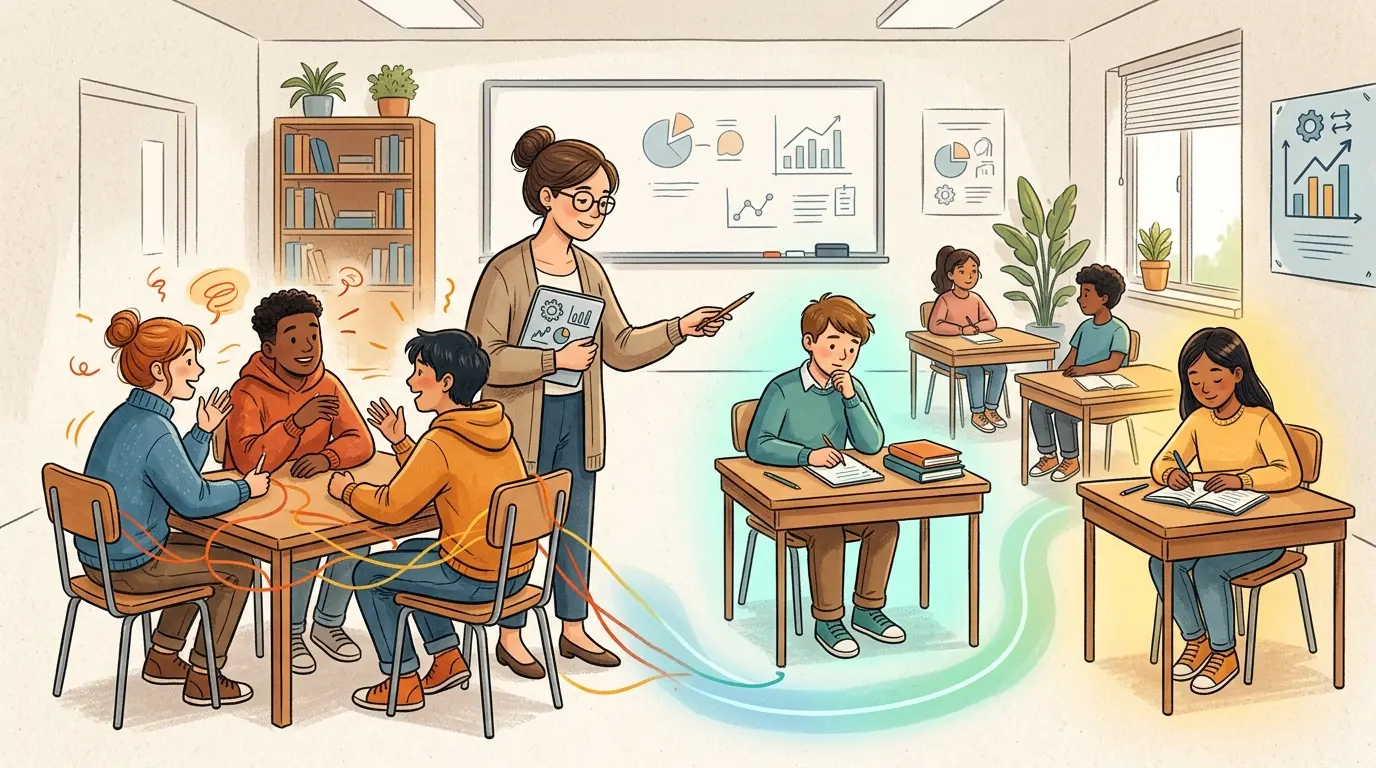
You know the two. Individually, each of them has a perfectly fine day. They do their work, they raise a hand, they line up like everyone else. Put them three feet apart, though, and something flips. One says something under his breath, the other cracks up, and within two minutes you've lost the whole front corner of the room.
This isn't a personality clash you just have to live with, and it isn't proof that either kid is a lost cause. It's a documented pattern in classroom research, with a real mechanism behind it and a genuinely useful body of evidence about what to do next. Separating two students who feed off each other works. Doing it well just takes a little more thought than moving one desk to the opposite wall.
Why Two Kids Set Each Other Off
Misbehavior in a classroom rarely happens in a vacuum. Back in 1973, researchers Robert Solomon and Robert Wahler spent time in an elementary classroom watching exactly what happened right after a child acted out, and who reacted to it.1Solomon, R. W., & Wahler, R. G. (1973). Peer reinforcement control of classroom problem behavior. Journal of Applied Behavior Analysis, 6(1), 49–56. https://doi.org/10.1901/jaba.1973.6-49. This is one of the earliest studies to experimentally demonstrate that peer attention, not just teacher attention, can function as a reward that maintains a student's disruptive behavior. The finding has held up well and still shapes how school psychologists think about functional behavior assessment today. What they found was almost embarrassingly simple: classmates were paying more attention to the problem behavior than to almost anything else happening in the room. Every laugh, eye-roll, or "ooh" from a peer worked like a small reward, and rewarded behavior tends to repeat.
That's the mechanism sitting underneath a lot of paired misbehavior. Two students find each other's reactions worth performing for. Student A does something, Student B lights up, and Student A gets exactly the response that makes doing it again worth the trouble. It has little to do with whether either kid struggles generally, and everything to do with the specific loop those two build together. Break the loop, and both of them often settle right back into their normal behavior with everyone else.
Teachers Have Been Doing This For Years. Research Just Caught Up.
If you've ever separated two kids because "they set each other off," you're already using a strategy researchers have started studying by name. A 2023 study out of Radboud University in the Netherlands interviewed thirteen upper-elementary teachers about how and why they build their seating charts.2Hoekstra, N. A. H., van den Berg, Y. H. M., Lansu, T. A. M., Mainhard, M. T., & Cillessen, A. H. N. (2023). Teachers' goals and strategies for classroom seating arrangements: A qualitative study. Teaching and Teacher Education, 124, 104016. https://doi.org/10.1016/j.tate.2023.104016. The study is based on semi-structured interviews with thirteen teachers, so the strategies described reflect what these teachers reported doing rather than a randomized test of what works best. A separate, smaller conceptual replication with a different group of teachers found largely the same set of goals and strategies, which is a reassuring sign for a qualitative study of this size. Separating students who reinforce each other's misbehavior showed up as one of the most common, deliberate strategies teachers described, right alongside seating a shy student near a friendly classmate or keeping several strong personalities from clustering in one corner.
One teacher in the study described it plainly: some years, a group of kids arrives that seems to set each other off constantly, and the only real fix is pulling them apart and rebuilding the chart around that fact. That's not a punishment mindset. It's the same logic a parent uses once they notice their toddler always melts down around one specific cousin. The relationship itself is the trigger, not either child on their own.
It's Not Just Talking. Attention Itself Spreads.
Separating a pair matters for a second reason that has nothing to do with talking or joking around. In 2024, a team led by Noah Forrin tracked what happened to students seated near a visibly bored or checked-out classmate during a lecture.3Forrin, N. D., Kudsi, N., Cyr, E. N., Sana, F., Davidesco, I., & Kim, J. A. (2024). Investigating attention contagion between students in a lecture hall. Scholarship of Teaching and Learning in Psychology. https://doi.org/10.1037/stl0000419. The study used undergraduates in a simulated lecture hall rather than an elementary classroom, so the exact figures shouldn't be treated as a direct prediction for a third-grade class. What generalizes well is the underlying pattern: attentiveness and inattentiveness both spread most strongly to whoever is seated closest, and the effect fades quickly with distance. Students sitting right next to an inattentive peer wrote roughly half as many notes and scored measurably lower on a follow-up quiz than students seated near an engaged classmate. The effect was specific to direct neighbors. Students one or two seats further away barely showed it at all.
Apply that finding to two students who wind each other up, and the stakes get bigger than just the two of them. Whoever sits next to that pair absorbs some of the fallout too, even without saying a word to either one. Moving the two instigators apart doesn't just calm their own interaction down. It also protects whichever students would otherwise be sitting in the blast radius.
Separating Is Not the Same as Isolating
Here's where it's worth slowing down, because there's a real difference between putting distance between two specific students and using distance as punishment for one of them. A 2025 study tracked seating placements for elementary students with or at risk for emotional and behavioral disorders and found that isolated seats, desks with open space on every side, predicted a worse reputation among classmates: more nominations for fighting and giving the teacher a hard time, not fewer.4Granger, K. L., Vogel, K., Vieten, E., Chow, J. C., & Broda, M. D. (2025). Classroom seating placements of students with or at risk for emotional and behavioral disorders. Journal of Emotional and Behavioral Disorders. https://doi.org/10.1177/10634266251365180. Braun, S. S., van den Berg, Y. H. M., & Cillessen, A. H. N. (2020). Effects of a seating chart intervention for target and nontarget students. Journal of Experimental Child Psychology, 191, 104742. https://doi.org/10.1016/j.jecp.2019.104742. The Granger study draws on a small preliminary sample of seventeen focal students, so its findings are best read as an early signal rather than a settled fact. The Braun study found its seating intervention caused more short-term tension rather than less, and the authors suggest a longer adjustment period might be needed before any benefit appears. Together, both studies are a useful caution against treating any seating change, including separating two students, as a simple fix with no downside to manage. Distance from the teacher's desk carried no such risk. It was specifically the isolation from peers that seemed to do the damage.
There's also a caution about moving fast on a well-intentioned seating change. A Dutch study that deliberately seated students near classmates they had previously said they disliked found the intervention increased aggression and lowered reported cooperation across the whole class, not just for the two students involved. The lesson isn't that seating changes backfire. It's that they're a real intervention with real effects on a kid's social world, and they deserve the same care you'd give any other classroom management decision, not a quick fix you set and forget.
The version of "separating" that actually helps looks less like exile and more like distance. Both students stay embedded in the normal flow of the room, each with their own set of neighbors and their own chance to participate like everyone else. What changes is that the two of them are no longer within arm's reach or easy eye contact for six hours a day.
How to Split Up a Pair Without Making It a Whole Thing
Move both kids, not just the one who seems worse. If you only ever relocate the student who appears to start it, that student quietly becomes "the problem kid" in the room's social memory, even though the dynamic took two people to build. Give both of them a new spot. It keeps the message focused on the pairing rather than on either child's character.
Think about diagonal and front-to-back, not just side-by-side. A pair that no longer shares a table can still trade looks and comments across a row or over a shoulder. A recent computational study out of a Brazilian engineering university modeled this exact problem and found that manually built seating charts tend to keep conflicting students out of the same cluster while still leaving them close enough in adjacent rows to keep the dynamic alive.5Charytitsch, B. C. B., & Nascimento, M. C. V. (2026). Conflict-aware seat assignment in classroom environments. arXiv:2605.04235. https://arxiv.org/abs/2605.04235. This is a preprint from an engineering research group and has not yet been peer reviewed. It focuses on mathematically modeling the seating problem rather than studying classroom behavior directly, but it's included here because it independently confirms, from a completely different angle, that hand-built seating charts often leave conflicting students closer together than teachers intend, particularly across adjacent rows rather than the same table. Real distance, not just a different table, is what actually breaks the pattern.
Keep the explanation boring on purpose. You don't need a conversation about the friendship or the behavior to make the move. A new seating chart applied to the whole room, rather than a visible swap of just the two of them, keeps an ordinary classroom management decision from turning into a big social event either student has to process.
Revisit it later in the year. Some pairs outgrow the dynamic that made them impossible to seat together in September. Reviewing your restrictions every quarter, instead of treating a separation as permanent, gives kids room to grow out of an old pattern instead of being defined by it for the rest of the year.
Using Inclusive Seating to Navigate This
This is exactly the kind of ongoing, slightly fiddly bookkeeping that Inclusive Seating was built to take off your plate. When you add a Must not sit near restriction between two specific students, that restriction belongs to the pairing, not to any single seating chart. It carries forward automatically every time you click Randomize, whether you're in rows, clusters, or a horseshoe, and whether it's the first week of school or the middle of April.
Because the restriction accounts for genuine distance rather than just "not the same table," a randomized chart won't quietly slip two conflicting students into adjacent rows or diagonal desks where the same old dynamic can restart. And because building a fresh chart takes a few clicks instead of a full redesign, reviewing and loosening restrictions once a pairing has settled down is realistic, not one more task that never quite happens. You can keep two students far enough apart to genuinely break the loop, without either one ever feeling singled out.
