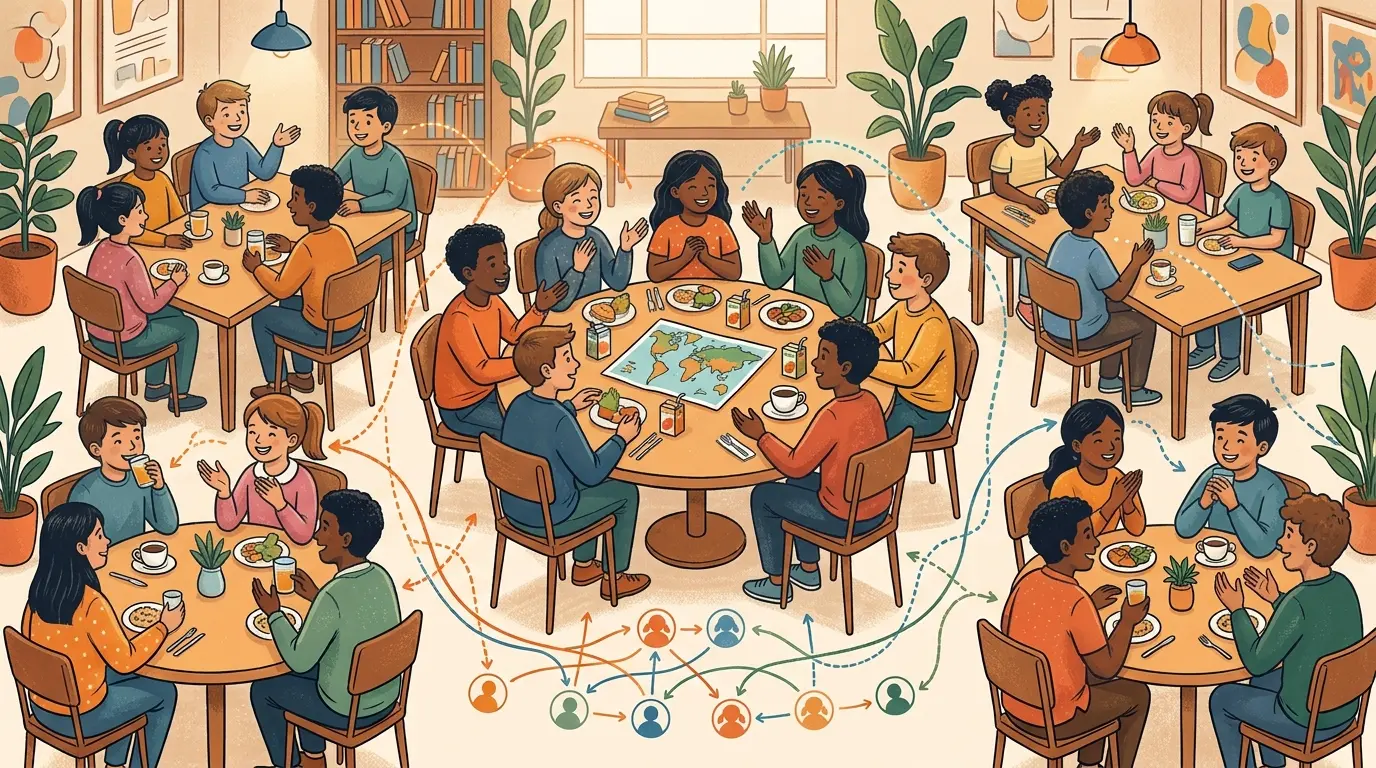
Walk into most elementary classrooms in September, and by December you can usually guess who eats lunch with whom. Friend groups form fast, and once they form, they tend to hold along familiar lines: gender, achievement level, sometimes background or the language spoken at home. Kids who never get seated near each other rarely find a reason to cross those lines on their own.
A 2021 study asked a direct question: if you take the choosing out of it entirely and randomly seat kids next to each other, does that change who becomes friends? The answer, from one of the largest randomized experiments ever run on this question, is yes. It is also more complicated and more honest than a simple yes, which is exactly what makes it worth understanding before you build your next seating chart.
A Field Experiment with Almost 3,000 Students
Julia Rohrer, Tamás Keller, and Felix Elwert ran the study across 182 classrooms in 40 primary schools in rural Hungary, working with students in grades 3 through 8.1The researchers describe two versions of the friendship effect, and it's worth knowing the difference. One is the underlying "propensity" toward friendship, meaning how much closer sitting together pushed two students toward liking each other; this rose by roughly the same amount for every pair of students, regardless of how similar they were. The other is "manifest" friendship, meaning whether that closer relationship crossed the threshold into an actual mutual best-friend nomination on the end-of-semester survey. The percentages in this post (the rise from 15 to 22 percent, for example) describe manifest friendships, the kind a parent or teacher would actually recognize, since that's the outcome that matters day to day in a classroom. Rohrer, J. M., Keller, T., & Elwert, F. (2021). Proximity can induce diverse friendships: A large randomized classroom experiment. PLOS ONE, 16(8), e0255097. https://doi.org/10.1371/journal.pone.0255097. Before the fall semester began, they used a random number generator, not a teacher's judgment, to assign every student a seat at a two-person desk. Teachers kept that arrangement in place for the three core academic subjects (math, grammar, and literature) for five straight months.
Nearly all prior research on proximity and friendship had focused on college students, often freshmen thrown into a dorm full of strangers. Rohrer's team described their work as the first randomized experiment of this kind conducted outside that narrow, unusually social-hungry context, and the first to test whether the effect held for elementary and middle schoolers who had already known their classmates for years, not just for young adults meeting for the first time.
That detail, the random number generator, is what separates this study from most of what has been written about classroom seating and friendship. Plenty of research has found that students who sit near each other tend to be friends. But that finding alone does not tell you much, because teachers often seat friends near each other on purpose, or place students who already get along near one another to keep the room calm. When Rohrer's team handed seat assignment over to a random number generator instead, they removed that possibility entirely. Any friendship pattern that showed up five months later had to be caused by the seating itself, not by a teacher's existing read on which students liked each other.
The Basic Finding: Sitting Together Builds Friendship
At the end of the semester, nearly 3,000 students filled out a survey naming up to five best friends in their class. The researchers checked which nominations were mutual, meaning both students named each other, and compared the rate of mutual friendship between students who had been randomly seated together and students who had not.
Being deskmates for one semester raised the odds of a mutual friendship from about 15 percent to about 22 percent, a jump of 7 percentage points from nothing more than where two kids happened to sit. No lessons on friendship, no group projects designed to build connection, no teacher intervention beyond following the seating chart they were handed. Just proximity, held in place for five months.
The obvious next question is whether this only works for kids who were already likely to become friends anyway, the ones separated by nothing more than bad luck in a previous seating chart. Or can it push kids toward friendships across lines that usually keep them apart?
Does It Reach Across Cultural Lines?
This is the question Rohrer and her colleagues built the study to answer, and it is the part that makes the research genuinely useful rather than just a confirmation of common sense. They tracked three dividing lines that friendships in the study tended to respect: gender, academic achievement, and ethnicity, specifically whether a student was Roma or non-Roma, a meaningful cultural divide in Hungarian schools that carries real social weight for Roma students in particular. That divide is a specific case of a broader pattern that shows up in American classrooms too: friendships that cross lines of culture, language, or immigration background tend to be rarer and harder to build without some kind of push.
The results on ethnicity were the murkiest of the three, and it is worth being straightforward about why. Roma students made up only about 22 percent of the sample, which left the researchers with a smaller and noisier group of cross-ethnic seating pairs to analyze. The data hinted that pairing Roma and non-Roma students together produced a smaller friendship boost than pairing students of the same ethnicity, but the statistical uncertainty around that estimate was wide.2The study's own estimate for mixed-ethnicity pairs carried real statistical uncertainty: the difference between mixed-ethnicity and same-ethnicity dyads came out to 5.8 percentage points, but the range of plausible values around that number was wide enough, and shifted enough across alternate model checks, that the researchers described the evidence as ambiguous rather than conclusive. A study with a larger sample of Roma students would be needed to resolve this one way or the other. See note 1 for the full citation. The honest conclusion is not that seating charts cannot build cross-cultural friendship. It is that this particular study could not confirm they reliably do, at least not with the confidence the researchers had for the other two dividing lines.
Those other two lines tell a clearer story, and they are worth knowing because they show what the mechanism can do when there is more data to work with. Pairing a stronger student with a struggling one raised the odds of a mutual friendship from 11 percent to 17 percent, a solid jump across a line that usually sorts kids into separate friend groups by the middle of the school year. Gender was the hardest line to move: pairing a boy and a girl roughly doubled their odds of becoming friends, but only from under 2 percent to about 4 percent. Elementary and middle schoolers hold onto gender lines in friendship with real stubbornness. Five months of forced proximity barely dents it.
Put plainly, proximity can push students across a line, but how far it pushes them depends heavily on how deep that line runs to begin with. Cultural and ethnic lines are often the deepest of all, shaped by forces well beyond a classroom, which is exactly why the study's cautious finding here should not be read as failure. Read it as a matter of scale: a one-semester seating chart is a small lever against a large, long-standing social pattern, and even a small lever moving in the right direction is worth pulling.
Why the Underlying Mechanism Matters More Than the Headline Number
There is a detail buried in the study's statistics that is genuinely worth understanding, because it changes how you should think about what a seating chart can and cannot do.
Sitting together raised every pair of students' underlying interest in becoming friends by roughly the same amount, regardless of how similar or different the two students were. The gap between groups showed up later, in whether that raised interest actually crossed the finish line into a reported mutual friendship. Students who were already alike started from a higher baseline of mutual interest (the well-documented human tendency to like people who resemble us, sometimes called homophily), so the same boost in interest was more likely to tip an already-similar pair over the threshold into "yes, we're friends" than it was for a dissimilar pair starting from further back.
In other words, seating together did not work less well for students who were different from each other. It just had less ground to cover, because dissimilar students started the semester further from the friendship threshold than similar students did. That is a meaningfully different story than "proximity does not help across cultural lines," and it is the more accurate one.
Why Cross-Cultural Friendships Are Worth the Effort
It is fair to ask whether engineering these friendships is worth the trouble at all. American classrooms are more culturally and ethnically diverse than they were a generation ago, which makes the question more relevant every year, not less.
A separate line of research suggests the effort pays off. Sandra Graham and her colleagues surveyed 536 Latino and 396 Black sixth graders across 66 classrooms in 10 urban middle schools and found that students with more cross-ethnic friendships reported feeling safer at school and less socially vulnerable.3This study surveyed 536 Latino and 396 Black sixth graders across 66 classrooms in 10 urban middle schools and measured cross-ethnic friendships against students' self-reported feelings of safety and vulnerability, rather than using the semester-long randomized design of the seating study above. That makes it correlational rather than experimental, so it cannot prove on its own that the friendships caused the safety gains, but the pattern held up consistently enough across the sample to be worth taking seriously. Graham, S., Munniksma, A., & Juvonen, J. (2014). Psychosocial benefits of cross-ethnic friendships in urban middle schools. Child Development, 85(2), 469–483. https://doi.org/10.1111/cdev.12159. The likely reason: when friendships cross group lines, no single group ends up holding all the social power in a classroom, which changes how safe every student feels moving through the day.
Related research on cross-ethnic and cross-race friendships in elementary and middle school has connected them to stronger conflict-resolution skills and more positive attitudes toward other groups, benefits that tend to outlast the school year they formed in. None of that requires a seating chart to happen on its own. But a seating chart is one of the only tools a teacher has that puts two students who would not otherwise interact within actual arm's reach of each other, every day, for months at a stretch. Based on what Rohrer's numbers show, that is frequently enough to start something a classroom's social dynamics would not have produced by themselves.
What a Single Semester Can't Do
It is worth being direct about the limits here, because a seating chart is a genuinely useful lever, not a solution to how children form in-groups.
The Hungarian study ran for one semester, in classrooms where students already knew each other from years of shared schooling. It found a real effect, but a modest one, and the least certain result landed on exactly the line, ethnicity, where progress usually matters most in a diverse American classroom. A seating chart is not a substitute for the slower work of building an inclusive classroom: modeling respectful behavior across differences, naming bias when it shows up, and building in structured reasons for students to actually work together rather than just sit near each other.
The takeaway: what the research does support is a narrower and more useful claim. Proximity is a lever that works, it costs nothing, and it does not compete with anything else a teacher is already doing to build a fair classroom. Leaving the same handful of students clustered together all year, because rearranging desks feels like a hassle, means giving up a free, evidence-backed tool for no real reason.
Turning This into a Habit with Inclusive Seating
The mechanism behind Rohrer's findings is almost disarmingly simple. A computer randomly decided who sat next to whom, and that alone was enough to shift the classroom's friendship map by the end of the semester. That is essentially what happens every time you click Randomize in Inclusive Seating.
The tool's randomization algorithm does not just shuffle names for variety's sake. It also actively avoids repeating the same neighbor pairings from the previous chart, so students who sat together last rotation are unlikely to land next to each other again right away. Given what this research found about proximity and friendship, that anti-repeat logic is doing more work than it might look like. Each new rotation is effectively a fresh run of the same intervention Rohrer's team tested in Hungary, exposing students to a new set of potential friends they might never have picked for themselves.
If random chance is not quite enough for a specific pairing you want to encourage, Inclusive Seating's proximity restrictions let you take it further. Setting a "must sit near" restriction between two students guarantees they will be seated together on the next chart, no matter what the algorithm would have picked on its own. A teacher who has noticed that a particular group of students never really interacts with the rest of the class can use that restriction to build the exact proximity this research points to, rather than waiting on a good roll of the dice.
None of this requires tracking friendships by hand or building a seating strategy around one semester's worth of data. Randomize the chart every few weeks, let the anti-repeat logic do the quiet work of introducing new neighbors, and step in with a targeted restriction when you notice two groups of students who have never really crossed paths. A free tool built for exactly this kind of small, ongoing adjustment is a far more realistic plan than trying to engineer the perfect diverse seating chart once and hoping it holds for the rest of the year.
