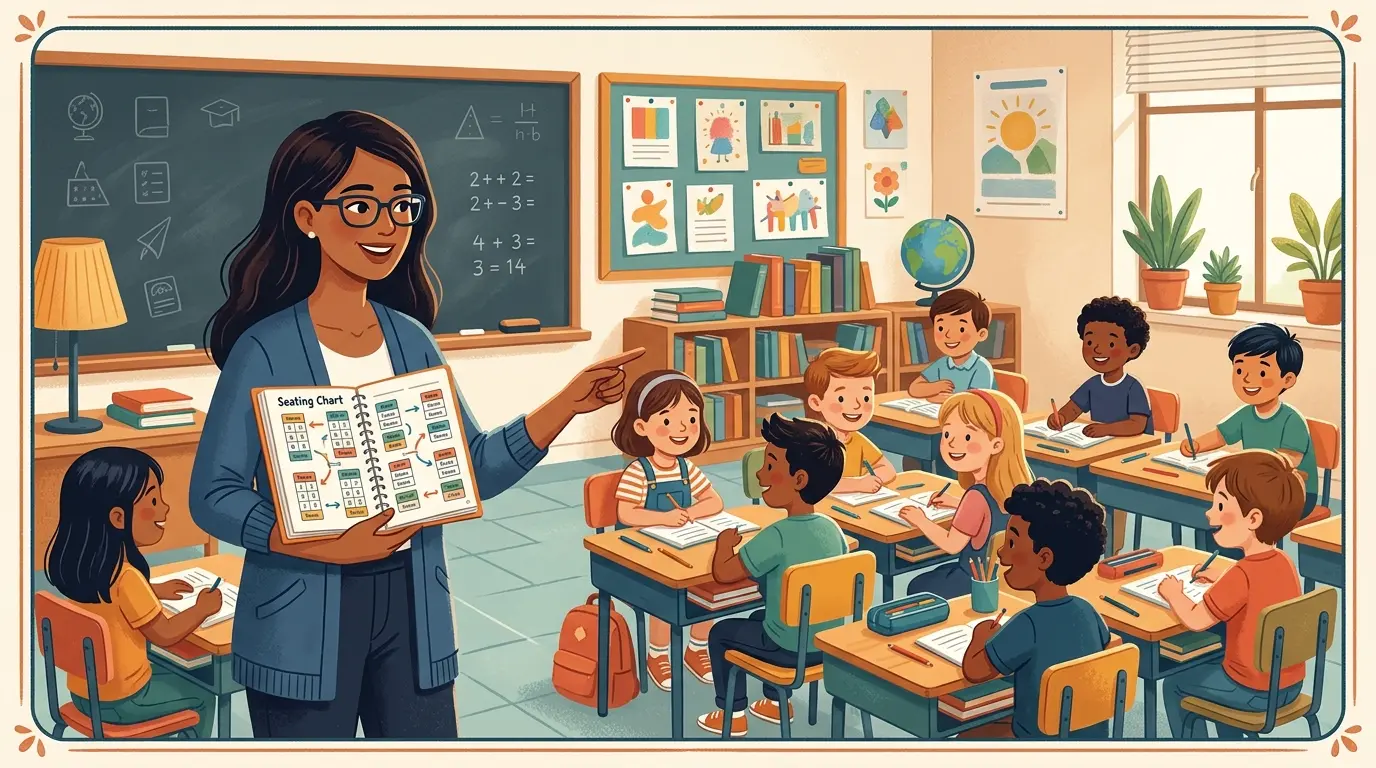
Most classroom management systems only turn on after something has already gone wrong. A student blurts out an answer, wanders off task, or starts a side conversation, and then the system responds: a warning, a lost point, a note home. All of that happens after the fact, once the disruption is already underway.
A seating chart is different. It's one of the few tools that does its work before anything happens at all. Where you put each student, and who ends up sitting next to whom, quietly shapes how much disruption you have to manage in the first place. The research on this has moved well past the old debate over rows versus groups versus a horseshoe, and it points to something more useful: seating is a behavior intervention, not just a layout decision. None of what follows is about which shape of room wins. It's about the specific, repeatable decisions that make any layout either work quietly in your favor or work quietly against you.
Seating Decisions Are Already Management Decisions
Teachers already sense this, even when they haven't put a name to it. Gremmen, Van den Berg, Segers, and Cillessen (2016) interviewed elementary school teachers about how they decide who sits where, and found that separating students they expected would set each other off, and seating a struggling student next to a friend who could help them feel secure, were both common, deliberate strategies. Hoekstra, Van den Berg, Lansu, Mainhard, and Cillessen (2023) followed up with a closer look at 13 teachers across grades 4 through 6 in the Netherlands and found the same pattern in more detail: teachers routinely break up combinations of students who reinforce each other's misbehavior, then build the rest of the chart around that one decision.
What's less obvious is how much this single choice affects behavior on its own, apart from any consequence system layered on top of it. Bicard, Ervin, Bicard, and Baylot-Casey (2012) compared classrooms where fifth graders picked their own seats to classrooms where the teacher assigned them.1"Disruptive behavior" in this line of research is a specific, observed category, not a general impression. Researchers use trained observers who code a defined list of behaviors from a script, typically things like talking without permission, being out of an assigned seat, and touching or bothering a peer, at fixed intervals during a lesson. That precision is what lets researchers compare seating conditions fairly, but it also means these studies capture visible, disruptive acts rather than a student's underlying motivation or internal state. A quiet student can be off task without ever registering as disruptive at all. During group work, disruptive behavior occurred twice as often when students had chosen their own seats. During independent seatwork, it occurred more than three times as often. The desks hadn't moved. Only who decided where each student sat had changed.
The Proximity Effect: It's Who's Next to You, Not the Shape of the Room
If seating affects behavior this directly, the next question is which part of the chart is actually doing the work. It isn't the overall layout. It's the one or two people close enough to touch.
Forrin, Kudsi, Cyr, Sana, Davidesco, and Kim (2024) demonstrated this with an experiment built around a simple setup: some students sat next to peers trained to act attentive, others sat next to peers trained to act bored and checked out.2The study used undergraduate psychology students in a simulated lecture hall rather than elementary school children, so the exact figures shouldn't be treated as a direct estimate for a third-grade classroom. What generalizes well across the wider body of research on attention contagion is the underlying mechanism: attentiveness and inattentiveness both spread most strongly to the people seated closest to you, and the effect fades quickly with distance. Forrin, N. D., Kudsi, N., Cyr, E. N., Sana, F., Davidesco, I., & Kim, J. A. (2024). Investigating attention contagion between students in a lecture hall. Scholarship of Teaching and Learning in Psychology. https://doi.org/10.1037/stl0000419. Students seated next to an inattentive peer took noticeably fewer notes and scored lower on a quiz over the same lecture content. Inattentiveness spread. Attentiveness, notably, did not spread nearly as reliably. Godwin, Almeda, Seltman, Kai, Skerbetz, Baker, and Fisher (2016) found something consistent with this in a much larger, more naturalistic setting: across dozens of kindergarten through fourth grade classrooms, peer-driven distraction was one of the most common sources of off-task behavior researchers observed, right alongside a cluttered visual environment and a student simply losing focus on their own.
The takeaway: Rows, clusters, and a horseshoe each have their place, and the layout question is worth getting right. But for pure behavior management, the arrangement itself matters less than one specific decision: which student ends up an arm's length from which other student, five days a week.
Assigned Seats Shape the Social Climate You're Managing
There's a second effect here that's easy to miss if you only think about seating in terms of suppressing bad behavior in the moment. Rohrer, Keller, and Elwert (2021) ran a large field experiment across 182 classrooms in grades 3 through 8, randomly assigning seat neighbors for a full semester. Students who were seated next to each other became mutual friends far more often than students who weren't, with the probability of a new friendship rising from 15 percent to 22 percent. That effect held up regardless of whether the paired students were similar or different in gender, ethnicity, or academic achievement.
Left to pick their own seats, students gravitate toward classmates they already know, which reinforces the exact friend groups and social boundaries that tend to generate exclusion, cliques, and the low-grade friction that eats up a teacher's attention all year. A deliberately assigned seating chart, especially one that gets refreshed every so often, works against that pattern instead of reinforcing it. That's a big part of why the same handful of students tend to show up in conflicts all year in some classrooms and not others: the seating chart never gave anyone a reason to interact outside the circle they arrived with. It's a genuinely underused management lever, and it doesn't cost anything beyond the time it takes to build the chart.
The Seating Trap: When "Managing" a Student Means Isolating Them
Here's where the instinct that feels most like good classroom management can backfire. When a student is a persistent source of disruption, the natural move is to give them a seat off to the side, away from peers, where they have fewer opportunities to set anyone off. It's an understandable response, and it often does reduce the disruption you can see.
Granger, Vogel, Vieten, Chow, and Broda (2025) looked closely at what that response actually costs. Studying kindergarten through third grade classrooms, they found that roughly half of the students with or at risk for an emotional or behavioral disorder were seated in isolation from their peers. Seat isolation was associated with a measurably worse reputation among classmates: more nominations from peers for fighting and giving the teacher a hard time, and fewer nominations for being nice or cooperative. Distance from the teacher's desk showed no such association at all.3These studies come from different countries, age groups, and research methods, which is worth keeping in mind when comparing them. Bicard et al. (2012) studied fifth graders in the United States; Rohrer et al. (2021) studied grades 3 through 8 in Hungary; Granger et al. (2025) studied kindergarten through third grade in the United States; Hoekstra et al. (2023) interviewed teachers of grades 4 through 6 in the Netherlands; and Forrin et al. (2024) studied undergraduates in Canada. The directional findings line up well across this range of contexts, but the exact figures from any one study shouldn't be treated as universal.
Bicard, D. F., Ervin, A., Bicard, S. C., & Baylot-Casey, L. (2012). Differential effects of seating arrangements on disruptive behavior of fifth grade students during independent seatwork. Journal of Applied Behavior Analysis, 45(2), 407–411.
Gremmen, M., Van den Berg, Y. H. M., Segers, E., & Cillessen, A. H. N. (2016). Considerations for classroom seating arrangements and the role of teacher characteristics and beliefs. Social Psychology of Education, 19(4), 749–774.
Godwin, K. E., Almeda, M. V., Seltman, H., Kai, S., Skerbetz, M. D., Baker, R. S., & Fisher, A. V. (2016). Off-task behavior in elementary school children. Learning and Instruction, 44, 128–143.
Rohrer, J. M., Keller, T., & Elwert, F. (2021). Proximity can induce diverse friendships: A large randomized classroom experiment. PLOS ONE, 16(8), e0255097. https://doi.org/10.1371/journal.pone.0255097.
Hoekstra, N. A. H., Van den Berg, Y. H. M., Lansu, T. A. M., Mainhard, M. T., & Cillessen, A. H. N. (2023). Teachers' goals and strategies for classroom seating arrangements: A qualitative study. Teaching and Teacher Education, 124, 104016.
Forrin, N. D., Kudsi, N., Cyr, E. N., Sana, F., Davidesco, I., & Kim, J. A. (2024). Investigating attention contagion between students in a lecture hall. Scholarship of Teaching and Learning in Psychology.
Granger, K. L., Vogel, K., Vieten, E., Chow, J. C., & Broda, M. D. (2025). Classroom seating placements of students with or at risk for emotional and behavioral disorders. Journal of Emotional and Behavioral Disorders. https://doi.org/10.1177/10634266251365180.
A student who struggles with behavior is often the same student who most needs a secure footing with peers to keep that behavior in check. Isolating them can trade a short-term drop in visible disruption for a longer-term hit to the peer relationships that would have helped the most.
The takeaway: Move a struggling student closer to you. Think hard before moving them away from everyone else.
A seating chart that only quiets a room in the moment is doing half its job. The other half is building a room that doesn't need as much quieting to begin with.
Building a Seating Chart That Actually Manages Behavior
None of this requires rebuilding your classroom every week. It mostly requires making a few decisions on purpose instead of by default.
Decide your anchor placements first. Before you fill in a single other seat, figure out which one or two students most need to be near you, and which pairs or trios most need to be kept apart. Build the rest of the chart around those decisions rather than starting from an alphabetical list and hoping the trouble spots sort themselves out.
Rotate on a schedule, not just after an incident. A bad pairing can start dragging down a student's attention and work quality within days, so waiting for a visible blowup before you make a change means the damage is already done. Moving neighbors every few weeks limits how long any single pairing, good or bad, gets to run its course.
Save real isolation for genuine safety needs. A seat near you is a lighter, more reversible accommodation than a seat away from everyone else. Reach for the second one only when there's a real safety reason behind it, not simply because it's the fastest way to quiet things down today.
Bring in support staff before you reach for a stronger consequence. If moving a student's seat once or twice hasn't changed a pattern of disruption, that's genuinely useful information, not a sign the seating chart failed. Share what you've tried and what changed with a counselor, case manager, or the student's family before escalating to a stronger consequence system layered on top.
Using Inclusive Seating to Put This Into Practice
This is exactly the kind of decision-making Inclusive Seating is built to support. Every student on your roster can carry their own restrictions: a rule that keeps them near your desk, a rule that keeps two specific students apart, a rule that keeps a student close to a peer who helps them stay regulated. Those restrictions belong to the student, not to any one chart, so they carry over automatically no matter how the room gets rearranged.
That matters most once you take the rotation advice above seriously. Click Randomize and the algorithm rebuilds the whole chart while still respecting every restriction you've set, which means refreshing your seating every few weeks takes a few clicks instead of a redesign from scratch. If you spot one pairing that isn't working, you can drag a single student to a new seat without touching anyone else's spot. And if you do need to isolate a student for a genuine safety reason for a short stretch, you can do it deliberately, then move them back the moment it's no longer necessary, instead of leaving them there because rebuilding the chart feels like too much work.
