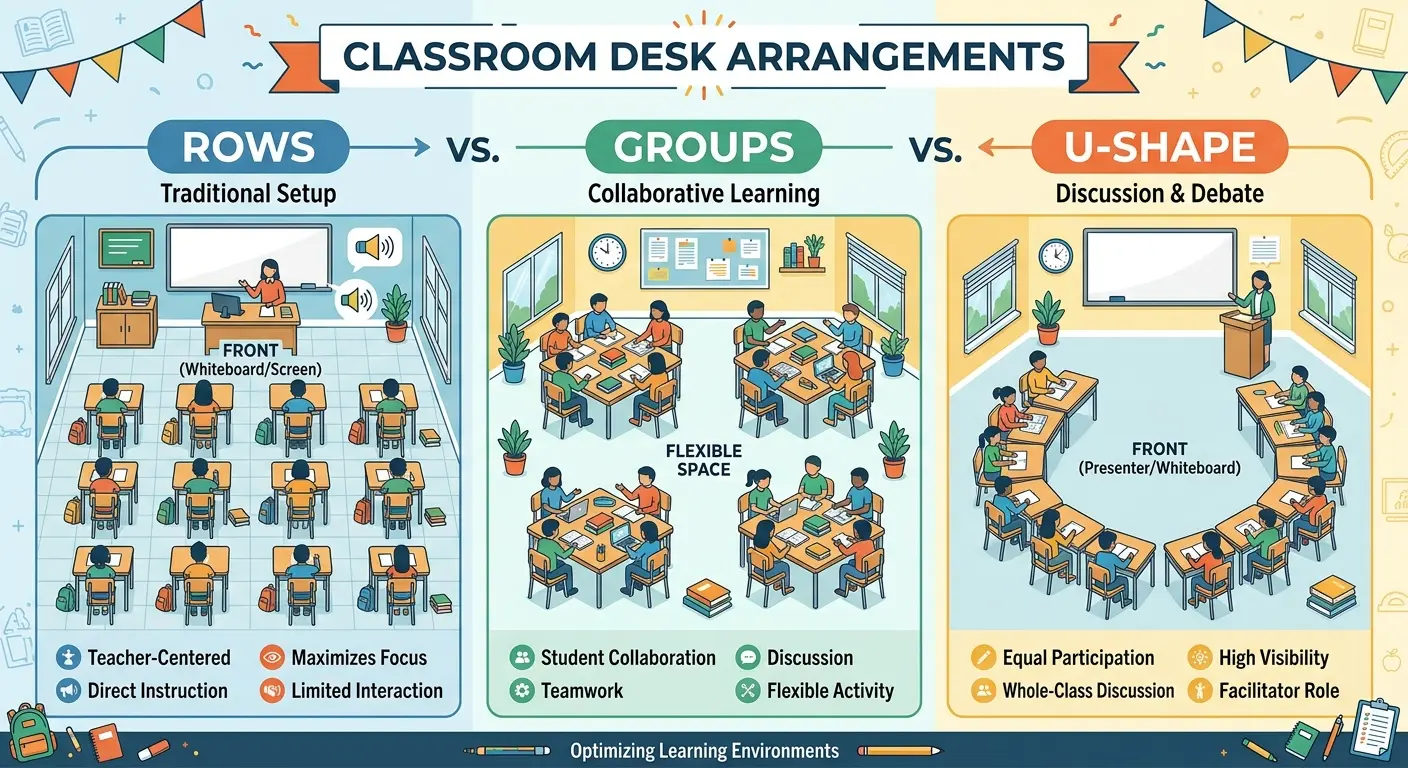
Every teacher has a preference. Some swear by rows for keeping students focused. Others would never go back to rows after trying collaborative group seating. And then there is the U-shape, which tends to inspire genuine converts among teachers who have used it for discussion-based learning.
There is actual research behind all three. The answer, though, is that no single arrangement wins across the board. What wins depends on what your students are doing at any given moment. Here is what the evidence actually says.
The Research Is More Settled Than You Might Think
Most of the foundational studies on classroom seating arrangements were conducted between the 1980s and the 2000s, which can make them sound dated. But the main findings have been replicated across enough classrooms, grade levels, and countries that they are considered reliable. A 2008 systematic review by Wannarka and Ruhl examined the available empirical research and drew clear conclusions about when each arrangement tends to work. That review remains one of the most cited sources in this area, and nothing published since has substantially contradicted its core findings.
One important framing note before getting into the specifics: most of this research measures "on-task behavior" as its primary outcome variable.1On-task behavior in educational research refers to whether a student is visibly engaged with the assigned work: looking at their materials, writing, listening to the teacher, or participating in the assigned activity. It is typically measured by trained observers using time-sampling protocols. While on-task behavior correlates with learning outcomes, it is not identical to learning. A student can be on-task without deeply processing material, and some brief apparent off-task behavior can actually support memory consolidation. These studies tell us about visible behavior and participation, which is useful and meaningful information, but it is not the whole picture of learning. That means the research can tell you a great deal about student behavior and participation, but somewhat less about long-term learning outcomes. Keep that in mind as we go through each arrangement.
Rows: Best for Independent Work
Let's start with the arrangement that has the strongest and most consistent research support for a specific purpose. When students are doing independent work, such as worksheets, tests, silent reading, or writing practice, rows come out clearly ahead.
Wannarka and Ruhl's 2008 review found that students in row arrangements were more on-task during individual tasks than students in cluster or group arrangements across multiple studies. Bennett and Blundell (1983) found something similar in their study of primary school students: children in rows produced more work during independent tasks, with no meaningful difference in the quality of that work. Hastings and Schweiso (1995) looked specifically at primary classrooms in the UK and found that group seating led to significantly more off-task behavior during individual work tasks compared to row seating.
The explanation is intuitive. When students are sitting in groups but working alone, the social environment of the table is working against them. The people right next to them, across from them, and diagonally nearby are all within easy reach, and the physical arrangement signals collaboration rather than individual focus. Even well-intentioned students find it harder to tune out neighbors they are facing directly.
There is one important caveat about rows worth knowing: the "action zone" effect.2The action zone is a pattern documented across many classroom studies in which students seated in the front row and the center column of a row arrangement receive disproportionately more teacher attention, more opportunities to participate, and more verbal interaction with the teacher. The pattern was first systematically described by Adams and Biddle (1970) and has been replicated many times since. It is partly driven by teacher behavior (teachers tend to face and direct questions toward the center when standing at the front) and partly by student self-selection (motivated or confident students often choose front-center seats). The action zone effect is one reason rows are not an uncomplicated recommendation: the arrangement concentrates teacher attention in a way that can leave students in the back corners at a real disadvantage. In a standard row arrangement, students in the front row and center column receive significantly more teacher attention, more opportunities to answer questions, and more interaction overall. Students in back corners are often effectively invisible during whole-class instruction. Rows help students focus, but they do not distribute teacher attention evenly.
The takeaway: Rows are well-supported by research for independent work and assessments, especially for students who are easily distracted by neighbors. They come with a trade-off in how teacher attention is distributed across the room.
Groups and Clusters: The Collaborative Arrangement With a Real Trade-Off
Group tables and cluster seating are probably the most common arrangement in elementary classrooms today. That makes a certain amount of sense: a lot of elementary school involves collaborative work, and clusters support it naturally. The research backs this up for collaborative tasks specifically.
But here is the trade-off that the research consistently surfaces. The same arrangement that makes collaborative activities feel natural also makes independent work harder. Hastings and Schweiso (1995) documented this clearly in their study of primary classrooms: cluster seating led to significantly more off-task behavior during individual work tasks than row seating. Students who are physically surrounded by peers on multiple sides are working against their environment when they need to focus on their own work.
There is also the neighbor-proximity effect to consider. A 2024 study by Forrin and colleagues found that inattentiveness spreads between students who are direct neighbors, not between students seated farther apart. Students who ended up seated next to an inattentive peer took fewer notes and scored lower on follow-up assessments. In a cluster arrangement, every student has more close neighbors, which means more exposure to this kind of influence in both directions. A focused, engaged neighbor can be a positive force; a distracted one can pull attention away.
The interesting irony here is that many classrooms keep group seating as the all-day default, even when a significant portion of the school day involves individual tasks. The research does not say to give up clusters. It says to think carefully about whether your default arrangement is well-matched to your most common activity type, and whether the mismatch is costing students more than it seems.
The takeaway: Group seating supports collaboration, group projects, and discussion-based activities well. For classrooms where independent practice takes up a significant portion of the day, the research suggests it may be the wrong default arrangement for those stretches of time.
U-Shape: The Discussion Arrangement Most Classrooms Underuse
The U-shape arrangement (sometimes called horseshoe seating) gets the strongest endorsement from research for one specific purpose: whole-class discussion. It is also the arrangement you see least often in real elementary classrooms, mostly because it requires more floor space than the other two.
Rosenfield, Lambert, and Black (1985) compared rows, clusters, and a semicircle arrangement and found that students in the semicircle participated significantly more in class discussions, initiated more interactions with the teacher, and asked more questions. Marx, Fuhrer, and Hartig (1999) found similar results focused specifically on student question-asking: children in horseshoe arrangements asked more questions than those in either rows or clusters.3Studies comparing seating arrangements use students across different age groups, classroom sizes, and subject areas, which makes direct comparisons tricky. Rosenfield et al. (1985) used sixth-grade students; Hastings and Schweiso (1995) used UK primary students aged 7 to 11; Marx et al. (1999) used children across multiple elementary grade levels. The general directional findings appear consistent across these different contexts, but the size of the effects varies. Teachers working with younger elementary students may see less pronounced effects than those working with upper elementary or middle school students, and individual classroom cultures matter too.
The structural reasons for this are fairly clear. In a U-shape, every student has a direct line of sight to the teacher and to most of their classmates. The teacher can reach every student with roughly equal ease, which reduces the action-zone effect that concentrates attention in rows. And the physical arrangement itself communicates something: it signals conversation rather than lecture, which appears to lower the social barrier to speaking up.
The limitations are also real. The U-shape is not well-suited for small-group collaborative work, because students are seated individually along the perimeter rather than clustered together. It requires more open floor space than most arrangements. And a large open space in the middle of the classroom with every student visible to every other student has its own distraction risks during independent work.
The takeaway: For whole-class discussion, morning meeting, read-aloud, or any activity centered on shared conversation and student voice, the U-shape has the clearest research support of the three arrangements. Its main practical limitation is the space it requires.
The Finding That Ties Everything Together
If there is one thing that stands out when you look across all of this research, it is that there is no universally best seating arrangement. There is a best arrangement for each type of activity.
Wannarka and Ruhl made this point explicitly in their 2008 review. The question is not "which arrangement is best?" The question is "which arrangement is best for what my students are doing right now?"
Rows work best for independent practice and assessments. Group clusters work best for collaborative and hands-on activities. The U-shape works best for whole-class discussion and student participation. These are not absolute rules, but they are consistent patterns across multiple studies in real classrooms.
The problem in most classrooms is that there is one default arrangement that stays in place all day, which means the arrangement is well-matched to some activities and poorly matched to others. Students doing independent work at cluster tables are working against their environment. Students trying to have a whole-class discussion from rows are fighting for eye contact and a sense of shared space. The research points toward something that sounds obvious once you see it: matching your arrangement to your activity is more valuable than picking the "best" arrangement and staying in it.
The best seating arrangement is not the one you default to. It is the one that fits what you are about to ask your students to do.
What This Means for Real Classrooms
Rearranging furniture several times a day is not realistic for most teachers. But the research does point toward some practical approaches that do not require that level of effort.
Choose your default intentionally. Rather than keeping clusters because that is how the room was set up when you arrived, decide which activity your class spends the most time doing and set your default arrangement around that. If your class does a lot of individual practice or written work, that is a clear argument for rows as the default, with occasional regrouping for collaboration. If collaborative work is the core of your daily structure, clusters make more sense as the starting point.
Use a secondary arrangement for specific activities. Many teachers keep their cluster arrangement most of the time and pull chairs into a partial U-shape or circle for morning meeting, class discussion, or read-aloud. You do not have to rearrange the whole room: a front gathering area where students bring their chairs can create a discussion-ready environment for a 15 or 20-minute window without a full furniture shuffle, and this kind of transition can become a smooth routine with practice.
Rotate who sits where, regardless of arrangement type. The research on neighbor proximity is neighbor-specific: the students sitting directly next to and across from each student matter more than the overall arrangement type. Rotating which students sit together, even without changing the arrangement itself, gives students a range of social environments across a term. A student who is easily pulled off-task by one neighbor may do significantly better next to someone else in the same cluster arrangement. This is where seating strategy goes beyond furniture and into who is sitting with whom.
Using Inclusive Seating to Navigate This
This is where Inclusive Seating becomes more than just a name-shuffler, and genuinely earns its place in your workflow.
The classroom grid in Inclusive Seating is a drag-and-drop layout editor. You can build your current arrangement, save it as one class file, then build a different layout (a U-shape for discussion days, rows for test days) and save that as a separate file. Switching between them takes seconds: open the Manage class panel, select the layout you want, and load it.
The magic wand button in the classroom grid cycles through eight preset arrangements, including rows, grouped tables, U-shape, circle, pairs facing each other, and others. It is a fast starting point when you want to experiment with a different layout without building from scratch. You customize from there by adding your teacher's desk, exits, and any other fixed landmarks that anchor the room.
The key thing is what happens when you click Randomize on any of those layouts. The algorithm generates a seating chart that respects all of your student-level restrictions. A student who needs to be near the teacher's desk, or away from the exit, or next to a specific supportive peer keeps those accommodations whether you are in rows, clusters, or a horseshoe. The restrictions belong to the student, not to any particular arrangement.
For teachers in inclusive classrooms where seating decisions carry real consequences for specific students, that combination of layout flexibility and persistent per-student accommodations is what makes rotating arrangements practically feasible rather than just theoretically appealing. You can change the furniture without starting your seating strategy from scratch every time.