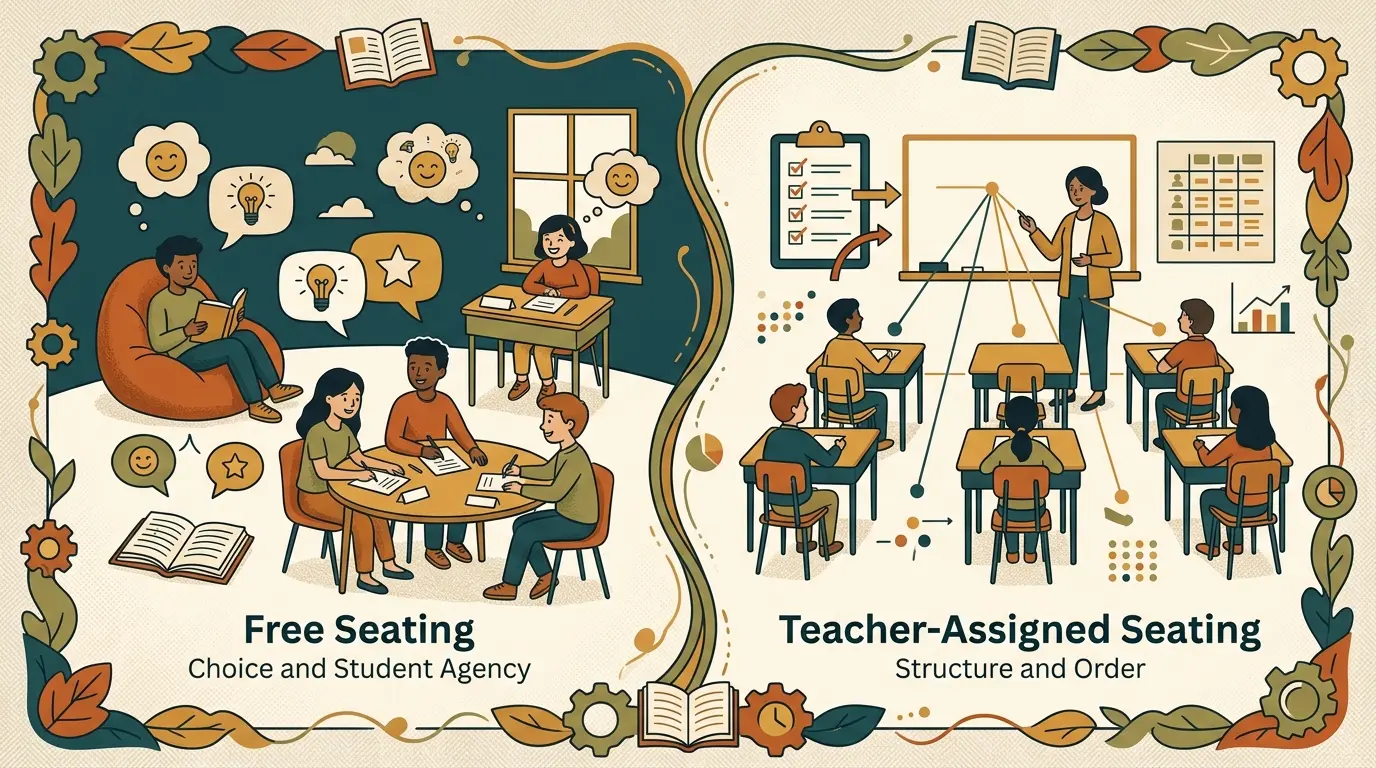
It is one of those classroom management questions that teachers have strong opinions about. Some are firm believers in free seating: students settle faster, the social dynamics feel more natural, and there is one less thing to manage. Others assign every seat on day one and never look back. Most teachers land somewhere in the middle and adjust as the year goes on.
What is less common is making the decision based on what the research actually shows. And the research, it turns out, is more useful here than you might expect. Not because it declares a clean winner, but because it reframes the question in ways that change how you think about the stakes.
Seat Location Actually Affects Learning
The first thing to settle is whether seat location even matters. The easy assumption is that motivated students choose the front, which is why they do better, and that the seat itself is just a symptom of their existing engagement. If that were true, it would weaken the case for teacher-assigned seating considerably: if front seats do not actually cause better outcomes, just reflect them, there is less reason to fight over who sits there.
Perkins and Wieman (2005) challenged this directly. In an introductory physics course where students were randomly assigned seats at the start of the semester, students assigned to the back of the classroom attended class less frequently and earned lower exam scores than students assigned toward the front. The troubling part: when seats were reshuffled halfway through the term and those same students moved to better positions, the gap did not fully close. The early seat placement had already shaped habits and expectations in ways that did not quickly reverse.1Perkins and Wieman's study used an introductory algebra-based physics course at the University of Colorado with 201 students. It is worth noting that the bulk of classroom seating research, including this study, has been conducted at the university level rather than in elementary schools specifically. The dynamics of a large lecture hall and those of a self-contained elementary classroom are meaningfully different. That said, the mechanisms the research describes, such as teacher proximity, ease of monitoring, frequency of interaction, and attention, operate in both settings and have been consistently observed across educational levels. Elementary teachers who have noticed that students in the back corners receive less of their attention are observing the same underlying phenomenon. Perkins, K. K., & Wieman, C. E. (2005). The surprising impact of seat location on student performance. The Physics Teacher, 43(1), 30–33. https://doi.org/10.1119/1.1845987
An earlier study by Stires (1980) looked at this question from a different angle. He compared students who chose their own seats against students assigned seats alphabetically, and found that students in the middle of the room earned higher grades and reported more positive feelings about the course in both conditions. The location advantage held up whether or not students had chosen the seat themselves, which suggests the environment is doing real work, not just reflecting who was motivated to begin with.
This matters because it directly shapes the free-seating question. If where a student sits affects what they get out of school, and students make that choice themselves, then who ends up where is not random. It is the result of student preferences, social comfort, and existing habits. And those things do not always point students toward the positions that would serve them best.
The Self-Selection Problem
When students choose their own seats, they tend to self-sort in predictable ways. Students who are already engaged and comfortable with school often gravitate toward the front and center. Students who feel anxious about attention, who are disengaged, or who want to avoid scrutiny tend to drift toward the back and edges. This means free seating tends to concentrate teacher interaction on the students who already have the most going for them, while reducing it for the students who most need support and visibility.
Teacher-assigned seating interrupts this pattern. A teacher who knows their students can place the student who struggles to focus near the board, not as a punishment, but because that position makes it easier for both of them. A student who gets lost in the back row has a better chance up front, not because they chose it, but because someone with insight into their needs made that decision.
This is the clearest argument in favor of teacher-assigned seating, and it is hard to argue with once you see the logic clearly. If seat location affects outcomes, and students systematically choose positions that do not serve their learning needs, then leaving the decision to students is not a neutral stance. It is an active choice that often benefits the students who least need the help.
Seating Shapes Social Lives, Too
Academic outcomes are only part of the picture. Seating decisions also do something teachers often underestimate: they build and reshape friendships.
A 2022 study by Faur and Laursen followed 235 elementary school students in grades 3 through 5 across two time points roughly thirteen weeks apart. Students sitting next to or near each other were significantly more likely to be friends and to form new friendships over the course of the study. When seat assignments changed between the two time points, students were more likely to become friends with their newly near-seated classmates than with students who remained or moved farther away. This was true even though by the middle of the school year, every student in the class was already familiar with every other student. Proximity was doing something beyond simple familiarity.2Faur and Laursen's study is notable for being one of the first to demonstrate longitudinally that classroom seat assignments, not just seat preferences, drive friendship formation. The study used 235 students (129 boys, 106 girls) in grades 3 through 5 at a single elementary school. Teachers reported seating arrangements; students nominated friends. The finding that new near-seated classmates became new friends even after a full year of shared classroom exposure strengthens the case that proximity is doing active social work, not just making it slightly easier for students to find each other. The researchers included a note of caution alongside their findings: "With great power comes great responsibility. Unintended social consequences have been known to arise when adults meddle in the social lives of children." This is worth keeping in mind alongside the other seating research. Faur, S., & Laursen, B. (2022). Classroom seat proximity predicts friendship formation. Frontiers in Psychology, 13, 796002. https://doi.org/10.3389/fpsyg.2022.796002
The researchers noted that teachers "wield enormous influence over the interpersonal lives of children" through seating, and called on teachers to exercise that power thoughtfully.
When students choose their own seats, they almost universally sit near their existing friends. This feels natural and kind, and in many ways it is. But it also means the seating chart reinforces existing social clusters for the entire year. Students who are socially isolated or who are having difficulty connecting with classmates do not get the benefit of proximity to potential new friends. And students who are embedded in friend groups that pull them toward off-task behavior stay embedded in those groups, right next to each other, all year long.
Teachers who care about community building in their classrooms lose a significant lever when they hand the seating chart over to students.
Teacher-assigned seating lets you use this social mechanism intentionally. A student who tends to be isolated can be placed near a friendly, inclusive classmate. Two students who bring out the worst in each other can be separated. New students can be seated near students who are likely to include them. None of this requires the teacher to explain what they are doing, and most of it works quietly in the background across weeks and months.
A Real Warning From the Research
Seating has power, and that means it also carries risk. A 2020 study by Braun, van den Berg, and Cillessen tested a specific seating intervention in 59 fifth-grade classrooms in the Netherlands. Pairs of students who actively disliked each other were moved closer together, based on earlier evidence that forced proximity could reduce conflict between them over time.
The results were sobering. Students in the intervention classrooms showed more overt aggression and perceived less cooperation among classmates than students in the comparison group. These effects were not limited to the pairs who had been moved. They spread across the wider class climate.3The Braun et al. (2020) study is a follow-up to an earlier randomized controlled trial by van den Berg, Segers, and Cillessen (2012) which had found positive dyad-level effects from the same intervention: students who initially disliked each other and were seated closer together reported liking each other more over time. Braun et al. (2020) extended this to look at effects on the wider class and found that those benefits at the level of the pair may come at a cost to the broader classroom climate. Together, these studies suggest that deliberate seating changes aimed at improving specific student relationships can work at the individual level, but may ripple outward in ways that are harder to predict and control. The lesson is not to avoid strategic seating, but to approach it with awareness of the full classroom rather than focusing only on the target students. Braun, S. S., van den Berg, Y. H. M., & Cillessen, A. H. N. (2020). Effects of a seating chart intervention for target and nontarget students. Journal of Experimental Child Psychology, 191, 104742. https://doi.org/10.1016/j.jecp.2019.104742. Van den Berg, Y. H. M., Segers, E., & Cillessen, A. H. N. (2012). Changing peer perceptions and victimization through classroom arrangements: A field experiment. Journal of Abnormal Child Psychology, 40(3), 403–412. https://doi.org/10.1007/s10802-011-9567-6
The lesson is not that assigned seating is dangerous. It is that seating decisions are more consequential than they often feel in the moment, which means they deserve more thought than they usually get. Deliberate, well-considered seat assignments that are based on your knowledge of the students and their dynamics tend to land well. Reactive or arbitrary shuffles, especially those aimed at forcing together students with real conflicts without any additional support, can make things worse.
The Autonomy Question
The strongest argument for free seating is grounded in something real. Students who have meaningful input in their classroom environment tend to be more engaged and invested. Self-Determination Theory, one of the most thoroughly validated frameworks in educational psychology, holds that people are more intrinsically motivated when their needs for autonomy, competence, and relatedness are supported. The ability to choose where you sit touches the autonomy piece of that picture.4Self-Determination Theory was developed by Edward Deci and Richard Ryan, beginning in the 1980s and refined extensively since. The theory proposes that humans have three basic psychological needs: autonomy (the experience of volition and self-endorsement of one's actions), competence (the experience of effectiveness and growth), and relatedness (the experience of meaningful connection with others). When these needs are supported in educational settings, students show higher intrinsic motivation, better engagement, deeper learning, and greater wellbeing. Research on autonomy-supportive teaching consistently finds that when teachers support student autonomy in structured ways, such as providing meaningful choices within defined boundaries, explaining rationales, and responding to student perspectives, student motivation and learning outcomes improve. The key word is "structured": the research does not find that purely open-ended choice reliably produces better motivation than structured choice, and for younger students, unguided choice can actually increase rather than reduce anxiety. Deci, E. L., & Ryan, R. M. (2000). The "what" and "why" of goal pursuits: Human needs and the self-determination of behavior. Psychological Inquiry, 11(4), 227–268.
But it is worth being careful about what "autonomy support" actually means in this framework. Research on student choice in educational settings shows that the benefits of autonomy depend heavily on how that choice is structured. Offering students a completely open choice, such as "sit anywhere you want," is not necessarily more autonomy-supportive than offering structured input within a teacher-managed system. For younger students especially, fully open choices can produce anxiety rather than freedom, because they require the student to navigate social pressures and competing considerations without any scaffolding.
Practically, this means there is genuine middle ground here. A teacher can survey students about their preferences, take those preferences seriously, and still make the final placement decisions. Students can request a change if something is not working. Seats can rotate periodically so no one is stuck anywhere forever. All of that honors the autonomy principle without sacrificing the teacher's ability to make decisions based on what students actually need.
What This Looks Like in Practice
The research points toward several practical approaches that do not require a complete overhaul of how you manage your classroom.
Assign seats, and use what you know. Your knowledge of your students is the most valuable input into any seating chart. Who needs to be near you for support or monitoring? Who gets pulled off task by a particular neighbor? Which students would thrive near each other socially and academically? These are questions only you can answer, and free seating opts out of them by default.
Run a preference survey before assigning. Ask students which classmates they work well with, which ones they find distracting, and whether there is a spot in the room that tends to help or hurt their focus. Use that input as one of several factors in your placements. Students feel heard without being in charge of the outcome, and you often learn things you would not otherwise know.
Rotate seats every six to eight weeks. The research on peer influence makes a strong case for periodic rotation. Students who sit near the same classmates all year accumulate a lot of exposure to each other's academic habits and social energy. Rotating gives students varied neighbors, prevents any one dynamic from hardening, and can quietly help isolated students build connections with classmates they would not otherwise spend much time near. Most students accept rotation better when they know it is coming and consistent.
Keep some seats fixed. For students with IEP accommodations, behavioral needs, sensory sensitivities, or other specific requirements, strategic seat placement is not optional. It is a support mechanism that needs to stay in place regardless of what else is happening with the rest of the chart. Those placements should be stable and informed by the student's actual needs, not subject to the same rotation as everyone else.
Explain your approach without explaining individual decisions. Students accept assigned seating more readily when teachers acknowledge it and offer a general rationale, rather than just handing down a chart with no context. You do not need to explain why any specific student is in any specific seat. Saying something like "I put thought into where everyone sits because it actually affects how much we learn, and I want everyone to have a fair shot" is honest and enough.
Using Inclusive Seating for This
The main practical obstacle to all of this is the mental load. Tracking which students need to be near you, who should stay apart, which assigned seats lock specific students in place, how all of that changes when you rotate, and how to update the whole system when a new student joins or someone's needs shift, adds up. Most teachers who try to manage all of this manually end up either oversimplifying the seating logic or only updating the chart when a situation has already become a problem.
This is what Inclusive Seating was built for. For each student in your roster, you can record specific restrictions: who they must not sit near, who they should sit near, which area of the room they belong in, or whether they have a fixed assigned seat that never moves. Every time you click Randomize, the algorithm generates a new chart that works within all of those constraints simultaneously, which means rotating seats across the year does not require rebuilding your seating strategy from scratch. The restrictions stay in place; the positions change.
The preference survey approach fits naturally here too. After you survey your students, those responses go directly into each student's restriction settings. A student who identifies a classmate who distracts them gets a separation restriction. A student who says they work best near the teacher's desk gets a proximity restriction. The survey becomes part of the system rather than a stack of notes you have to manually translate into a chart while juggling ten other things. Students get a real say in the process, and you still make the final call.