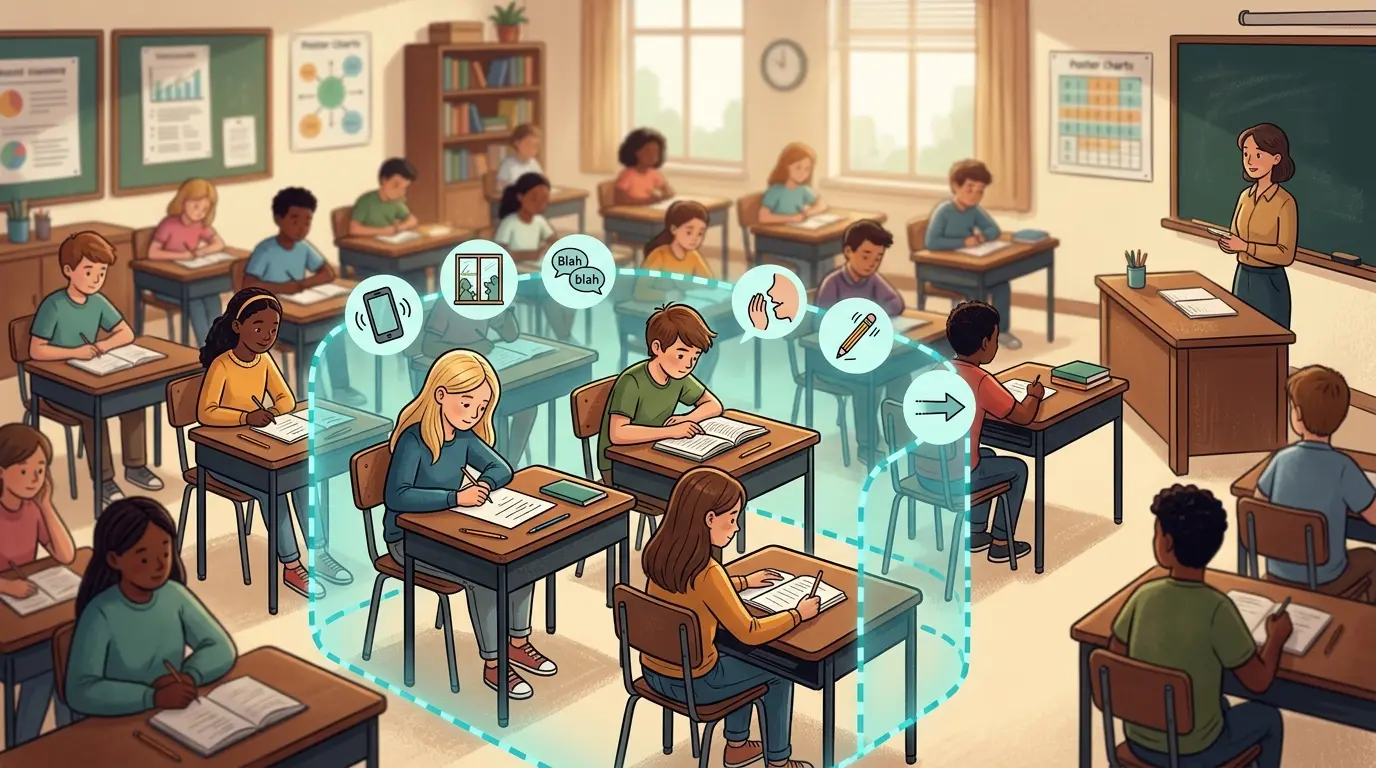
Picture a student who can't stay in her seat past minute four of independent work. She isn't being defiant, and she isn't bored either. Trace her eyes during those four minutes and you'd probably catch them landing on the kid tapping a pencil to her left, then the hallway door someone left cracked open, then a poster of the water cycle that's hung on that wall since September. None of that is her seating chart's fault, exactly. But her seating chart could be doing a lot more to help.
Call it the distraction perimeter: the ring of sound, motion, and visual clutter surrounding every desk in your room. For most students, that perimeter fades into background noise their brain filters out without much effort. For a student with ADHD, filtering isn't automatic. It takes real, conscious effort, and that effort competes directly with whatever you're trying to teach. A seating plan built around this idea doesn't just decide who sits next to whom. It decides how much of the lesson actually reaches the kids who work hardest to hold onto it.
Why a Bad Seat Costs an ADHD Brain More
Every student gets distracted sometimes. The difference for a student with ADHD isn't that distractions exist. It's that the mental machinery for pushing distractions aside runs less efficiently, so a stray sound or a flicker of movement pulls attention away more easily and holds onto it longer.
A 2025 scoping review by researchers Kiri Mealings and Joerg Buchholz pulled together the available research on classroom environments and ADHD and found a consistent pattern: auditory and visual distractions hit attention, writing output, and math performance harder in children with ADHD than in their classmates, and the gap shows up most clearly during independent work.1Not every child described as having ADHD in this body of research was identified the same way. Some studies recruit children with a formal clinical diagnosis. Others, including a widely cited 2019 study on seating and attention, measure inattention and hyperactivity-impulsivity as a continuous spectrum using teacher or parent rating scales, whether or not a diagnosis was ever made. That's a meaningful difference. These findings describe how attentional difficulties in general interact with the classroom environment, not the experience of any single diagnostic label, and an effect that shows up at one end of that spectrum won't necessarily show up the same way at the other. The same review found real reasons for optimism. Interventions as simple as background white noise, a brief fine-motor activity before a task, or swapping a standard chair for a therapy ball measurably helped attention and output in children with ADHD, even when the surrounding environment stayed noisy.
That's the case for treating seating as an intervention rather than an afterthought. You aren't just deciding where a body sits. You're deciding how much of a student's limited attention gets spent fighting the room instead of doing the assignment.
Map the Perimeter Before You Place the Desk
Before assigning a single seat, it helps to walk your own classroom and look at it the way a distractible eight-year-old would. Where does foot traffic cut through? Which wall catches afternoon light bouncing off a window? Which spot has a direct sightline to the hallway, the pencil sharpener, or the class hamster?
The visual environment matters more than most teachers assume, and not only for kids with attention difficulties. Anna Fisher, Karrie Godwin, and Howard Seltman ran kindergartners through the same set of science lessons twice: once in a heavily decorated classroom and once with the walls stripped down. Children spent more time off task and learned less in the decorated version.2Studies like these typically measure "off task" through trained observers using time-sampling: watching a child at set intervals and recording whether their eyes, hands, and attention are on the assigned work. It's a behavioral proxy, not a direct window into learning, though a 2026 follow-up by Godwin and Fisher went further by linking off-task attention to specific, measurable drops in what children retained from the lesson, closing some of that gap. A follow-up study from Godwin and Fisher, published in early 2026, dug into why. Children who spent more time looking away from the lesson toward the classroom displays could later describe those displays in surprising detail, and the more accurately they could describe them, the worse they performed on what they were supposed to be learning. Their attention wasn't wandering aimlessly. It was locking onto whatever competed hardest for it.
None of this means stripping your walls bare. It means being deliberate about what sits in the direct sightline of a desk that belongs to a student who struggles to look away. A seat facing a bulletin board crammed with student art is a different seat than one facing a calmer stretch of wall, even if both are technically the same distance from the teacher.
It's also worth resisting the urge to solve this by tucking the student into an isolated corner, out of everyone's way. Research on seating isolation suggests that move tends to backfire, chipping away at a student's standing with classmates without doing much for their focus. The goal is a quieter sightline, not a quieter social life.
The Neighbor Effect Is Bigger Than People Think
Who sits directly next to a student may matter more than anything else on the chart. A 2024 study led by Noah Forrin found that inattentiveness spreads between neighboring students almost like a contagion: students seated beside a visibly bored or disengaged classmate took roughly half as many notes and scored about nine points lower on a follow-up quiz, compared to students seated next to an engaged peer.3This was a study of 180 undergraduates in a university lecture hall rather than children in an elementary classroom, and the inattentive neighbors were research confederates instructed to act disengaged rather than students who drifted on their own. One asymmetry in the results is worth holding onto: inattentiveness spread between neighbors, but attentiveness did not. A focused seatmate is less able to pull a distracted student back than a distracted seatmate is to pull a focused one away.
That effect runs in both directions. A calm, steady neighbor can anchor a student prone to drifting. A restless or checked-out one can pull them off course fast. For a student with ADHD, whose attention is already working overtime to filter out competing input, an inattentive neighbor isn't just an occasional distraction. It's a second attention demand sitting eighteen inches away for the entire class period. Some student pairings feed off each other in ways worth breaking up entirely, but even outside those extreme cases, this is a real reason to think hard about who ends up shoulder to shoulder.
Proximity to the Teacher Helps, But It Isn't Magic
Sitting near the teacher is probably the single most common seating accommodation for ADHD, and there's good reason for the instinct. Proximity gives a teacher more chances to redirect quietly, check in without singling anyone out, and catch a student drifting before they've missed too much.
The research backs up part of that instinct, and complicates the rest. A 2019 study by Friederike Blume and colleagues placed fifth and sixth graders in a virtual classroom at varying distances from the teacher and measured how much math content they retained. Students learned better overall when seated close to the teacher. But when the researchers looked specifically at students with higher levels of inattention and hyperactivity, proximity didn't give them any extra boost beyond what everyone else got. More severe symptoms predicted weaker learning outcomes no matter where the seat sat.
The takeaway: front and center is a solid default, but it isn't a fix, and a teacher who assumes proximity alone will settle a student's attention is likely to be disappointed. How and when a teacher moves through the room tends to matter just as much as where any one desk sits.
There's a practical wrinkle here too. The area right next to a teacher's desk is often the busiest square footage in the room: the spot where students line up with questions, drop off papers, and linger for a word. A seat that's technically close to the teacher but sits in the middle of that traffic can trade one kind of distraction for another. Close to the teacher and clear of that particular current are two different things, and it's worth checking a seat has both.
Rows, Choice, and Who Actually Picks the Seat
One of the more striking findings in this whole body of research has nothing to do with furniture arrangement. It has to do with who chooses the seat.
In a 2012 study, David Bicard and colleagues tracked disruptive behavior in a fifth-grade classroom under two conditions: days when students picked their own seats, and days when the teacher assigned them.4Studies in this post span very different settings: a real fifth-grade classroom for the seat-choice study, a virtual reality classroom for the teacher-proximity study, and a lab-based kindergarten classroom for the visual-clutter research. Sample sizes range from a few dozen students to several hundred. That mix makes it hard to compare exact effect sizes across studies, though the direction of each finding has generally held up across the different contexts researchers have tested it in. During independent seatwork, disruptive behavior was more than three times higher when students chose their own seats. During group work, it was roughly double. The furniture never changed. The only variable was who made the decision.
The furniture never changed. The only variable was who made the decision.
That result is worth sitting with, especially for teachers who feel a pull toward giving students more say in where they sit. Choice has real value in a classroom, but seating during solo, focus-heavy tasks doesn't seem to be where it pays off. This lines up with what this blog has covered before: rows consistently outperform clusters for independent work, and for a student with ADHD specifically, the reasons stack. A cluster puts more faces, more hands, and more motion inside a student's peripheral vision than a row does, and each one is a small additional draw on attention that a distractible brain has to keep fighting off.
The takeaway: assign the seat yourself during independent work, even for students who handle choice well in other parts of the day. The cost of getting it wrong is measured in real minutes of lost focus.
Building the Perimeter Around One Desk
Put all of this together and a seat that works for a student with ADHD tends to share a handful of features rather than one magic location. It sits somewhere the teacher can reach easily without being planted in a high-traffic lane. It faces a calmer stretch of wall rather than a busy display. Its neighbor is someone steady rather than someone who drifts easily. And it isn't treated as a permanent placement handed down once in September. What works during a unit full of worksheets might not work once the class shifts into partner projects.
None of this requires an elaborate system. It requires actually looking at a room through one particular student's eyes before deciding where their desk goes, and being willing to move it again once you learn something new.
Where This Gets Easier With the Right Tool
This is exactly the kind of seating decision that gets messy fast on paper, because it involves several overlapping requirements for one student instead of a single simple rule. Inclusive Seating was built around that reality. You can set a restriction that keeps a student's desk away from windows, doors, or high-traffic zones, a separate one that keeps a specific pair of students apart, and another that requires proximity to your desk, all attached to that one student at the same time.
Click Randomize, and the algorithm builds a full seating chart around every one of those restrictions at once, whether you're arranging rows for a test or clusters for a group project. The restrictions travel with the student, not with the layout, so switching from rows to a horseshoe for discussion doesn't mean rebuilding an ADHD accommodation from scratch. You can also save a current arrangement and load a different one for a different kind of day, then randomize within whichever layout you're using while every accommodation stays intact.
A seating chart won't replace the other supports a student with ADHD needs. But it's one of the few supports that costs nothing, takes effect the moment class starts, and never has an off day.
