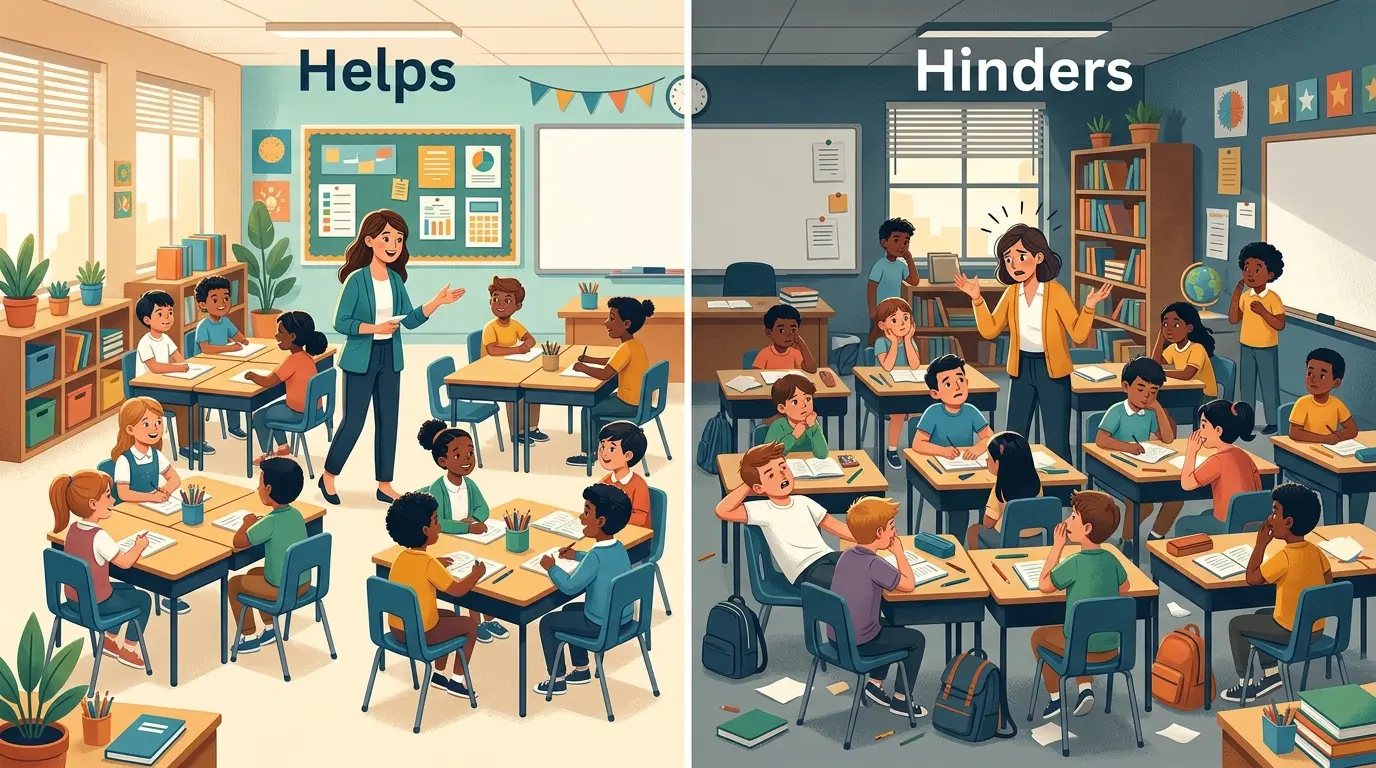
Ask a room full of teachers what classroom management is made of, and you'll hear the same list every time: clear expectations, consistent consequences, a calm voice, maybe a behavior chart taped to the wall. Almost nobody mentions the furniture.
That's a strange omission, because the furniture is doing work whether you plan for it or not. Where a desk sits determines who a student can reach out and touch, who they can see without turning their head, and how easily you can watch them without walking across the room. None of that is neutral. A seating chart is a behavior-management tool. The only question is whether you're the one designing it, or whether it's designing itself.
A wave of research from the past few years backs this up in ways that go beyond old intuitions about rows versus groups. Studies out of the Netherlands, the United States, and China have each tested a different piece of the same idea: seating position changes what a teacher notices, how a specific student behaves, and how safe a classroom feels for the students inside it. These studies weren't designed around the same question, yet they keep landing in the same place. Layout isn't decoration. It's one of the most direct levers a teacher has over classroom behavior, and most classrooms aren't using it on purpose.
Behavior Management Starts With What You Can See
Jacob Kounin, one of the most influential researchers in classroom management, spent years studying why some teachers seemed to catch problems before they started while others were always a step behind. He landed on a concept he called withitness1Withitness describes a teacher's ability to communicate awareness of everything happening in the classroom, even multiple things happening at once, and to intervene with the correct student at the right moment rather than a nearby bystander. Kounin's original research found that teachers rated high in withitness had significantly fewer behavior problems in their classrooms than teachers rated low in withitness, largely because they caught issues while those issues were still minor.: the sense, real or perceived, that a teacher has eyes everywhere in the room. Teachers who show withitness respond to the right student at the right moment, before a small issue turns into a bigger one. Teachers who lack it often catch the wrong student, catch the behavior too late, or miss it completely. Kounin's work is decades old, but two recent studies confirm that withitness isn't just a personality trait. It's heavily shaped by where students are sitting.
In 2022, researchers at Zhejiang Normal University tested this directly. Cao and colleagues ran an inattentional blindness experiment with more than 120 pre-service teachers: each one was asked to count students raising their hands in a simulated classroom while, without warning, one student got up and walked out. The seat that student came from mattered enormously. Teachers caught the departure far more often when the seat sat toward the edge of the room than when it sat near the center, and seats toward the lower left of a teacher's field of view were missed more often than seats toward the upper right. Nothing about the classroom changed. Only the seat did.
A follow-up study published in Current Psychology in 2026 pushed the question further. Cao and a different set of colleagues tested 230 special education teachers, both new and experienced, on their ability to detect off-seat behavior in two conditions: a still classroom scene, and one where the teacher was moving around the room the way they normally would during a lesson. Front-row seats were detected significantly more often than seats farther back, in both conditions, and the pattern held regardless of how many years a teacher had spent in the classroom. Experience didn't fix the blind spot. Seating position did.
The takeaway: The hardest seats to supervise aren't necessarily the ones farthest from your desk. They're the ones outside your natural sightline, often centrally placed or off to one side, where your eyes have to work to land. Before deciding who needs a seat near you for behavior reasons, walk your own room and notice where your eyes actually go without effort.
Rows Cut Down on Disruption, and Teachers Already Know It
If you've ever moved a class into rows specifically because things felt chaotic, you weren't imagining the effect. A 2023 study out of Radboud University interviewed thirteen upper-elementary teachers about how and why they build their seating charts. The researchers, led by Nathalie Hoekstra, expected to hear mostly academic reasoning. Instead, several teachers described choosing a row arrangement specifically to prevent disruptions and unsafe social situations. That's a direct, deliberate use of furniture as a behavior tool, described in the teachers' own words, not inferred from test scores after the fact.
The same study found that teachers rarely stop at one goal. They also used seating to support students they described as socially weaker, placing them in central, visible spots so classmates would notice and include them, and they paired students with less favorable social standing next to supportive classmates rather than leaving that connection to chance. Behavior management and social support weren't separate decisions. They were made in the same breath, with the same chart.
Rows do come with a cost worth naming. Decades of classroom observation research have documented what's often called the action zone, first described by Ray Adams and Bruce Biddle in 1970 and replicated many times since: students seated front and center receive noticeably more of a teacher's attention, more questions, and more chances to participate than students seated in back corners, regardless of ability. If a student who struggles with behavior ends up in one of those corners, rows can quietly work against you instead of for you. The fix isn't to avoid rows. It's to decide who sits where inside them, rather than letting the arrangement make that decision by default.
The takeaway: Rows genuinely help with disruption and unsafe peer dynamics, and experienced teachers already use them that way. But rows only deliver that benefit for students you've deliberately placed within your own sightline. A student who struggles with behavior, seated in a back corner because that's where a desk happened to be open, isn't getting the benefit rows are known for.
Where a Specific Student Sits Changes How They Behave
So far, this has been about what a teacher can see. The next question is what happens to a specific student once you decide where to put them, and the research here is more encouraging than you might expect.
In 2018, Yvonne van den Berg and Saskia Stoltz ran a randomized controlled trial across 64 classrooms, focused on 221 fourth- through sixth-grade students whose teachers had flagged them for elevated externalizing behavior2Externalizing behavior is the term researchers use for a cluster of behaviors including noncompliance, impulsivity, aggression, and disruption, as opposed to internalizing behavior such as anxiety or withdrawal. Deviancy training refers to a documented risk in which students who already share similar behavior challenges reinforce that behavior in each other when grouped together, gradually shifting the whole group's behavior toward its own norm rather than toward the classroom's expectations.. Rather than isolating these students or seating them together, researchers carefully placed them next to classmates likely to model calmer behavior. Over the course of the study, the students with externalizing behavior were better liked by their new seatmates, and teachers reported measurably fewer behavior problems from them. The seating decision itself was the intervention. Nothing else changed.
That result matters because it cuts against two instincts many teachers have. The first is to seat a few disruptive students together, on the theory that it keeps the disruption contained in one part of the room. Research on peer influence suggests the opposite tends to happen: students seated together reinforce each other's behavior, a pattern researchers call deviancy training, pulling the whole cluster toward its own average, which usually isn't the average you want. The second instinct is to isolate a struggling student entirely, seating them alone as a kind of containment strategy. A 2025 study of K-3 classrooms found that roughly half of students at risk for emotional and behavioral disorders were seated in isolation from their peers, and the researchers flagged this as a real concern rather than a solution. Isolating a student can protect the rest of the room in the short term, but it does little for the student's peer standing, and peer standing is part of what keeps behavior from escalating in the first place.
The influence between neighboring students runs in both directions, and it isn't limited to students already flagged for behavior. A 2024 study by Naomi Forrin and colleagues seated students in a lecture hall next to a research confederate instructed to look visibly bored and disengaged. Students seated beside that confederate wrote roughly half as many notes and scored measurably lower on a follow-up quiz than students seated elsewhere in the same room, listening to the same lecture. The effect was specific to direct neighbors. Students two or three seats away weren't affected. For an elementary classroom, the practical version of this finding is simple: a seating chart isn't just managing the students you're worried about. It's managing who sits close enough to catch what those students are doing, in either direction.
The takeaway: A student flagged for behavior doesn't need to sit alone, and doesn't need to sit with other students who share the same struggle. The evidence points toward a specific, supportive neighbor: someone whose own behavior the student is likely to pick up on, seated close enough that the effect actually reaches them.
Layout Also Protects Safety, Not Just Attention
Behavior management isn't only about keeping students on task. It's also about keeping them safe from each other, and the research on that front has moved from correlation to controlled experiment in just the past two years.
In 2024, Tessa Lansu and colleagues ran a field experiment across 182 classrooms and nearly 3,000 students in grades three through eight. Teachers commonly separate a student who is being bullied from the student bullying them, and seat the victim near a friend, on the assumption that it helps. The researchers tested this directly by comparing classrooms where seating was deliberately arranged this way to classrooms where seating was assigned at random. Being seated next to a classmate raised the odds of a mutual friendship forming from about 15 percent to about 22 percent, on average. A strategy teachers had been using on instinct held up under a controlled test.
The takeaway: For a student dealing with peer conflict, the seat you assign isn't a small gesture. It's one of the few levers with actual experimental evidence behind it, and it costs nothing to use.
One Layout Is Not Enough
Put these findings side by side and a pattern emerges. None of them argue for a single best arrangement. They argue for two separate layers of planning that most seating charts collapse into one. The first layer is the room-wide layout: rows for a quiz, a U-shape for morning meeting, clusters for a group project. The second layer is a set of rules that belong to individual students, not to the layout: this student needs to stay in your direct sightline, this student needs distance from that student, this student does better next to a calm, supportive peer than alone or in a cluster of similar struggles.
Where a student sits changes what a teacher can see. What a teacher can see changes what a teacher can manage.
Most classrooms only plan the first layer. A teacher picks rows or groups for the week and calls it done, and the individual rules, if they exist at all, live in a teacher's memory rather than anywhere durable. That works fine until the layout has to change for a special activity, at which point every individual accommodation has to be reconstructed from scratch, usually under time pressure, right before students walk in.3This research spans a wide range of ages, countries, and settings, which is worth keeping in mind. The seating-detection studies used pre-service and in-service teachers in China, tested with simulated or video-based classroom scenes rather than a live class of children. The interview study drew on thirteen Dutch upper-elementary teachers. The externalizing-behavior trial involved fourth- through sixth-graders in the Netherlands. The K-3 study was conducted in the United States. The bullying field experiment spanned grades three through eight, also in the Netherlands. The neighbor-contagion study used university students in a lecture hall, not elementary classrooms. The direction of these findings lines up well across that range, but effect sizes are unlikely to look identical in every classroom, and no single study here was conducted with the youngest elementary grades specifically in mind.
How Inclusive Seating Makes This Practical
This is the exact problem Inclusive Seating is built to solve. Every student in a class file can carry their own restrictions: stay near the teacher's desk, keep distance from a specific classmate, sit within reach of the door, or any other rule a teacher needs to track. Those restrictions belong to the student, not to whatever layout happens to be on screen.
The magic wand button cycles through eight preset layouts, including rows, grouped tables, a U-shape, a circle, and paired desks facing each other, so switching the room-wide structure for a different kind of lesson takes seconds rather than a lunch period spent moving furniture on a floor plan. Clicking Randomize after that generates a full seating chart that respects every individual restriction already in place. A student who needs to stay in a teacher's direct line of sight keeps that placement whether the room is arranged in rows for a test or a horseshoe for a class discussion.
Teachers can also save more than one layout for the same class and load whichever one the day calls for, without losing a single accommodation in the switch. That's what makes the two-layer approach from the research above realistic on a Tuesday morning, not just on paper. The room-wide layout can change as often as your lesson plan does. The behavior-specific decisions built into it don't have to change with it.
