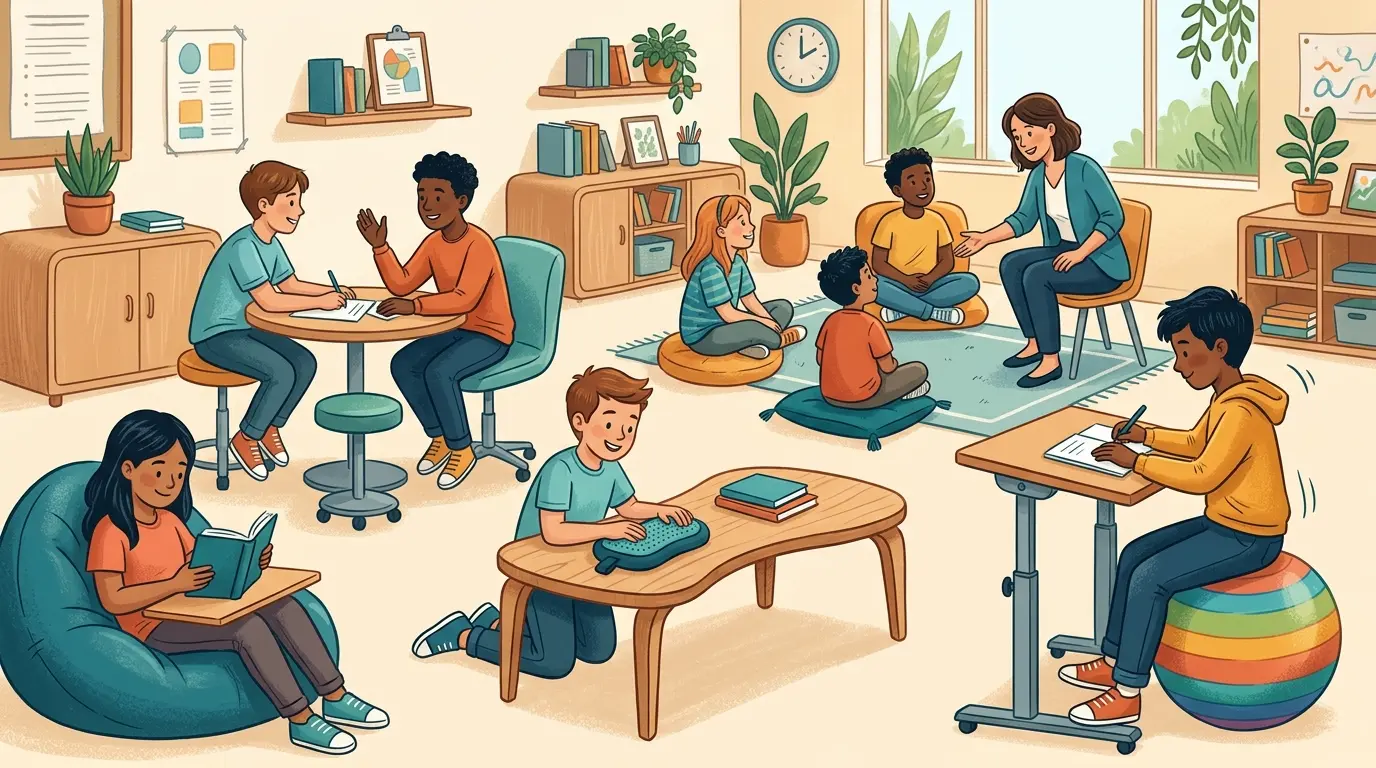
Every teacher who has had a student with ADHD in their classroom has heard the same piece of advice: move them to the front. It shows up in IEP meetings, in hallway conversations between colleagues, and in nearly every generic classroom management guide ever printed. It isn't wrong, exactly. But it treats a well-studied question as though it already had a simple answer, and the research tells a more specific story.
ADHD is common enough that most classrooms have more than one student living with it. National data collected in 2022 and published in 2024 put the number at about 11.4 percent of children ages 3 to 17 in the United States, or roughly 7.1 million kids, close to one in nine.1Danielson, M. L., Claussen, A. H., Bitsko, R. H., Katz, S. M., Newsome, K., Blumberg, S. J., Kogan, M. D., & Ghandour, R. (2024). ADHD prevalence among U.S. children and adolescents in 2022: Diagnosis, severity, co-occurring disorders, and treatment. Journal of Clinical Child & Adolescent Psychology, 53(3), 343–360. https://doi.org/10.1080/15374416.2024.2335625. In a class of 25 or 26 students, that works out to two or three children whose brains handle attention, distraction, and movement differently from their classmates' brains, in nearly every classroom in the country, every single year.
Seating is one of the few tools a teacher can use on this every day, for free, without a form to fill out or a meeting to schedule. The trouble is that the common advice, front-row seating, fidget-friendly chairs, keep them close to the teacher, gets applied without much attention to what the underlying research actually found. Some of it holds up well. Some of it turns out to be more specific than the popular version suggests. And at least one common instinct, when tested directly, appears to work against the student it's meant to help.
The Front Row Isn't the Automatic Fix It's Made Out to Be
The front-row recommendation comes from real classroom research, just not research that was designed with ADHD in mind. Teachers direct more questions, more eye contact, and more spontaneous interaction toward the front and center of a row arrangement, a pattern researchers have called the action zone since it was first documented in 1970.2Adams, R. S., & Biddle, B. J. (1970). Realities of teaching: Explorations with video tape. Holt, Rinehart and Winston. The original study and most of the research that followed it measured classrooms as a whole rather than isolating outcomes for students with ADHD specifically, so the extra teacher contact that comes with front-row placement is a reasonable inference for this group rather than a directly tested one. That extra contact is genuinely useful for a student who benefits from frequent check-ins and quick redirection, which describes a lot of kids with ADHD.
But the front row is also, in a lot of classrooms, the busiest real estate in the room. It tends to sit closest to the teacher's desk, which is where students line up to ask questions, turn in papers, and grab supplies. It's often the first stretch of floor anyone crosses on the way in the door. For a student whose attention is already hard to hold onto, more proximity to the teacher can come bundled with more foot traffic and more competing activity to track, which can cancel out some of the benefit before it has a chance to help.
Seating guides written specifically for ADHD tend to land somewhere more targeted: close enough for easy eye contact and a quiet check-in, but out of the busiest path through the room. That isn't a formal experimental finding so much as accumulated classroom practice, but it fits with the research on distraction below. What predicts a student's ability to hold attention isn't distance from the front wall. It's distance from whatever is most likely to pull that attention away.
What Actually Predicts Distraction Isn't the Row Number
A 2022 study gives a clearer picture of what that pull looks like. Researchers built a virtual reality classroom and had 20 children ages 8 to 12, all diagnosed with ADHD, work through math problems and attention tasks while eye-tracking equipment recorded exactly where they looked. Partway through, a distraction would appear, a school bus rolling past the window, for instance. The researchers weren't just interested in whether a student glanced over. They tracked what happened afterward, and found that the more hyperactive and impulsive a child's symptoms, the harder it was for them to turn their eyes and head back to the board once the distraction had passed.3The study used a small sample of 20 children in a simulated virtual reality classroom, so the exact effect sizes shouldn't be treated as a precise real-classroom estimate. The underlying pattern, that more hyperactive and impulsive symptoms predicted more difficulty disengaging from a distraction once it appeared, lines up with a broader body of research on attention and distractibility in ADHD. Stokes, J. D., Rizzo, A., Geng, J. J., & Schweitzer, J. B. (2022). Measuring attentional distraction in children with ADHD using virtual reality technology with eye-tracking. Frontiers in Virtual Reality, 3, 855895. https://doi.org/10.3389/frvir.2022.855895.
That detail matters more than it might sound like at first. It means the cost of a distraction isn't the glance itself. It's the drag afterward, the extra beat it takes to re-engage, repeated every time something worth looking at crosses a window, a doorway, or a busy corner of the room. A seat near a window that faces the playground, or a door that opens onto hallway traffic, sets that cycle in motion again and again across a single lesson, regardless of which row the desk happens to sit in.
Neighbors add a second layer to this. Research on attention contagion has found that inattentiveness spreads specifically to the students seated directly beside a distracted peer, more than to those in front, behind, or across the room. For a student who is already working harder than most of the class to hold focus, a chatty or restless deskmate isn't a minor annoyance. It's a second distraction source stacked directly on top of whatever the room itself is already offering. It's also part of why rows tend to support independent, quiet work better than table clusters do: fewer neighbors within easy reach means fewer chances for someone else's off-task moment to become the student's own.
Movement-Friendly Seating: What the Evidence Actually Supports
Fidget-friendly seating, stability balls, wobble stools, standing desks, rests on a reasonable idea: for a lot of kids with ADHD, movement isn't defiance, it's regulation. The research on whether it actually works is more mixed than the marketing around these products usually lets on.
A small early study found that stability ball seating improved on-task behavior and reduced hyperactivity specifically among students already flagged for attention concerns, and a later randomized controlled trial linked stability balls to better academic achievement and fewer discipline referrals. But when researchers tested the same idea on a general education fourth-grade classroom, without singling out students who actually needed extra movement, they found no meaningful difference in on-task behavior at all.4Fedewa, A. L., & Erwin, H. E. (2011). Stability balls and students with attention and hyperactivity concerns: Implications for on-task and in-seat behavior. American Journal of Occupational Therapy, 65(4), 393–399. Fedewa, A., Davis, M. A., & Ahn, S. (2015). Effects of stability balls on children's on-task behavior, academic achievement, and discipline referrals: A randomized controlled trial. American Journal of Occupational Therapy, 69(2), 1–9. Erwin, H. E., Fedewa, A., Ahn, S., & Thornton, M. (2016). Elementary students' physical activity levels and behavior when using stability balls. American Journal of Occupational Therapy, 70(2), 700220010p1–700220010p7. The benefit, where it shows up, seems to belong to the kids who need it rather than to students in general.
A 2024 pilot study pushed on this further, comparing walking, standing, and sitting in children ages 6 to 11 with a diagnosis of ADHD, using standardized tests of executive function. The differences between the three conditions weren't statistically significant, though standing showed the most favorable trend across several measures. The researchers were upfront that their study was a feasibility test with a small sample, not a conclusive trial, and called for larger studies to settle the question properly.5Barudin-Carreiro, A., Camhi, S. M., Stanish, H. I., & Wright, J. A. (2024). Acute effects of walking and standing on executive function in children with attention deficit/hyperactivity disorder: A feasibility study. Children, 11(3), 341. https://doi.org/10.3390/children11030341.
Put together, the honest read is that movement options help some kids with ADHD specifically, they don't reliably help kids in general, and the strongest evidence so far comes from small studies that leave real room for a bigger trial to change the picture. That's a good reason to make a stability ball or a standing option available to a student who wants one. It's not a good reason to treat it as a guaranteed fix, or to turn it into something that singles a kid out in front of classmates. The version that seems to work best in practice is quiet: offer the option, and let the student decide whether to use it.
Isolation Is Not a Behavior Plan
When a student's behavior is hard to manage, moving their desk away from the group is one of the most common responses a teacher reaches for, sometimes framed as a fresh start, sometimes as a straightforward consequence. A 2025 study of K through 3rd grade classrooms found that this instinct is widespread: roughly half of students identified as having or being at risk for emotional and behavioral disorders, a group that overlaps heavily with students who have ADHD, were seated apart from their peers rather than among them.6This study followed students identified as having or being at risk for emotional and behavioral disorders, a category that overlaps substantially with ADHD in the classroom supports students receive but is not identical to an ADHD diagnosis. Granger, K. L., Vogel, K., Vieten, E., Chow, J. C., & Broda, M. D. (2025). Classroom seating placements of students with or at risk for emotional and behavioral disorders. Journal of Emotional and Behavioral Disorders. Advance online publication. https://doi.org/10.1177/10634266251365180.
What the researchers found next is the part worth sitting with. Seat isolation was linked to a measurably worse reputation among classmates. Isolated students received more peer nominations for fighting and giving the teacher a hard time, and fewer nominations for being nice and cooperative, than students with comparable behavior histories who were seated among the group. You can read more about this pattern in our earlier look at seating isolation. Isolation didn't appear to fix the underlying problem. It just changed how the rest of the class saw the student sitting in the corner.
Isolating a struggling student swaps one problem for another: the behavior that worried you in the first place, for a reputation among classmates that outlasts the seating chart that created it.
None of this means a student should never be moved away from a specific classmate. If two kids consistently set each other off, separating that pair is a reasonable, targeted response. The difference is between removing a student from one or two peers who are a genuine problem, and removing them from the entire class as a standing policy. And if a student truly needs a lower-stimulation space to reset during a hard moment, a calm corner they can choose to use works very differently, psychologically, than a fixed desk in the back that they can't leave.
What This Actually Looks Like in a Classroom
Picture a nine-year-old with ADHD on the first day of a new seating chart. The research above doesn't point to one perfect desk. It points to a short list of things worth checking at once. Is the seat close enough for easy eye contact with you, without sitting in the busiest corridor of the room? Is it away from the window that looks out on the playground, and away from the door that opens onto hallway traffic? Are the deskmates steady rather than the two most talkative kids in the class? Does the student have access to a wobble cushion or a standing option if they want one, without a big announcement about it?
None of that is a one-time decision. A seat that works in September can stop working once the unit changes, the class dynamic shifts, or a new student joins the group nearby. Seating charts are worth revisiting on a real schedule rather than set once and left alone for the year, the same way a seat that's right for a test is often wrong for a discussion circle or a group project.
Where Inclusive Seating Fits In
All of this is easy to describe and hard to hold in your head every time you build a new chart, especially with 25 students at once and a running mental list of who can't sit near the door, who needs a calm neighbor, and who has a standing desk tucked in the back corner. Inclusive Seating is built so those decisions get made once and then get respected automatically from then on.
For a student who does better away from a specific window or door, a Must not sit near restriction keeps that landmark off-limits every time you randomize, without you needing to remember it fresh each week. For a student who needs steady eye contact with you or a specific calm neighbor, a Must sit near restriction handles the other side of the same problem. Restrictions belong to the student rather than to a single layout, so they carry over automatically whether the room is set up in rows for a quiet test or clusters for a group project, which is exactly the kind of accommodation a lot of IEPs and 504 plans already call for under the heading of preferential seating.
And because the tool genuinely rotates who sits next to whom, no single classmate becomes an unplanned, semester-long neighbor for better or worse. None of this replaces a teacher's judgment about a particular kid in a particular room. It just means the seating chart that reflects what the research actually recommends doesn't have to be rebuilt from a blank grid every time something needs to change.
