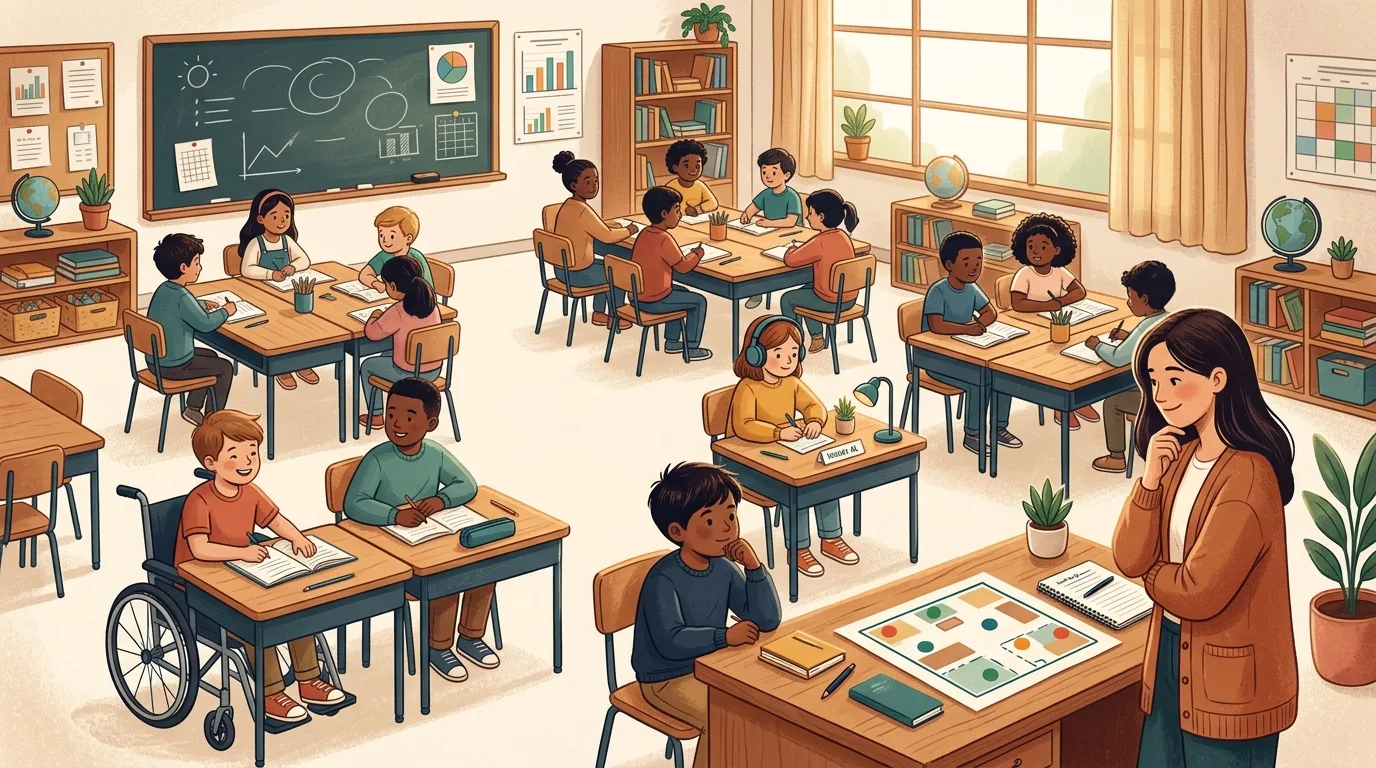
Most seats in your classroom are interchangeable. Any student could sit in them, and in a few weeks a different one probably will. Then there's the seat that never changes hands: the desk with the tilted writing surface the occupational therapist ordered, the spot by the outlet where a video magnifier plugs in, the end of a row with enough room for a wheelchair to turn. That seat belongs to one student, and it's going to belong to them until June.
Assigning it is the easy part. The hard part is everything around it. Where the seat goes, who ends up beside it, and whether the rest of your chart can keep changing while one desk stays put all shape what that student's year actually feels like. This guide is for general education teachers who've been handed a placement requirement and want to get it right without freezing the whole room.
When a Student Needs an Assigned Seat, Not Just a Seating Rule
Most placement needs in an IEP or 504 plan aren't really about one seat. "Near the teacher" can be met by several desks. So can "away from the door." We've written about turning IEP and 504 accommodations into seat rules, and rules like those are flexible on purpose. They describe a zone, and any desk inside the zone will do.
An assigned seat is for the cases where only one spot in the room works, usually because something physical won't move. Equipment is the most common reason. Standing desks, adapted chairs, a slant board clamped to one desk, a tablet or magnifier that needs an outlet within reach of its cord: if the equipment can't travel, the student can't either. Physical access comes next. A student who uses a wheelchair or a walker needs a seat they can get to without asking three classmates to scoot in, and that limits you to the spots along a wide, clear path.
Medical plans can pin a seat down too. A student with a seizure action plan may need open floor around the desk, and a student who heads to the nurse at 10:15 every morning does better with a short, quiet route to the door. And some students, often autistic students or students with anxiety, have plans that call for a predictable spot. For them, the sameness is the accommodation.
Here's a quick test. Picture sliding the desk three feet in any direction. If the accommodation would break, lock the seat. If it would still work, write a rule instead and let the student move with everyone else.
The test matters because every locked seat takes a desk out of play. One or two won't strain anything. Lock six and you're no longer making a seating chart. You're filling in gaps between fixed points, and the kids parked beside those points end up stuck too.
Where You Put the Assigned Seat Matters More Than You'd Think
The seat that fits the equipment is often the seat nobody else wanted. It's at the end of the back row because that's where the outlet is. It's beside the door because that's where the wheelchair fits. It's off to the side because the paraprofessional needs a chair next to it. Each choice makes sense alone. Put together, they can quietly move a student to the edge of the class.
Rebecca Feldman, Erik Carter, and their colleagues documented how often that happens. They ran 324 full-period observations of 108 high school students with severe disabilities who were enrolled in general education classes. The students weren't present for a large share of those classes, and when they were in the room, they were rarely near classmates without disabilities. Watching a comparison group of peers in the same rooms made the gap plain: the students with disabilities were missing social opportunities their classmates got every day.1This was an observational study of high school students with severe disabilities, including autism and intellectual disability, so it describes older students with more intensive support needs than many elementary classrooms serve. It shows how often students were near their peers, not why they weren't. The data are also more than ten years old, and some schools have changed how they support students in general education since then. Being enrolled in a class and sitting among the class turned out to be two different things.
Edge seats carry a social cost even when there's no physical reason for them. In a 2025 study of kindergarten through third-grade classrooms, Kristen Granger and her colleagues found that about half of students with or at risk for emotional and behavioral disorders had been given a seat apart from their classmates. Those isolated students had worse reputations among their peers, with more nominations for fighting and giving the teacher a hard time and fewer for being nice. How far a seat sat from the teacher's desk showed no link to reputation at all.2This study found an association, not a cause. It's possible some students were seated apart because classmates already saw them negatively, rather than the other way around. The students in it had or were at risk for emotional and behavioral disorders, not physical disabilities or medical needs, and the authors describe their findings as preliminary.
Those students were mostly isolated as a behavior strategy, which isn't the same as a desk placed for a wheelchair. But classmates don't know the reason behind a seat. They only see who sits apart. We dug into this more in our post on the hidden risk of isolating students.
So before you lock anything, look for a version of that seat that sits inside the arrangement. If the only outlet is on the back wall, ask whether a longer charging cable or a battery pack could free the device from it. If the wheelchair needs clearance, build the open space into the end of a table group instead of leaving the student alone beside an empty table. The ADA's design standards call for an accessible route at least 36 inches wide and a 60-inch circle for a wheelchair to turn around in, which makes a handy yardstick when you're eyeballing the gaps between desks. If a paraprofessional needs to be close, give them a stool they can pull up and push away, not a permanent chair that turns into a wall between the student and the kid at the next desk.
Ask the Student, and the Specialists, Which Seat Works
The person most likely to know whether a seat works is the student sitting in it. That sounds obvious, and it gets skipped all the time.
In 2025, Dagmar Sedláčková and an international team of researchers pulled together 19 qualitative studies in which students with physical disabilities, ages 6 to 20, described their own experiences in mainstream schools. The students talked about daily struggles getting around the building and taking part in class, and about how those struggles affected the way they saw themselves and what they expected from their futures. The reviewers concluded that many of these barriers can be overcome, and that giving students a voice in decisions about their own schooling is part of how.3A qualitative review gathers what students said about their experiences. It can show which problems come up again and again, but not how common each one is or how much any particular fix helps. The 19 studies came from different countries and school systems, and a student's experience of access depends a lot on the building and the policies around them.
A 2026 study from Australia reached a similar place from the adult side. Kerryn Bagley and her colleagues asked an expert panel what separates a high-quality adjustment for a student with a disability from a box-checking one. The panel's answer was that good adjustments work on several levels at once. They support real participation, they bring the adults around the student into the conversation, they leave the student some choice, and they fit the student's actual learning goals.4This finding comes from a panel of four people in Victoria, Australia, whose discussions were part of building a scale to rate adjustments. It reflects expert judgment rather than measured student outcomes. Australia's "reasonable adjustments" framework also differs in its legal details from IEPs and 504 plans in the United States. A seat by the door technically meets a plan. A seat the student helped choose, near a friend, checked by the physical therapist, meets it well.
In practice, this comes down to a couple of short conversations. Ask the student where they like to sit and where they don't, and ask privately. Older elementary kids will usually tell you straight out. Younger ones often answer better if you walk the room together and let them point. Then check with whoever knows the requirement best. That might be the occupational or physical therapist for furniture and positioning, the vision teacher for glare and distance from the board, the school nurse for a medical plan, or the case manager when you're not sure what the plan actually requires. Five minutes with the right person might reveal that "seat near the door" was really about quick nurse visits, which suddenly makes three desks work instead of one.
A Locked Seat Shouldn't Come with Locked Neighbors
Here's the part that's easiest to miss. When one desk never moves, it's tempting to leave the desks around it alone too. The student is settled, the neighbors are kind, and nobody's complaining. By March, that student has sat beside the same two classmates for six months while everyone else in the room has rotated through half the class.
That's a real loss, because the seat next to you is one of the strongest forces in a classroom's social life. Randomized experiments have found that simply sitting beside someone makes a friendship between the two of you noticeably more likely, which we covered in our post on how assigned seating boosts friendships. A student whose neighbors never change gets fewer of those chances than anyone else in the room.
A student whose neighbors never change gets fewer of those chances than anyone else in the room.
Neighbors can affect schoolwork too, though not always the way teachers expect. Tamás Keller and Felix Elwert randomized the seating charts of 195 classrooms in Hungary, covering 3,365 students in grades 3 through 8, and kept the deskmate pairs in place for a full semester. For the average student, sitting beside a higher-achieving deskmate made no meaningful difference. The effects showed up at the ends. The lowest-achieving students did better when they sat beside the highest achievers, and the highest achievers did worse beside the lowest, with their grades dropping by about 0.2 standard deviations.5The results for the highest and lowest achievers came from exploratory analyses the authors ran after their main pre-registered tests, so they deserve more caution than the finding about the average student. The study grouped students by prior grades, not by disability, and it only included classrooms with freestanding two-person desks. It can't tell us how deskmates affect students with disabilities in particular.
For a fixed seat, that means the neighbor role is both a gift and a load. A student beside a steady, capable classmate can get a real boost, and that classmate pays a small price if the pairing never changes. Rotating the neighbors spreads both around. It also keeps any one child from becoming the official helper all year, a job that wears down even the kindest eight-year-old eventually.
So when you change the rest of your chart, change the seats around the assigned one too. Keep a short list of three or four classmates who work well beside that student and rotate through them with everyone else. If the plan names a specific peer partner, keep that partner in place and rotate the other side.
How to Keep the Rest of Your Seating Chart Moving
Fixed seats and a fresh chart can live together. It's a puzzle, and it's exactly the kind of puzzle computers are good at.
In a 2025 paper, Alessandro Hill and his colleagues built a seating method that tries to put each student next to as many unfamiliar classmates as possible while still honoring instructor preferences and individual students' special needs. When they tried it in three real university classes with more than 70 students, 40 percent of the new-neighbor pairings it created turned into actual connections between students who hadn't known each other before.6This was a mathematical optimization study tested in university classes, not elementary classrooms, and the three real-world trials had no comparison group seated some other way. It shows that a seating chart can honor fixed requirements and still mix students up, but not how much that mixing helps younger children. The fixed requirements didn't stop the mixing. They just became part of the puzzle.
The same logic works on paper. Place the students with assigned seats first. Then place anyone with strong rules, like a pair who can't sit together. Fill in everyone else last, and shuffle that last group every time you change the chart. The fixed points stay fixed, and the rest of the class gets the same variety it would have had anyway.
Two more things belong in the plan before you call it finished. Walk the route from the assigned seat to the exit and make sure it stays clear once backpacks pile up and table groups drift. Then write the seat and the reason for it, in plain words, in your substitute folder: "Desk 4 is Maya's. Her standing desk lives there, and the aisle on her right needs to stay clear." Keep that note in the folder, not on the chart taped to the wall, since a student's needs are nobody else's business. A sub who doesn't know why a desk is reserved will eventually let someone else sit in it.
Setting Up Assigned Seats in Inclusive Seating
Inclusive Seating treats an assigned seat as a real object in your room. When you build your classroom layout, drag in an assigned seat (the one with the lock icon) and put it exactly where that student's desk belongs, whether that's beside the outlet or at the open end of a table group. Each assigned seat gets a number. Then open the student's restrictions and pick that seat under Must sit in.
When you click Randomize, students with assigned seats are placed first, students with other restrictions go next, and everyone else is shuffled into the seats that are left. The neighbors around a locked seat change every time you randomize, with no extra work from you. If the student's plan names a peer partner, give that classmate a Must sit near restriction pointing at the student. The locked student won't move, but the partner will land beside them.
Saved classes bring back the layout, the locked seat, and every restriction just as you left them. One thing to know: the auto-layout button builds a fresh room of regular seats, so after you generate a new arrangement, drop the assigned seat back where it belongs before you randomize. The roster PDF lists each student's restrictions next to their name, which gives your sub folder and the next IEP meeting a clean page to work from.
The seat that never moves is still part of the class. Put it somewhere that says so.
