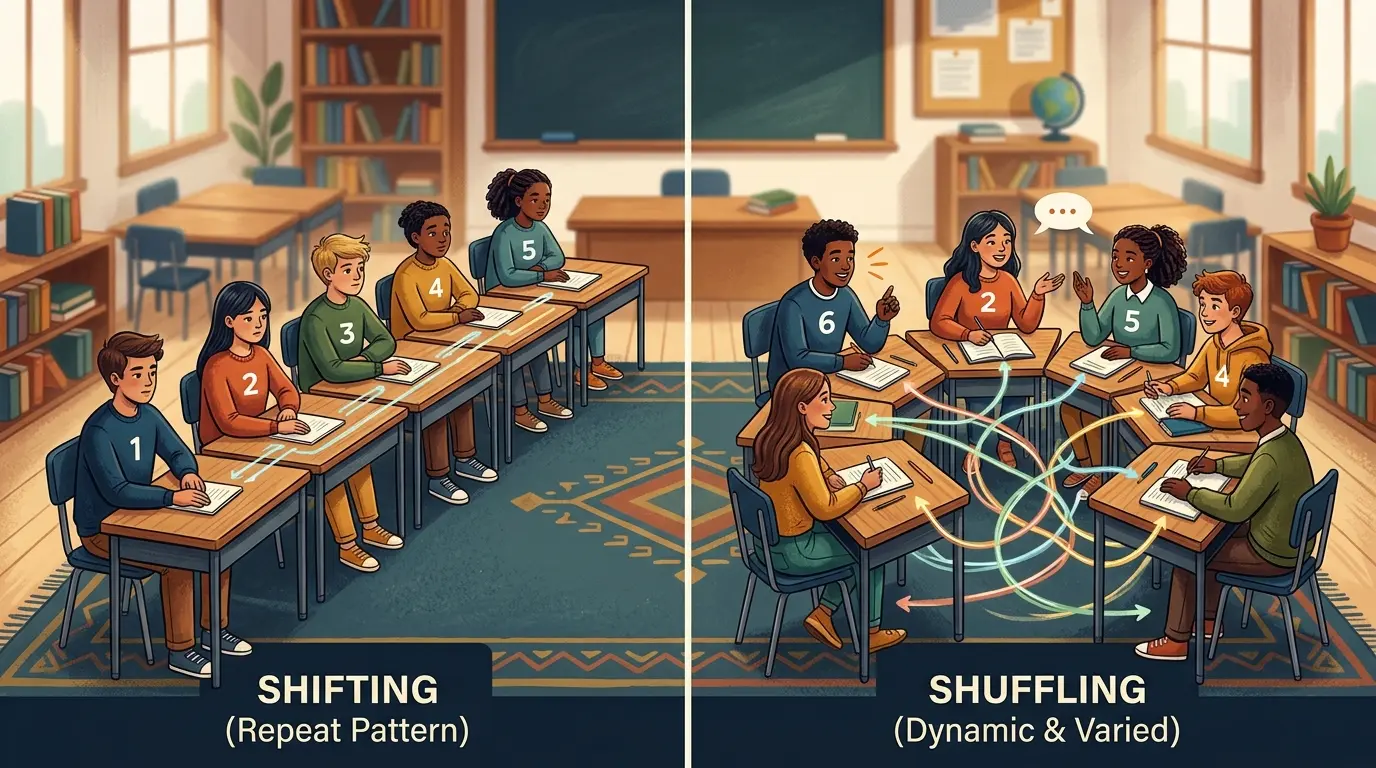
Ask a teacher whether they rotate their seating chart, and almost everyone says yes. Ask what that actually looks like week to week, and the answers get less impressive fast. Row one moves to row two. Everyone shifts one seat to the left. Names get reassigned alphabetically every few weeks, which mostly just means the student who sat next to Aiden in September is still sitting next to Aiden in April, only now they're both by the window instead of the door.
That's not really rotating. It's rearranging furniture around the same relationships. A growing body of research on classroom seating suggests that distinction, between shifting the whole room and genuinely shuffling who sits next to whom, matters more than most teachers assume. Here's what that research actually found, and why the extra effort of a real shuffle tends to be worth it.
The Habit Teachers Call "Rotating" Isn't Always Rotating
Picture a classroom of grouped tables where, every month, each table rotates one spot clockwise around the room. It feels like a fresh start: a new view of the board, a new spot by the window, a new distance from the pencil sharpener. Look closer, though, and nothing about who sits with whom has actually changed. The four kids at that table are still the same four kids. They just moved together.
This isn't a niche problem. A 2023 study of fourth-grade classrooms by Steggerda and colleagues found that teachers made small tweaks, like switching two or three students while leaving everyone else in place, far more often than they made real overhauls that touched a large share of the class. That gap makes sense once you think about the effort involved. A genuine reshuffle means checking who can't sit near whom and who needs to be up front before you move a single desk. A one-block shift takes thirty seconds. Given that trade-off, it's no surprise most classrooms lean on the shift, and the kids notice. Ask any class that's been shifted by the same one-seat rotation all year, and they can usually tell you exactly who's coming up next to them before you've finished announcing the change.
Why Neighbors Matter More Than Where the Desks Are
Once you separate shifting from shuffling, the natural question is whether shuffling is actually worth the trouble. The strongest evidence comes from a field experiment run by Tamás Keller and Felix Elwert, who worked with 41 rural Hungarian primary schools to genuinely randomize the deskmates1Researchers who study this usually mean something narrower than "everyone in the room." Most of what's covered here focuses on deskmates, the one or two students sharing a desk or sitting immediately beside someone, because that's where the clearest exposure happens: shared materials, overheard conversation, direct eye contact. A few studies extend the idea to the student directly in front or behind. None of this claims a student three rows away has zero influence, only that the effect is strongest, and cleanest to measure, at close range. That's exactly why a genuine shuffle, which changes who sits in that close range, is the actual lever these studies are testing. of 3,365 students across 195 classrooms for an entire semester.
On average, students weren't much affected by who they sat next to. But that average hid something real: students with the lowest prior grades did meaningfully better when placed beside a high-achieving deskmate, and students with the highest prior grades did meaningfully worse when placed beside a low-achieving one. Students in the middle barely moved either way. In their simulations, seating charts that deliberately paired high performers with low performers reduced achievement inequality across the classroom, while charts that grouped similar students together increased it.
The mechanism isn't mysterious once you think about it. Deskmates ask each other for help, explain confusing instructions to one another, and quietly model what focused work, or distracted work, looks like up close. None of that needs anyone to say a word out loud. It's just what happens when two people share a working space for months.
Here's where the shift-versus-shuffle question comes back in. Keller and Elwert also surveyed hundreds of Hungarian teachers and found that most run something close to a fixed chart: about three quarters said their seating rarely changes, and only one in ten reported changing it as often as monthly. If a mismatched pairing shows up, two struggling students who end up stuck together, say, a fixed chart lets that pairing run for months. A genuine shuffle limits how long any single pairing gets to shape a student's semester, for better or worse.
The takeaway: Who a student sits beside can move their grades, and the effect is strongest for students who are already struggling or already excelling. A chart that rarely changes leaves that outcome up to one lucky, or unlucky, pairing.
The Cost of a Bad Match That Never Ends
Achievement isn't the only thing that travels between deskmates. Attention does too. A 2024 study by Forrin and colleagues tracked attention contagion2Forrin and colleagues measured this by observing which students sat beside classmates who were already showing signs of disengagement, then comparing note-taking and quiz performance afterward for the students seated nearby. The effect held specifically for immediate neighbors and did not extend to students seated further away, which is why the researchers call it contagion rather than a general classroom mood. Forrin, N. D., Kudsi, N., Cyr, E. N., Sana, F., Davidesco, I., & Kim, J. A. (2024). Investigating attention contagion between students in a lecture hall. Scholarship of Teaching and Learning in Psychology. https://doi.org/10.1037/stl0000419. in a university lecture hall and found that students seated beside an already-distracted classmate took fewer notes and scored lower on a quiz afterward, even though they weren't the ones who started out checked out.
The effect was specific to immediate neighbors. It showed up between students sitting right next to each other and didn't show up between students seated further apart. That detail matters here: if the same two students are always adjacent, one distracted week can turn into a distracted month simply because the geometry of the room never changes. Shuffle the seats regularly and that exposure gets spread across the whole class instead of concentrated on whoever happens to be within arm's reach.
The takeaway: Sitting beside a chronically distracted classmate is a real cost, and it compounds the longer that pairing stays fixed. Reshuffling regularly keeps any one student from absorbing it for an entire year.
The Social Case for Genuine Shuffling
Achievement and attention are only part of the picture. The other part is who your students end up calling friends, and there the research is genuinely encouraging. Rohrer, Keller, and Elwert ran a companion experiment to the deskmate study, randomizing the seating charts of 182 classrooms in grades three through eight. Being placed next to a classmate for a semester measurably increased the odds the two of them became friends, and the effect held even across lines kids usually sort themselves along without meaning to: gender, ethnicity, and achievement level.
The study is honest about its limits too. Proximity moved the needle on friendships across ethnicity and achievement level more easily than it did across gender; boundaries tied to gender proved the hardest to shift even after months of enforced closeness. A single semester of shuffled seating won't rewrite every social pattern in a classroom, but it measurably widens the range of people a student ends up close to, which is more than a fixed chart, or a shift that just moves the same cliques around the room, can claim.
Left on their own, students tend to cluster with people who already look and act like them. A genuine shuffle interrupts that pattern in a way a shift never can, because a shift keeps the exact same social groupings intact, just relocated to a new part of the room.
Teachers who watch classroom dynamics closely already sense this. Hoekstra and colleagues interviewed upper-elementary teachers in the Netherlands3These studies span a few different countries and age groups, and that's worth flagging. Keller and Elwert (2023) and Rohrer and colleagues (2021) studied third through eighth graders in rural Hungary. Hoekstra and colleagues (2023, 2024) studied upper-elementary classrooms in the Netherlands. Granger and colleagues (2025) studied kindergarten through third-grade classrooms in the United States, and Forrin and colleagues (2024) studied a university lecture hall, a much older population in a very different kind of room. The direction of the findings lines up across all of these settings, but school systems and everyday seating norms vary by country, so the exact size of any effect in a given classroom won't match the number from any single study. about how and why they arrange seating, and found that some deliberately break up seating patterns when they notice a clique forming, or when they want to widen who a student interacts with beyond the friends they've already made. For these teachers, a reshuffle isn't paperwork. It's an intervention.
The takeaway: A genuine shuffle is one of the simplest, lowest-cost ways to widen a class's social fabric instead of leaving it to sort itself by whoever already looks familiar.
A Genuine Shuffle Doesn't Mean Abandoning Judgment
None of this means randomness should always win. Sometimes a teacher knows something an algorithm can't: that one student is being targeted by another, or that two particular students need distance for reasons that have nothing to do with academic mismatch. Hoekstra and colleagues also ran a randomized controlled trial testing exactly this kind of override, seating bullying victims far from their aggressors and beside a close friend in some classrooms while leaving seating fully random in others. The strategic placement supported victims' wellbeing more effectively than random seating did in that specific situation. Genuine shuffling is a strong default, not a rule that overrides a teacher's judgment about a student's safety.
There's a related warning worth taking seriously. A 2025 study by Granger and colleagues looked at where students with or at risk for emotional and behavioral disorders end up seated in kindergarten through third-grade classrooms. Nearly half were seated in physical isolation in the fall, cut off from any adjacent classmate. Isolated seating was tied to worse peer-reported reputations: more nominations for starting fights and giving the teacher a hard time, fewer for being nice or cooperative. The researchers flagged, as an open question for future work, whether periodically rotating seat placements might change that pattern; nobody has tested it directly yet. What the existing evidence does say clearly is that isolation carries a real social cost, and a hands-off, unchanging chart makes it easy for that isolation to quietly become the default for the one student everyone finds hardest to place.
The takeaway: Shuffle by default, and override it on purpose when a specific student's safety or wellbeing calls for it. What you want to avoid is a fixed chart that leaves a hard-to-place student stuck in the same isolated seat for months without anyone deciding that on purpose.
How Often Is Actually Enough?
The research doesn't hand teachers a specific number, and it would overstate the evidence to pretend otherwise. What it does offer is a mechanism: the benefit comes from limiting how long any single pairing sits fixed, not from hitting some magic frequency. That gives a workable starting point. Reshuffling every few weeks, or at natural breaks like the start of a new unit, beats a chart set in September and never revisited, and it beats a monthly shift that quietly preserves the same neighbors.
There's a real cost to overcorrecting, too. Younger students especially lean on the predictability of knowing where their materials live and who's sitting beside them. Shuffling every single day would trade the benefits of variety for a level of disruption that outweighs them, particularly for students who find transitions stressful. Somewhere between rigid and chaotic is the useful range. Teachers who treat seating as a deliberate tool tend to land on something like every three to six weeks, adjusted based on what they're actually seeing in the room: a friend group hardening into a clique, one student stuck in a rough pairing, energy dragging in a particular corner. Many tie the change to something they're already doing, the start of a new unit or the return from a school break, so it doesn't need its own reminder on the calendar.
What Actually Makes a Shuffle "Genuine"
It's worth being precise about what counts as a real shuffle, because the line between shifting and shuffling can blur in practice. A genuine reshuffle assigns each student a new seat independent of where they sat last time. If you can predict who's going to end up next to whom just by looking at who was already next to them, whatever just happened wasn't actually random, even if every desk in the room physically moved.
The honest reason most teachers default to shifting instead of shuffling isn't a lack of belief in the idea. It's that doing a real reshuffle by hand, while also tracking every seating restriction, who can't sit near whom, who needs to be up front, who needs an aisle seat for a mobility accommodation, turns a two-minute task into a twenty-minute puzzle, every single time. That bottleneck is worth naming honestly. It's the actual reason genuine shuffling is rare, not indifference to the idea.
A shift moves the furniture. A shuffle changes who's sitting next to whom, and that's the part the research says actually matters.
Using Inclusive Seating to Make Genuine Shuffling Practical
This is exactly the gap Inclusive Seating is built to close. Clicking Randomize doesn't nudge the previous chart over by one spot; it generates a fresh, independent arrangement from scratch every time, which means clicking it twice in a row produces two genuinely different seating charts, not the same one rotated.
The part that makes this practical rather than reckless is that every student's restrictions travel with them through every random draw. A student who needs to sit away from a particular classmate, close to the teacher's desk, or in a specific zone of the room keeps that accommodation whether it's the first shuffle of the year or the fifteenth. If a teacher needs to do what Hoekstra and colleagues tested, seat a student who's being bullied far from their aggressor and beside a trusted friend, that constraint gets set once and then respected by every future shuffle, without anyone having to remember it or rebuild it by hand.
It also helps to have a record of what's already been tried. Inclusive Seating lets you print or save a roster alongside each chart, so if you're checking whether a shuffle actually moved two particular students apart, or you just want a paper copy for a substitute, that information doesn't live only in your memory of clicking Randomize a few weeks back.
Because a genuine reshuffle takes seconds instead of the twenty-minute puzzle described earlier, it stops being a task that gets put off until the semester is nearly over. It becomes something that's actually feasible to do every few weeks, which is the whole point.
None of this requires a bigger overhaul than what most teachers already do a few times a year. It just requires making sure the click that follows actually counts as a shuffle, not another shift in disguise.
